

Key Takeaways
- Street food offers lower-cost, high-authenticity access to regional and immigrant food traditions.
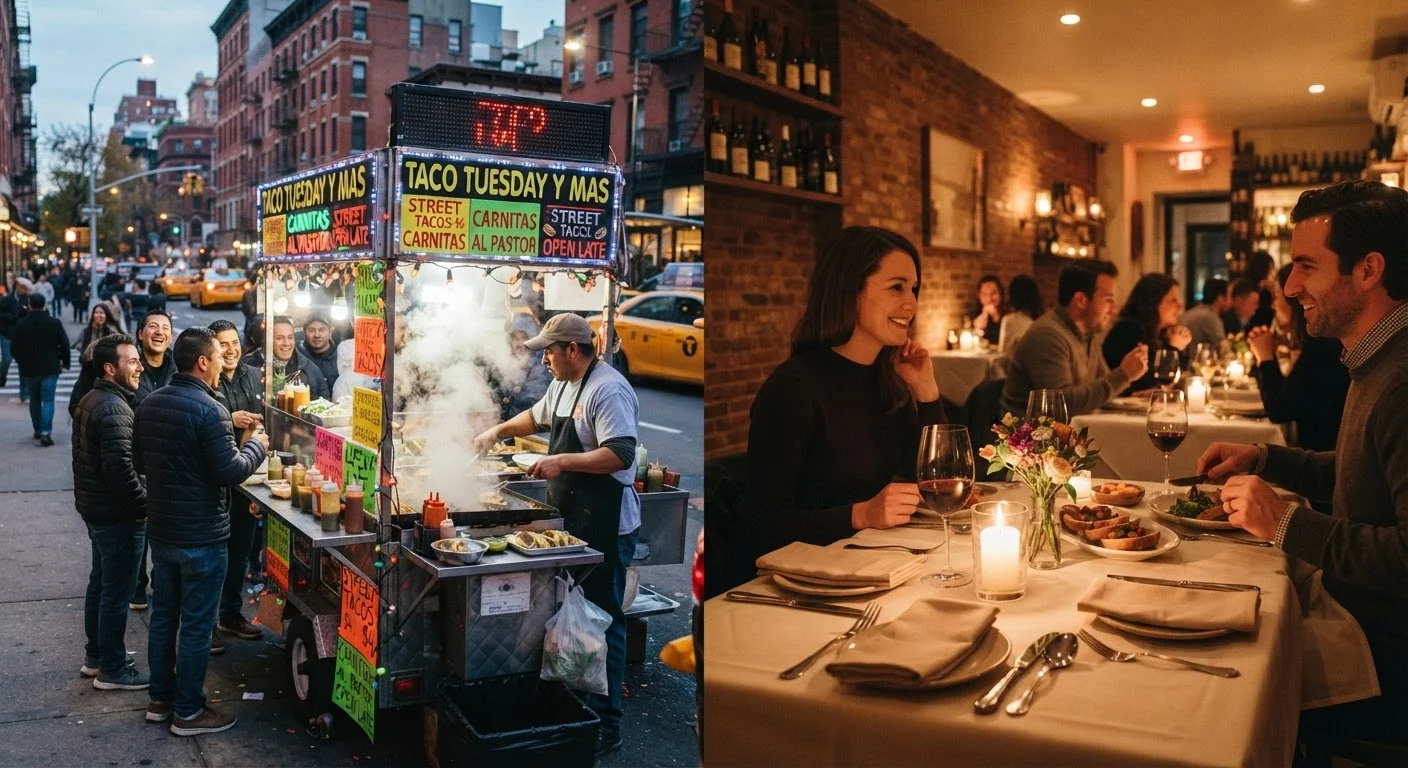
- Restaurant dining provides a curated environment that shapes how flavors and stories are presented.
- Both formats reflect and reinforce American food culture in distinct, complementary ways.
- Street food often introduces new cuisines faster; restaurants tend to codify and preserve them.
- Neither format is inherently superior - the right choice depends on context, appetite, and intent.
Option A
Street Food
The accessible, community-rooted way to eat.
Best for: Curious eaters who want an immediate, affordable taste of a city's culinary identity.
Option B
Restaurant Dining
The structured, immersive culinary experience.
Best for: Diners seeking a full sensory environment, curated menus, and extended social occasions.
If you want to explore a city's food identity quickly and affordably
Street Food
Street vendors and food trucks put diverse flavors directly in public spaces, letting you sample broadly without a reservation or high price tag.
If you're marking a special occasion or want a deep dive into a single cuisine
Restaurant Dining
Sit-down restaurants craft a full experience - service, ambiance, and a structured menu - that's designed to immerse you in a culinary perspective.
If you're traveling and want to understand a place's cultural character through food
Street Food
Street food scenes cluster in neighborhoods shaped by immigration and local tradition, making them a fast, authentic guide to a city's roots.
If you want to explore a specific chef's creative vision or a regional culinary tradition in depth
Restaurant Dining
Restaurant menus are curated expressions of culinary philosophy, and a knowledgeable server or tasting menu can tell a complete story.
What Each Format Actually Is
Street food and restaurant dining aren't simply different price points - they represent fundamentally different relationships between the cook, the food, and the eater. Understanding why Americans eat the way they do means grappling with both.
Street food encompasses anything prepared and sold in public, informal spaces: food trucks, carts, market stalls, festival stands, and sidewalk vendors. It's designed for immediacy - grab it, eat it standing or walking, move on. The barriers to entry are low for both vendor and customer, which has historically made it a launchpad for immigrant cuisines and working-class food traditions. Think of the taco trucks that introduced Northern California to regional Mexican flavors, or the hot dog carts that became inseparable from the experience of New York City.
Restaurant dining means sitting down in a dedicated space where food is prepared in a kitchen, presented by staff, and consumed as part of a designed experience. That design includes the menu, the décor, the lighting, and the service - all working together to frame how the meal feels and what it communicates. Reading a restaurant menu like a curious eater reveals how much intention goes into every item on the page.
| Criterion | Street Food | Restaurant Dining |
|---|---|---|
| Average cost per meal | Low to moderate | Moderate to high |
| Reservation required | Rarely | Often |
| Cultural authenticity | High - vendor-driven | Variable - chef-curated |
| Dining environment | Public, informal, mobile | Private, designed, fixed |
| Spontaneity | Very high | Low to moderate |
| Menu depth | Narrow, specialized | Broad, layered |
| Social experience | Community, public mixing | Intimate, table-focused |
| Cuisine discovery | Fast, wide exposure | Deep, contextual learning |
How Each Format Carries Food Culture Forward
Street food is often the first public stage for cuisines that immigrant communities bring with them. A vendor selling pupusas at a weekend market isn't just feeding people - they're making a cuisine visible and accessible to a broader audience. This informality lowers the cultural stakes for curious eaters: trying something unfamiliar from a cart feels low-risk in a way that walking into an unfamiliar restaurant may not. The story of how immigrant foods change when they cross borders often begins exactly here, in public spaces where exchange happens organically.
Restaurants, by contrast, tend to formalize and preserve culinary traditions. A chef who trains in a regional cuisine and builds a menu around it is doing an act of curation - selecting which dishes represent a tradition, how they should be prepared, and what story the room should tell. That structure can deepen understanding, but it also involves editorial choices about what gets elevated and what stays invisible.
1 in 3
Americans who eat street food weekly
A National Restaurant Association survey found that roughly one-third of American adults purchase food from a street vendor or food truck at least once a week in urban areas.
$2.7B+
U.S. food truck industry annual revenue
IBISWorld estimates the U.S. food truck industry generates over $2.7 billion annually, reflecting the sector's sustained growth since the early 2010s.
~$3,500
Average annual U.S. per-household restaurant spend
The Bureau of Labor Statistics Consumer Expenditure Survey places average U.S. household spending on food away from home at roughly this level, underscoring how central dining out remains to American life.
Food halls represent a hybrid worth noting - they combine the vendor variety of street food with the permanence of restaurant infrastructure. Why food halls are replacing food courts points to the same cultural appetite that has driven the street food renaissance: diners want variety, authenticity, and a sense of place all at once.
Access, Cost, and Spontaneity
One of the clearest practical differences between these two formats is the friction involved. Street food removes nearly all of it: no reservation, no dress code, no minimum spend, no menu to decode. That accessibility has real cultural weight. It means that a first-generation immigrant vendor and a college student and a tourist can all be eating the same thing at the same cart, an experience that rarely happens inside a formal dining room.
Restaurant dining asks more of the diner - in money, time, and sometimes social confidence. But what it offers in return is an environment purpose-built for the meal. Ambient sound, table spacing, plating design, and server knowledge are all tools that a well-run restaurant uses to make food more meaningful. For a dish that benefits from explanation - a fermented condiment, a slow-cooked regional preparation - that context can be the difference between confusion and genuine appreciation.
If you're navigating a new city through its food scene, a mix of both formats gives you the most complete picture: street food for breadth and spontaneity, sit-down dining for depth and narrative.
A Note on 'Authenticity'
The word 'authentic' gets applied unevenly across food formats - street food is often romanticized as more genuine, while restaurant versions of the same dish are sometimes dismissed as diluted. In practice, authenticity in food is complex and context-dependent. A family-run restaurant that has served the same regional recipe for three generations is just as authentic as a sidewalk cart. What matters more is understanding who made the food, what tradition it comes from, and how it's been adapted - if at all.
The Evolving Landscape: Trucks, Halls, and Ghost Kitchens
The line between street food and restaurant dining has blurred significantly over the past two decades. Food trucks now operate with full commercial kitchens and sophisticated menus. Pop-up dinners happen in parking lots. Michelin-starred chefs have opened street stalls. Meanwhile, ghost kitchens - delivery-only operations with no physical dining space - have introduced a third category entirely, one that decouples food quality from both the street and the dining room.
What this evolution reveals is that Americans don't experience cuisine through format alone. They experience it through context, community, and story. A BBQ plate eaten at a picnic table outside a pit in Texas and the same dish served in a white-tablecloth Dallas restaurant are telling different stories about the same food. Understanding regional BBQ styles across America requires encountering both versions.
Ultimately, street food and restaurant dining aren't competing systems - they're complementary ones. Each format creates different conditions for curiosity, connection, and discovery, and the richness of American food culture depends on both remaining vibrant and accessible.