

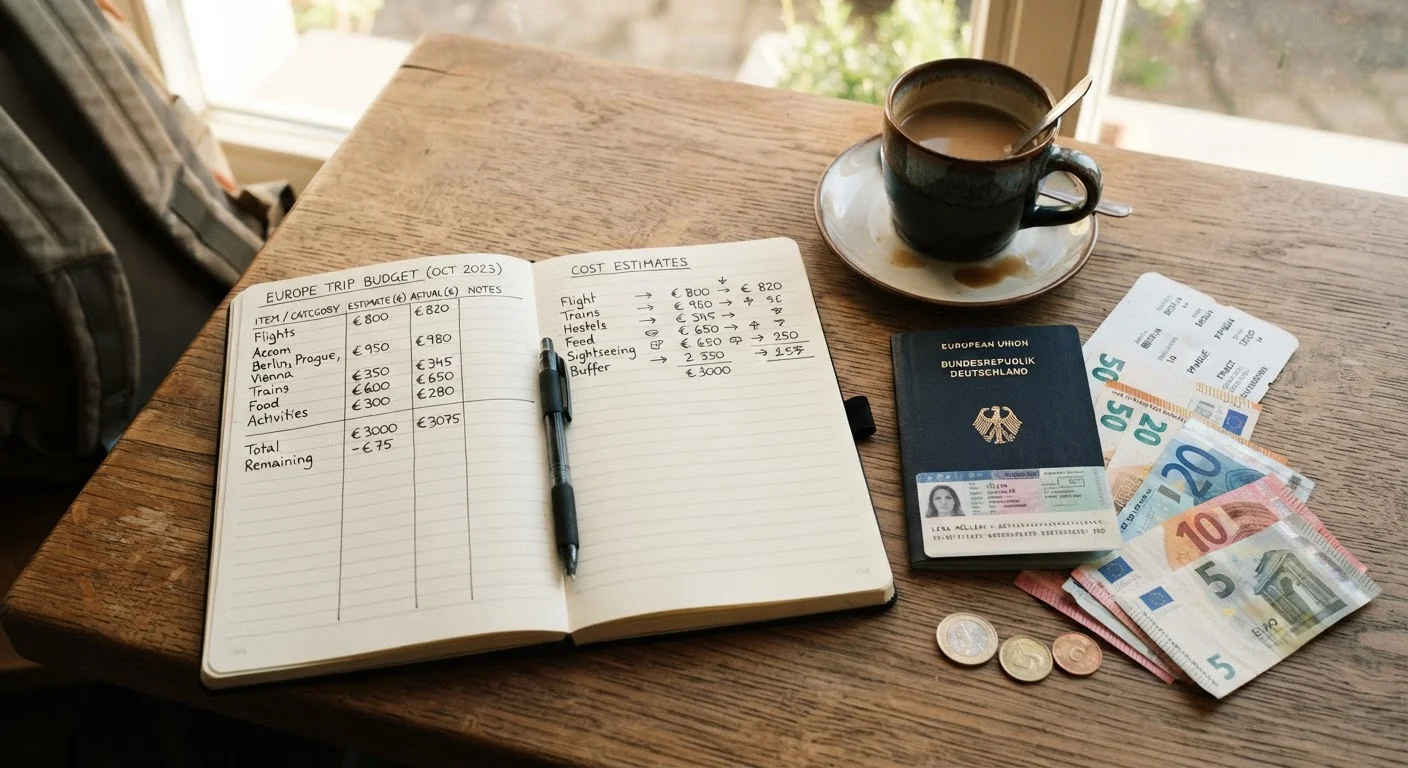
Key Takeaways
- Most trip budgets fail because they omit recurring small costs, not just major expenses.
- Breaking your budget into clear categories-transport, lodging, food, activities, fees-prevents surprises.
- Adding a 15-20% contingency buffer is one of the most effective safeguards against overspending.
- Currency exchange decisions and foreign transaction fees can quietly add meaningful cost to international trips.
- Revisiting and adjusting your budget after booking is a step most travelers skip but shouldn't.
What you will need
Why Most Travel Budgets Fall Apart
Travelers rarely blow their budgets on flights or hotels - those numbers are visible early and easy to track. The breakdown usually happens in the middle: the taxis that seemed cheap individually, the restaurant meals that cost more than expected, the admission fees nobody mentioned, and the checked bag charge discovered at the gate.
A realistic travel budget isn't just a list of your biggest costs. It's a complete accounting of every category where money leaves your hands, from the moment you head to the airport to the moment you return. Done properly, it becomes a tool you actively use during the trip, not just a pre-departure formality.
For a broader look at the planning errors that derail travelers before they even leave, see our breakdown of common trip planning myths.
What you will need
What You'll Need Before You Start
Good budgeting requires specific inputs. Vague estimates produce vague budgets - and vague budgets fail. Before building your numbers, gather realistic price ranges for flights (including baggage fees), nightly lodging rates in the neighborhoods you're considering, a general sense of daily meal costs at your destination, and any known entry or visa costs.
If you're planning a multi-destination trip, budget complexity increases significantly. Our guide to organizing multi-city trips walks through the sequencing and cost considerations that are easy to overlook.
Spreadsheet or budgeting app
Organize cost estimates by category and track actual spending against your plan.
Destination cost-of-living reference
Establish realistic daily spending benchmarks for food, transport, and activities in your destination.
Credit card with no foreign transaction fees
Avoid per-transaction fees on international purchases, which typically range from 1-3% per charge.
Travel insurance policy details
Understand what financial losses are covered before factoring insurance cost into your overall budget.
How to Build Your Budget Step by Step
Define the non-negotiable fixed costs
Start with the expenses that are largely set once booked: round-trip flights (including any checked baggage fees), accommodation for every night, and any prepaid tours or event tickets. List each as a confirmed or estimated line item. These form your budget floor - everything else builds on top of them.
Estimate a realistic daily spending allowance
Research typical daily costs at your destination for food, local transportation, and entry fees to attractions. Assign a per-day number to each category, then multiply by the number of days you'll be spending at each location. Many destination-specific travel forums and cost-of-living databases provide community-sourced spending averages that are more accurate than generic estimates.
Add a dedicated line for fees and surcharges
Create a separate category for costs that are easy to miss: visa application fees, airport transit costs (both departure and arrival), checked baggage fees on each flight segment, tourist taxes, and any mandatory travel insurance. These are real costs that belong in the budget, not surprises to absorb later.
Build in a contingency buffer
Once your fixed costs, daily spending, and fee categories are totaled, add 15-20% of that total as a contingency line. This buffer covers delays, unexpected costs, price increases since you researched, and opportunities you didn't plan for. Treat it as part of the budget, not bonus money to spend freely.
Update the budget as bookings are confirmed
A budget is a living document through the planning phase. Each time you confirm a flight, hotel, or major activity, update your numbers with the actual confirmed cost - including all taxes and fees shown at checkout. This prevents you from arriving at departure with a budget based on estimates rather than reality.
The Costs Most Travelers Underestimate
Even careful planners tend to undercount a few categories consistently. Food is the most common - budgeting only for sit-down meals ignores coffee, snacks, bottled water, and the inevitable convenience store runs. A useful rule of thumb is to estimate your daily food budget and then add 25-30% for incidentals.
Local transportation is another gap. Getting from the airport to your lodging, moving between neighborhoods, and taking day trips adds up faster than most people expect. Research typical taxi, rideshare, or transit costs specific to your destination rather than assuming they mirror home.
International fees deserve a dedicated line item. Foreign transaction fees, ATM withdrawal fees, and poor currency conversion rates each chip away at your budget invisibly. See our overview of currency exchange decisions for guidance on minimizing those costs.
Don't Finalize a Budget Before Researching Fees
Baggage fees, resort fees, visa fees, and tourist taxes are often invisible during initial planning. These charges can collectively add hundreds of dollars to a trip. Always read the fine print on flights and accommodations before locking in your numbers.
Finally, consider whether travel insurance belongs in your budget. Understanding what it covers before you assume you're protected matters. Our explainer on travel insurance coverage is a good starting point.
Track Spending in Real Time
Use a simple notes app or a dedicated travel expense app to log purchases as you make them. Waiting until you return home to review spending means you can't course-correct mid-trip. Even a rough daily tally helps you stay aware.
Reviewing and Stress-Testing Before You Go
Once your budget draft is complete, stress-test it. Ask: what happens if one flight is delayed and I need an extra night? What if the restaurant I planned on is closed and I eat somewhere more expensive? What if I want to do one unplanned activity? A 15-20% contingency buffer across your total budget addresses these scenarios without requiring you to plan for every possibility.
Then, review once more after all bookings are confirmed. Actual booking confirmations often reveal fees - resort fees, destination fees, seat selection charges - that didn't appear in initial price estimates. Adjust your budget after each major booking, not just before departure.
Before you travel, pair your finalized budget with a full pre-departure review. Our pre-departure checklist covers what to confirm, what to notify, and what to prepare so your trip starts without scrambling.