

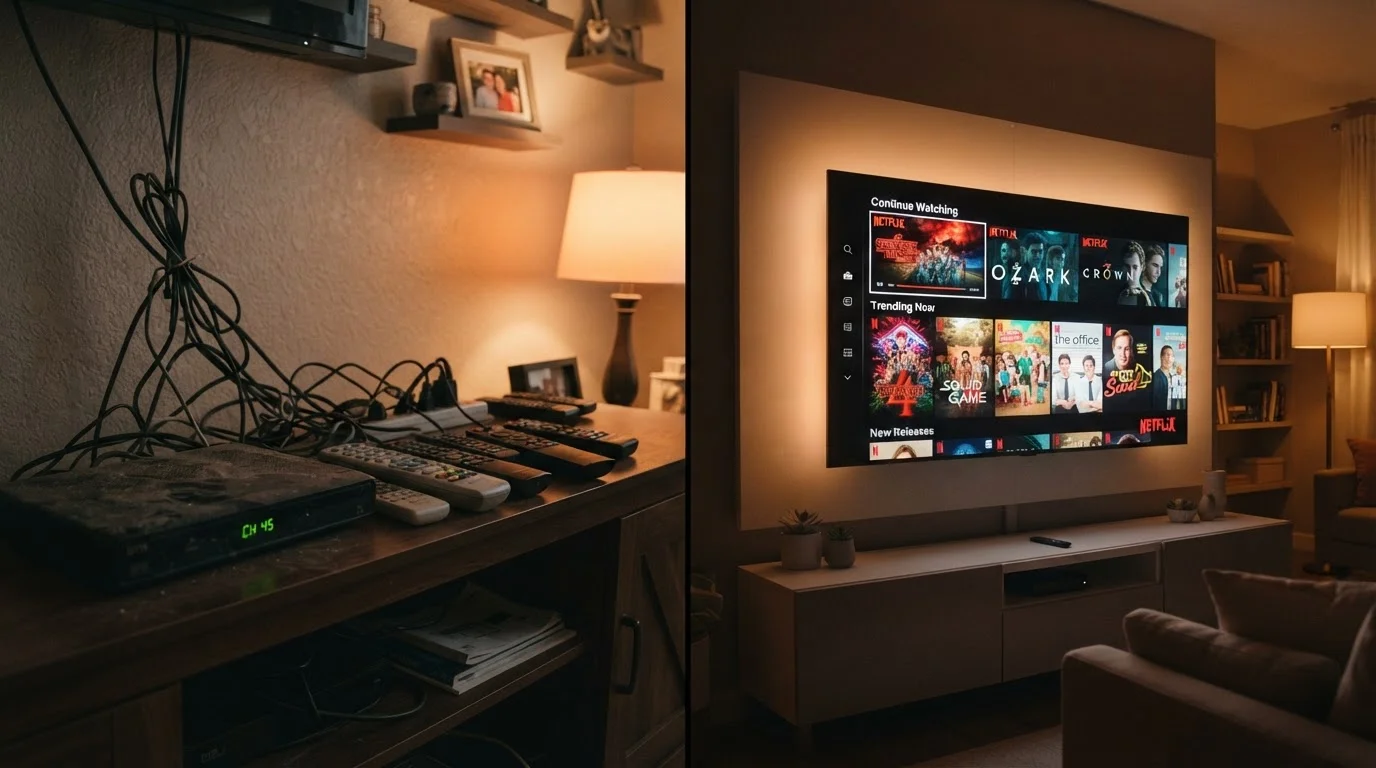
Key Takeaways
- Cable offers live sports, local news, and linear TV in one package; streaming rarely replicates all three seamlessly.
- Streaming costs can rival or exceed cable once multiple services are stacked together.
- Cord-cutting shifts control to the viewer but also shifts the responsibility of managing content and subscriptions.
- Live event coverage remains cable's clearest advantage over most streaming setups.
- Streaming's on-demand library depth and original programming have made it a serious cultural force.
Option A
Cable TV
The established, all-in-one broadcast experience.
Best for: Viewers who want live TV, local news, and sports without managing multiple accounts.
Option B
Streaming Services
The flexible, on-demand alternative built for the internet age.
Best for: Viewers who prefer watching on their own schedule and are comfortable curating their own channel lineup.
If you follow live sports religiously
Cable TV
Major sports leagues, regional broadcasts, and playoff events are still predominantly locked behind cable and cable-affiliated sports packages. Streaming equivalents exist but are patchwork and often more expensive.
If you watch mostly on-demand shows and films
Streaming Services
On-demand libraries from major streaming platforms offer far more choice and flexibility than cable's on-demand tiers, and you can pause or cancel subscriptions month to month.
If local news and weather are daily essentials
Cable TV
Local affiliate channels remain deeply integrated into cable packages; streaming access to local news is possible but inconsistent depending on your market.
If you want to minimize monthly bills and watch selectively
Streaming Services
A single or small bundle of streaming services can cost significantly less than a full cable package, provided you're disciplined about subscriptions.
If your household includes both live-TV fans and binge-watchers
Cable TV
A cable subscription combined with one or two streaming add-ons may offer the least friction for mixed viewing households rather than a full cord-cut.
The Real Meaning of 'Cutting the Cord'
The phrase has been in circulation for well over a decade, but cutting the cord still carries a weight of finality it doesn't entirely deserve. What it actually means - canceling a cable or satellite TV subscription in favor of internet-delivered content - is less a dramatic break than a gradual migration. Millions of American households have made the shift, yet cable hasn't disappeared. Understanding why helps clarify what's genuinely at stake in this choice.
Cable television was built around a bundle: you paid one company for a pipe that delivered hundreds of channels, a DVR box, and in many cases internet service itself. That convenience came at a price - both literally and in terms of flexibility. Streaming inverted the model, letting viewers pay per service, per month, and watch on their schedule. But as the streaming landscape has grown more fragmented, the promise of simplicity has gotten more complicated.
Cost: The Numbers Are Murkier Than They Look
On the surface, streaming looks like the obvious winner on price. A basic cable package can run $80-$120 per month or more before fees, equipment rentals, and taxes. A single streaming service might cost $8-$18 per month. But those two numbers rarely belong in the same sentence.
Most cord-cutters don't subscribe to just one service. Between a general entertainment platform, a premium movie channel, a live-TV streaming service for sports or news, and perhaps a niche add-on, monthly streaming costs can creep toward - or past - what a cable bill looked like. The difference is that streaming costs feel more controllable because you can cancel at any time. Whether most people actually do cancel and rotate strategically, rather than let subscriptions quietly pile up, is another question.
| Criterion | Cable TV | Streaming Services |
|---|---|---|
| Typical monthly cost | $80-$120+ (bundled) | $10-$70+ (varies by stack) |
| Live sports coverage | Comprehensive, integrated | Partial; fragmented by platform |
| Local news access | Reliable, included | Inconsistent by market |
| On-demand library depth | Limited on-demand tier | Extensive, platform-specific |
| Contract flexibility | Often 1-2 year contracts | Month-to-month, cancel anytime |
| Setup complexity | Low - one provider, one box | Moderate - multiple apps/accounts |
| Original programming | Network and cable originals | Growing, award-winning exclusives |
There's also the infrastructure question. Streaming requires a reliable, fast internet connection. If you're currently bundling internet with cable, unbundling might raise your standalone internet cost - potentially wiping out any savings.
Content: What You Gain, What You Lose
Streaming's original programming has matured into genuine cultural weight. Series and films produced exclusively for streaming platforms have won major awards and driven mainstream conversation in ways that would have seemed improbable fifteen years ago. If anything, the line between streaming and prestige film has blurred considerably, with streaming premieres carrying real critical and audience significance.
What streaming still struggles to replicate is the live experience. Appointment television - the Super Bowl, awards shows, breaking news, live sports playoffs - retains a gravitational pull that cable channels are built around. Some live-TV streaming services attempt to bridge this gap, but blackout restrictions, regional availability, and technical hiccups during high-traffic events remain real friction points.
Streaming and Live Events: A Moving Target
The availability of live sports and breaking news on streaming platforms shifts frequently as licensing deals are renegotiated. Services that carry certain games or channels one season may not have them the next. Before cutting the cord, it's worth confirming which specific events and local affiliates are available in your ZIP code through any live-TV streaming service you're considering - and checking again at renewal time.
It's also worth noting how audience measurement has changed. When you watch something on a streaming platform, the metrics work very differently from traditional broadcast ratings - a dynamic that shapes what gets renewed, canceled, and greenlit. How those numbers actually work is widely misunderstood and worth understanding if you care about supporting the shows you love.
Convenience: Control Has a Learning Curve
Cable's passive quality - flip it on and something is always there - suits a certain kind of viewing. Streaming demands a different relationship with your screen. You arrive, you search, you choose. That's empowering until it isn't, and the phenomenon of spending twenty minutes browsing without landing on anything is genuinely common enough to have its own cultural shorthand.
Device compatibility, app interfaces, and account management all become your responsibility when you cut the cord. Smart TVs, streaming sticks, and gaming consoles have made the hardware side fairly seamless for most households. But the cognitive overhead of managing five different logins, tracking which show lives on which platform, and remembering to cancel a free trial is real - and often underestimated before the switch.
Live experiences beyond TV follow a similar logic. Just as streaming a concert trades atmosphere for accessibility, streaming TV trades the effortlessness of cable for personalization and flexibility. Neither is objectively better; they reflect different priorities.