

Key Takeaways
- Food halls prioritize local and independent vendors over national fast-food chains.
- They are intentionally designed as social destinations, not just places to grab a quick meal.
- The food hall trend reflects broader American interest in culinary diversity and authenticity.
- Real estate shifts - especially post-pandemic - accelerated the conversion of mall and retail spaces into food halls.
- Food halls generate economic opportunity for small-scale food entrepreneurs with lower overhead than a standalone restaurant.
Food Hall
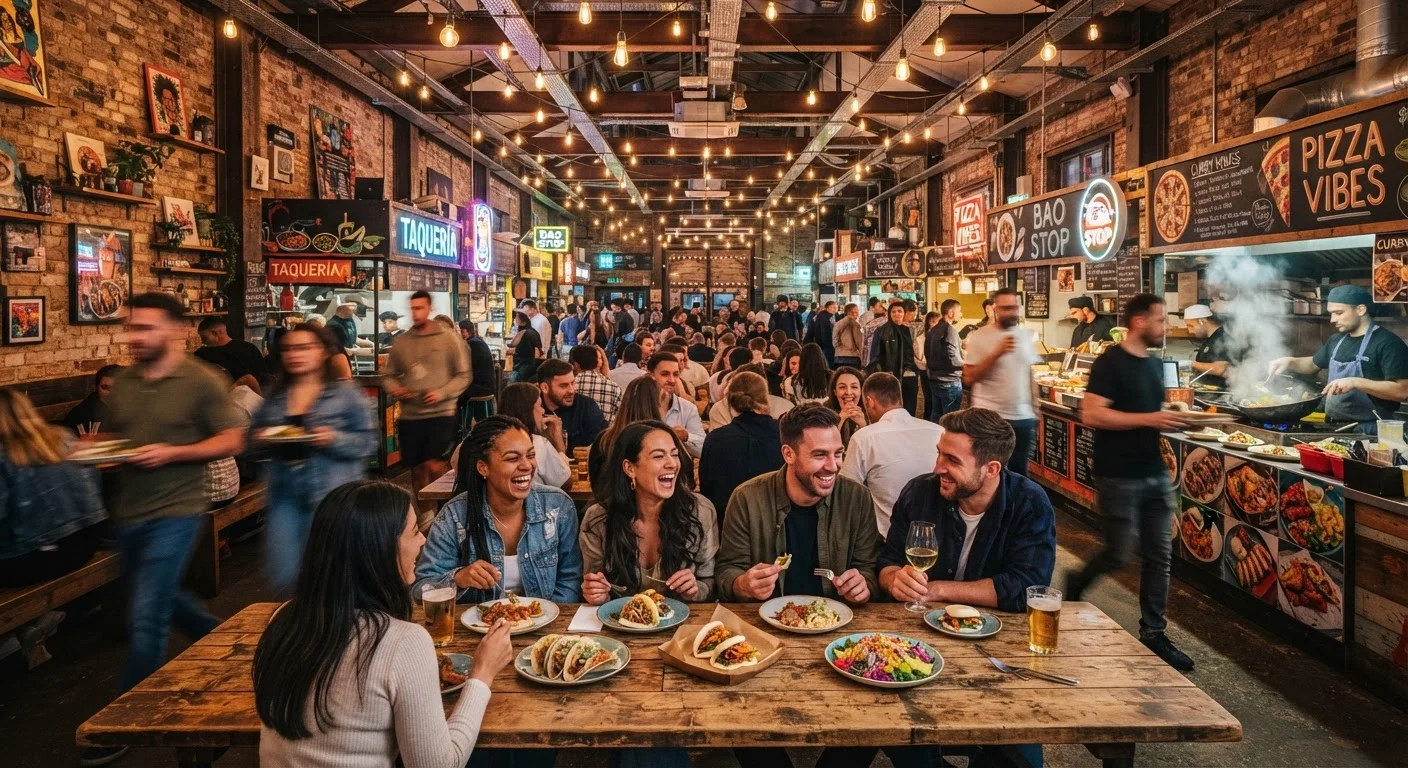
A food hall is a curated marketplace - typically housed in a large, architecturally distinctive space - where multiple independent food vendors operate under one roof. Unlike a food court, each vendor is usually a local chef, artisan producer, or specialty concept rather than a national chain. Diners can sample different cuisines and drinks in a shared, social environment.
Food halls often blend elements of the European market hall tradition with American dining culture, and are increasingly designed as anchor tenants in mixed-use real estate developments.
The Decline of the Food Court Model
For decades, the food court was a fixture of American suburban life - a ring of fast-food counters arranged around a cluster of plastic chairs in the middle of a shopping mall. Convenient and predictable, it served a purpose. But as mall traffic declined and consumer expectations around food shifted, the format began to feel dated.
The hollowing out of traditional retail accelerated through the 2010s, leaving developers with large, high-visibility spaces and a need for a new kind of anchor tenant. Food, it turned out, was one of the strongest draws. Unlike clothing or electronics, dining out is an experience that cannot be replicated online - and that insight reshaped how property owners thought about unused square footage.
Meanwhile, American diners were changing. Exposure to global cuisines, a growing appetite for locally sourced ingredients, and a general skepticism of chain restaurants all pushed interest toward something more considered. The food hall stepped into that gap.
300+
Food halls operating across the U.S.
According to Cushman & Wakefield research, the number of U.S. food halls grew from roughly 70 in 2016 to over 300 by the early 2020s.
4x
Growth in U.S. food halls over roughly five years
Industry trackers noted a roughly fourfold increase in food hall openings between 2016 and 2021, driven by retail vacancies and consumer demand for experiential dining.
~$3B
Estimated annual U.S. food hall revenue
Market analysts have estimated the U.S. food hall segment generates billions annually, though figures vary based on how the format is defined and tracked.
What Makes a Food Hall Different
The clearest distinction between a food hall and a food court is curation. A food court aggregates brands that are already widely distributed. A food hall, at its best, is assembled like a playlist - each vendor chosen to complement the others, reflect the local food culture, or introduce diners to something unfamiliar.
Vendors in a food hall are more likely to be chef-driven concepts, specialty producers, local restaurant offshoots, or immigrant-owned businesses with deep roots in a community. This connects directly to broader conversations about how American food culture evolves - as explored in our piece on how immigrant cuisines adapt and transform in the U.S..
The physical design matters too. Food halls tend to occupy converted industrial or historic spaces - old markets, warehouses, train stations - and lean into that character with communal seating, open kitchens, and a general atmosphere more akin to a neighborhood gathering place than a transactional food stop.
A Low-Risk Incubator for Food Entrepreneurs
One underappreciated function of food halls is their role as a business incubator. Opening a standalone restaurant requires substantial capital: commercial leases, full kitchen buildouts, staffing, licensing, and marketing. For talented cooks without deep financial backing, those barriers can be prohibitive.
A food hall stall typically requires less upfront investment. Infrastructure like ventilation, seating, and foot traffic is shared. This makes food halls an accessible proving ground - a place where a small dumpling concept, a family-recipe hot sauce vendor, or a regional barbecue style can find an audience before committing to a larger operation.
That entrepreneurial energy is part of what gives food halls their vitality. Visitors often describe the experience as closer to street food discovery than to a traditional restaurant visit - a sense of stumbling onto something new and genuine.
Food Halls as a Reflection of City Identity
At their best, food halls function as a kind of edible snapshot of a city. A well-curated hall in New Orleans will feel meaningfully different from one in Seattle or Detroit - not because they serve different cuisines by coincidence, but because intentional curation brings local producers, regional traditions, and neighborhood food culture into a single space.
This stands in contrast to the experience of ghost kitchens and delivery-only restaurants, which optimize for efficiency and reach but often lack any sense of place or community. Food halls move in the opposite direction - they are deliberately anchored in their geography.
For visitors, a food hall can serve as one of the most efficient introductions to a city's culinary personality. As our guide to navigating a new city through its food scene notes, food markets and local vendors often reveal a city's character more clearly than any guidebook recommendation.
Whether the food hall format continues to mature - or eventually follows the food court into obsolescence - will depend on whether operators stay committed to authentic curation rather than chasing the format's aesthetic without its substance.