

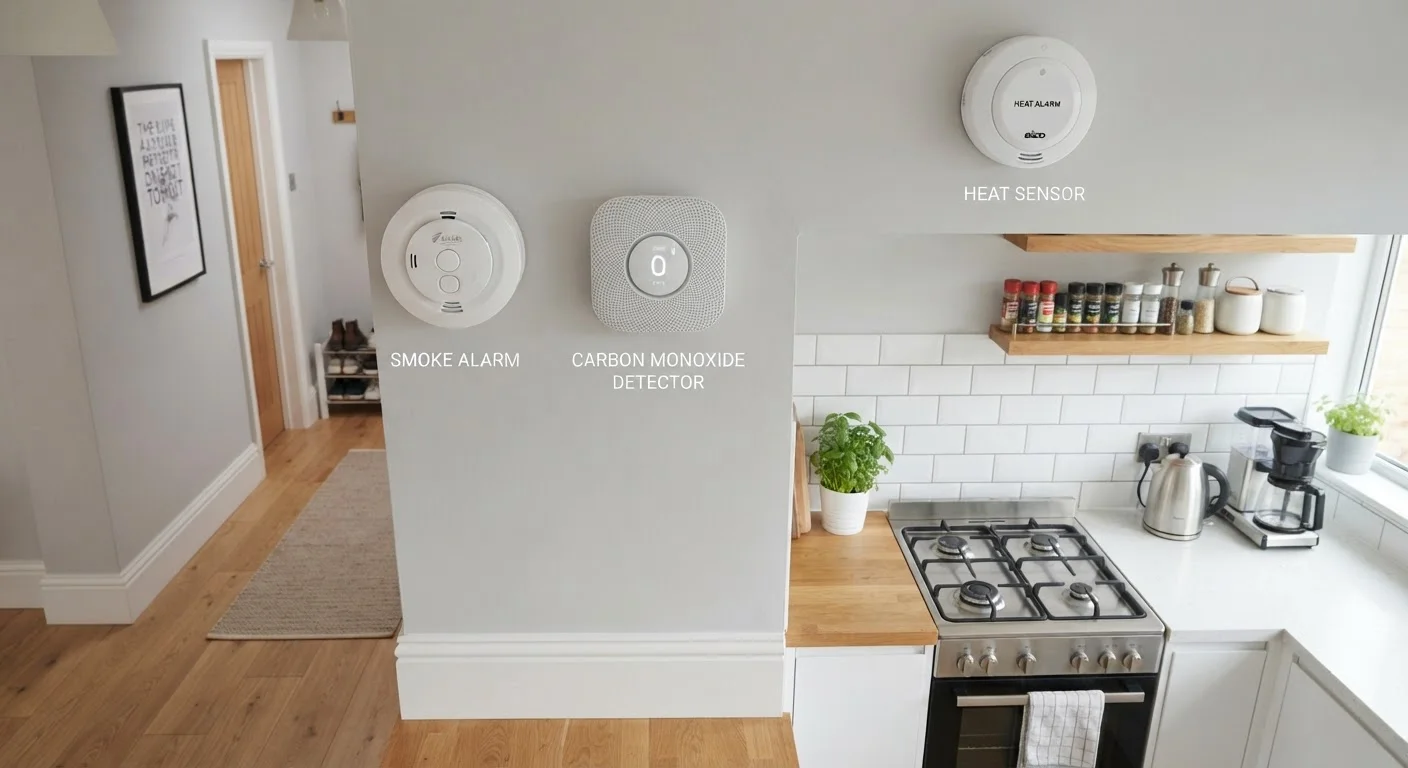
Key Takeaways
- Smoke alarms detect airborne combustion particles, not heat or gas.
- Carbon monoxide detectors sense an invisible, odorless gas produced by fuel-burning appliances.
- Heat sensors respond to rapid or extreme temperature changes - not smoke or CO.
- Each device belongs in specific locations; no single unit protects the whole home.
- Combination detectors exist but do not eliminate the need for correct placement strategy.
- Testing devices monthly and replacing them on schedule is essential for reliable protection.
Home Hazard Detection Devices
Smoke alarms, carbon monoxide (CO) detectors, and heat sensors are three separate devices designed to detect different types of household hazards. Each responds to a specific threat - airborne particles from combustion, invisible toxic gas, or rapid temperature rise - and triggers an alert before harm occurs. Understanding what each device does helps you place them correctly and rely on them with confidence.
Most modern combination units incorporate two or more detection technologies in a single housing, but each sensor type still operates independently based on its specific detection mechanism.
Smoke Alarms: Detecting the First Sign of Fire
A smoke alarm does exactly what its name says - it detects smoke. Inside the unit, one of two sensor types does the work: ionization sensors respond quickly to fast-flaming fires that produce fine particles, while photoelectric sensors are better at catching slow, smoldering fires that produce larger, visible smoke particles. Dual-sensor alarms combine both technologies.
Smoke alarms should be installed on every level of the home, inside each bedroom, and outside sleeping areas. They do not detect carbon monoxide or temperature changes - they only respond to combustion particles in the air. This makes them poorly suited for kitchens or garages, where cooking fumes or exhaust can trigger frequent false alarms.
For a broader look at how these devices fit into a complete safety plan, see our complete home safety overview. If you're deciding between hardwired and battery-powered units, our guide on hardwired vs. battery-powered smoke detectors covers the key trade-offs.
Test Your Alarms Every Month
Press the test button on each smoke alarm and CO detector monthly to confirm the battery and sensor are working. Replace batteries at least once a year - or whenever a low-battery chirp starts. Most devices also have a manufacture date printed inside the cover; use it to track when full replacement is due.
Carbon Monoxide Detectors: Guarding Against an Invisible Threat
Carbon monoxide is a colorless, odorless gas produced when fuel - gas, oil, wood, or propane - burns incompletely. It can build up to dangerous levels indoors without any visible or smell-based warning. A CO detector continuously samples the air and sounds an alarm when concentration levels reach a threshold that poses a health risk.
CO detectors should be placed on every level of the home, within 10 feet of each sleeping area, and away from fuel-burning appliances like furnaces or water heaters. Unlike smoke, CO disperses relatively evenly throughout a room, so ceiling or mid-wall placement are both effective options.
~400
U.S. CO poisoning deaths per year (non-fire related)
The U.S. Centers for Disease Control and Prevention estimates roughly 400 Americans die annually from unintentional, non-fire-related carbon monoxide poisoning.
~50%
Homes without a working CO detector
National Fire Protection Association surveys have consistently found that a significant share of U.S. households either lack CO detectors or have units that are not functioning properly.
It's worth understanding why this gas is so dangerous before assuming a smoke alarm provides coverage. Our article on why CO is called the silent killer explains how it forms and affects the body.
Heat Sensors: The Right Tool for Kitchens and Garages
Heat detectors do not sense smoke or gas - they respond to temperature. There are two main types: fixed-temperature detectors trigger when the air reaches a set threshold (commonly 135°F), while rate-of-rise detectors activate when temperature climbs unusually fast, even before reaching a fixed limit. Some units combine both methods.
Heat sensors are well-suited for spaces where smoke alarms frequently false-alarm: kitchens, attached garages, and attics. They're also useful in dusty or steamy environments. The trade-off is that they are slower to respond than smoke alarms in a room where an actual fire is actively producing smoke, so they are not a replacement for smoke alarms in living areas and bedrooms.
Heat Detectors Don't Replace Smoke Alarms
While heat detectors are valuable in specific rooms, they respond more slowly to fires that produce heavy smoke before generating significant heat. Fire safety guidelines generally recommend that heat detectors supplement - not substitute - a full smoke alarm network in living spaces and bedrooms.
If you're new to setting up home safety systems, our beginner's guide to home safety outlines the foundational steps every household should take from day one.
Choosing and Placing Each Device Correctly
Understanding each device's purpose helps you map out your home's protection without gaps or redundancies. A practical approach:
- Smoke alarms: Every bedroom, outside sleeping areas, and on every floor - not in kitchens or garages.
- CO detectors: Every floor, within 10 feet of sleeping areas, near any fuel-burning appliance zone (but not directly adjacent to the appliance).
- Heat sensors: Kitchens, garages, attics, and laundry rooms - anywhere steam, dust, or exhaust would cause a smoke alarm to false-alarm.
Combination units can simplify installation in some rooms but don't replace the need to think through coverage for each area. For definitions of the terms you'll encounter when shopping or reading your local code, see our plain-language home safety reference guide.
If hardwired installation is involved, check with a licensed electrician and verify local permit requirements before proceeding. Many jurisdictions have specific code requirements governing detector placement and interconnection.