

Key Takeaways
- American museums are moving Indigenous works from anthropology halls into fine-art galleries, reflecting a major curatorial shift.
- Native artists and tribal nations are increasingly involved in how their cultural objects are acquired, displayed, and described.
- NAGPRA, enacted in 1990, gave tribes legal standing to reclaim sacred objects and ancestral remains from museum collections.
- Contemporary Indigenous artists are challenging stereotypes by working across painting, sculpture, video, and installation.
- Visitors can engage more meaningfully with Indigenous art by reading wall text critically and seeking out artist-led interpretation.
Indigenous Art in Museums
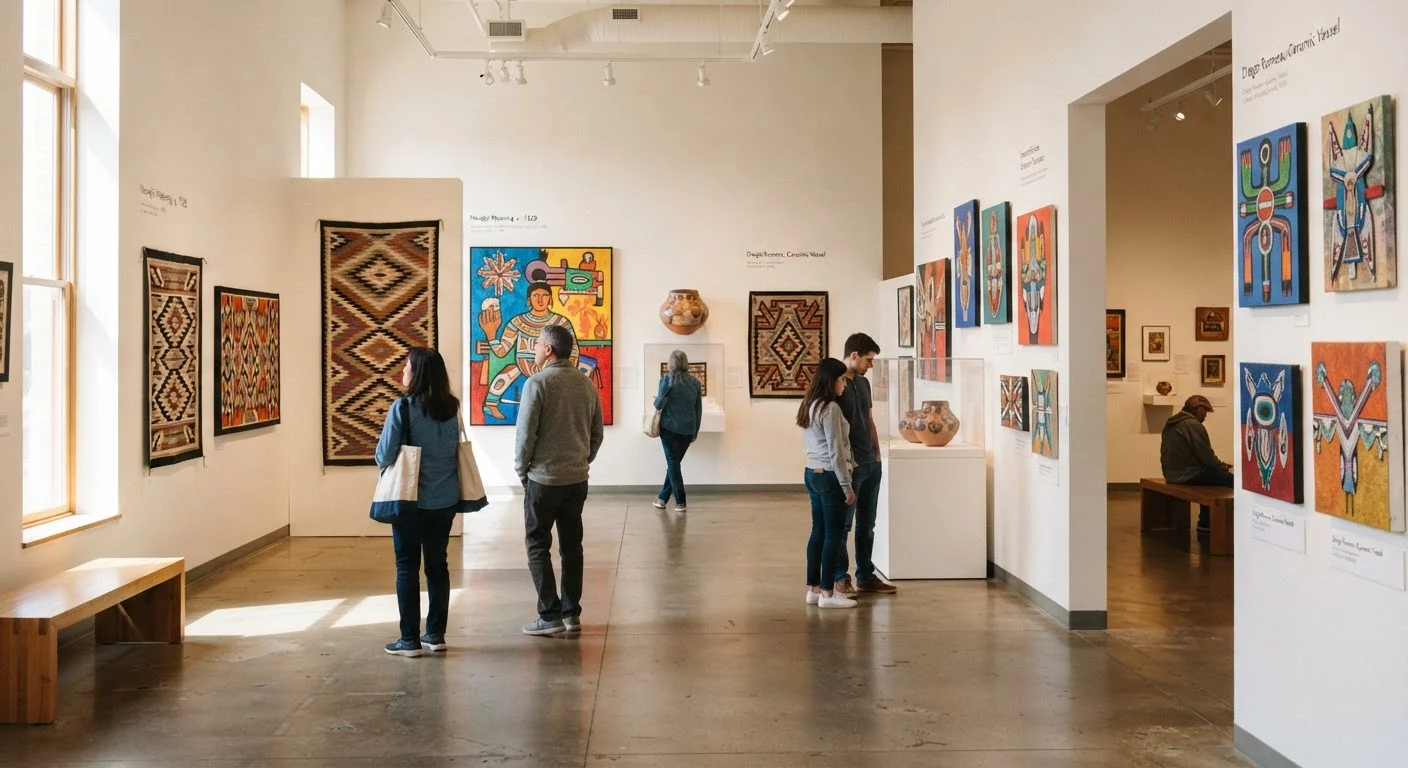
Indigenous art encompasses visual works created by Native American, Alaska Native, and Native Hawaiian peoples - spanning ancient pottery and beadwork to contemporary painting, sculpture, and digital media. In museum contexts, the term increasingly describes not just the objects on display but the frameworks used to collect, interpret, and credit them. The current shift involves moving Indigenous art from ethnographic halls into fine-art galleries and giving Native communities a meaningful voice in how their cultural heritage is presented.
The Native American Graves Protection and Repatriation Act (NAGPRA), enacted in 1990, legally requires federally funded institutions to return certain sacred objects and ancestral remains to affiliated tribes - a foundational policy shaping museum practices today.
From Curiosity Cabinet to Fine-Art Gallery
For most of the twentieth century, Native American objects in American museums were housed in natural history halls alongside dinosaur bones and geological specimens - a placement that said something quietly damaging: that Indigenous peoples and their creativity belonged to the past, or to science, rather than to the living story of art. That arrangement is now under serious, sustained revision.
The change is visible in floor plans. Works that once sat in glass cases labeled by region and date are being moved into galleries where they hang beside - or anchor - collections of American and contemporary art. Attribution has shifted too: maker names, tribal nations, and cultural contexts appear on labels where 'unknown' or a broad tribal category once sufficed. This isn't cosmetic. It reflects a fundamental rethinking of whose knowledge counts in an institution built on display.
For readers curious about how American artistic movements define and redefine themselves, this shift sits alongside other cultural reckonings - not unlike the way Abstract Expressionism and Pop Art staked competing claims to what American art could mean in the postwar era.
574+
Federally recognized tribes in the U.S.
According to the Bureau of Indian Affairs, more than 574 distinct tribal nations hold legal standing - each potentially affected by how museums collect and display cultural objects.
1990
Year NAGPRA became law
The Native American Graves Protection and Repatriation Act passed with bipartisan support and began reshaping the legal relationship between museums and tribal nations.
~200,000
Native items subject to NAGPRA review
Estimates from the National Park Service suggest hundreds of thousands of objects in U.S. institutional collections have been identified for potential repatriation consideration.
The Policy Behind the Change
Institutional change rarely happens through goodwill alone, and the reorientation of Indigenous art in American museums has a legal backbone: the Native American Graves Protection and Repatriation Act, passed by Congress in 1990. NAGPRA obligated federally funded museums to catalog their holdings of Native human remains, funerary objects, sacred items, and objects of cultural patrimony - and to work with affiliated tribes toward their return.
The process has been slow and imperfect. Critics, including tribal leaders and scholars, have documented significant delays, disputed affiliations, and institutions that have repatriated as little as possible while technically complying with the law. But NAGPRA created something that hadn't existed before: a formal relationship between tribal nations and museum professionals, a negotiating table where communities could assert claims and institutions were legally required to respond.
That relationship, even when contentious, opened doors. Tribes that engaged with museums over repatriation began consulting on exhibition design. Indigenous scholars entered curatorial roles. What started as a legal process evolved, in many cases, into an ongoing creative and intellectual partnership.
NAGPRA Compliance Is Still a Work in Progress
Decades after NAGPRA's passage, many institutions have repatriated only a fraction of eligible holdings. Investigative reporting and tribal advocacy have kept pressure on major research universities and natural history museums to accelerate compliance. The law was amended in 2023 to strengthen repatriation timelines and tribal consultation requirements, signaling that the policy conversation is still very much ongoing.
Contemporary Native Artists Are Reshaping the Conversation
The most vivid evidence of the shift isn't in policy - it's in the work itself. A generation of Indigenous artists is making paintings, installations, video pieces, and sculptures that engage directly with history, identity, and the politics of representation. Artists such as Jaune Quick-to-See Smith, whose retrospective traveled major American institutions, and Jeffrey Gibson, who represented the United States at the 2024 Venice Biennale, have brought Native American perspectives into some of the most prestigious venues in global contemporary art.
These artists don't fit neatly into a single aesthetic category - which is exactly the point. Their work ranges from abstract to figurative, playful to confrontational, deeply rooted in specific cultural traditions and fluently conversant with international art discourse. They resist the idea that Native art must be 'traditional' to be authentic, or that contemporary ambition erases cultural grounding.
Viewers interested in how place and cultural identity shape artistic communities will find a rich parallel in America's regional art scenes, where cities like Santa Fe have long been meeting points for Indigenous and non-Indigenous creative traditions.
“We are not artifacts. We are not relics. We are living peoples with living cultures, and our art reflects that - it always has.”
— Peggy Flanagan, Lieutenant Governor of Minnesota and enrolled member of the White Earth Nation of Ojibwe
What Visitors Can Take Away
Walking into a museum gallery that includes Indigenous art well can feel different from walking into one that does not. The difference is usually in the details: whether artists are named, whether tribal affiliations are given, whether the wall text speaks of living cultures or past ones, whether programming invites Native voices to interpret the work. These aren't small courtesies - they shape whether a visitor leaves with genuine understanding or with a more comfortable, less accurate version of history.
If you want to engage more critically with what you see, our guide to getting more out of every gallery visit offers practical strategies for reading exhibitions with intention. And if you're drawn to the broader question of how cultures interact, borrow from each other, and draw boundaries, our explainer on cultural appropriation versus cultural exchange provides useful context for those conversations.
The rise of Indigenous art in American museums isn't a finished story. It's a shift still underway - in collections, in curatorial hiring, in legal compliance, and in the ongoing work of communities asserting the right to shape how their heritage is known.