

Key Takeaways
- Abstract Expressionism emerged in the 1940s as a deeply personal, emotionally charged movement centered in New York City.
- Pop Art arose in the late 1950s and 1960s as a deliberate reaction to both Abstract Expressionism and the rise of consumer culture.
- Abstract Expressionism prized individual gesture and raw feeling; Pop Art embraced flat imagery, irony, and mass-produced iconography.
- Both movements shifted the global center of gravity in contemporary art toward the United States.
- Each movement reflected a different America - one introspective and anxious, the other playful and commercially saturated.
Option A
Abstract Expressionism
The brooding, interior voice of postwar American ambition.
Best for: Viewers drawn to emotional depth, psychological intensity, and art as personal expression rather than cultural commentary.
Option B
Pop Art
The sardonic, wide-eyed mirror held up to consumer culture.
Best for: Viewers who enjoy wit, accessibility, and art that engages directly with everyday images from advertising, media, and mass production.
If you're moved by emotional intensity and the idea of art as raw self-disclosure
Abstract Expressionism
The movement prizes gesture, scale, and feeling above all else - standing before a Rothko or de Kooning canvas can feel genuinely overwhelming in the best possible way.
If you enjoy art that makes you laugh, think, or feel a little uneasy about advertising and celebrity culture
Pop Art
Pop Art meets viewers exactly where they are, using familiar imagery - soup cans, comic strips, movie stars - to ask sharp questions about what American society truly values.
If you want to understand how American art gained international prestige
Abstract Expressionism
It was the first genuinely American movement to dominate the global art conversation, making New York the new Paris for serious critics and collectors.
If you're new to visual art and want an accessible entry point
Pop Art
Its recognizable imagery and playful tone lower the barrier to entry, making it easier to form an opinion without art-world training.
The Emotional Interior vs. The Crowded Marketplace
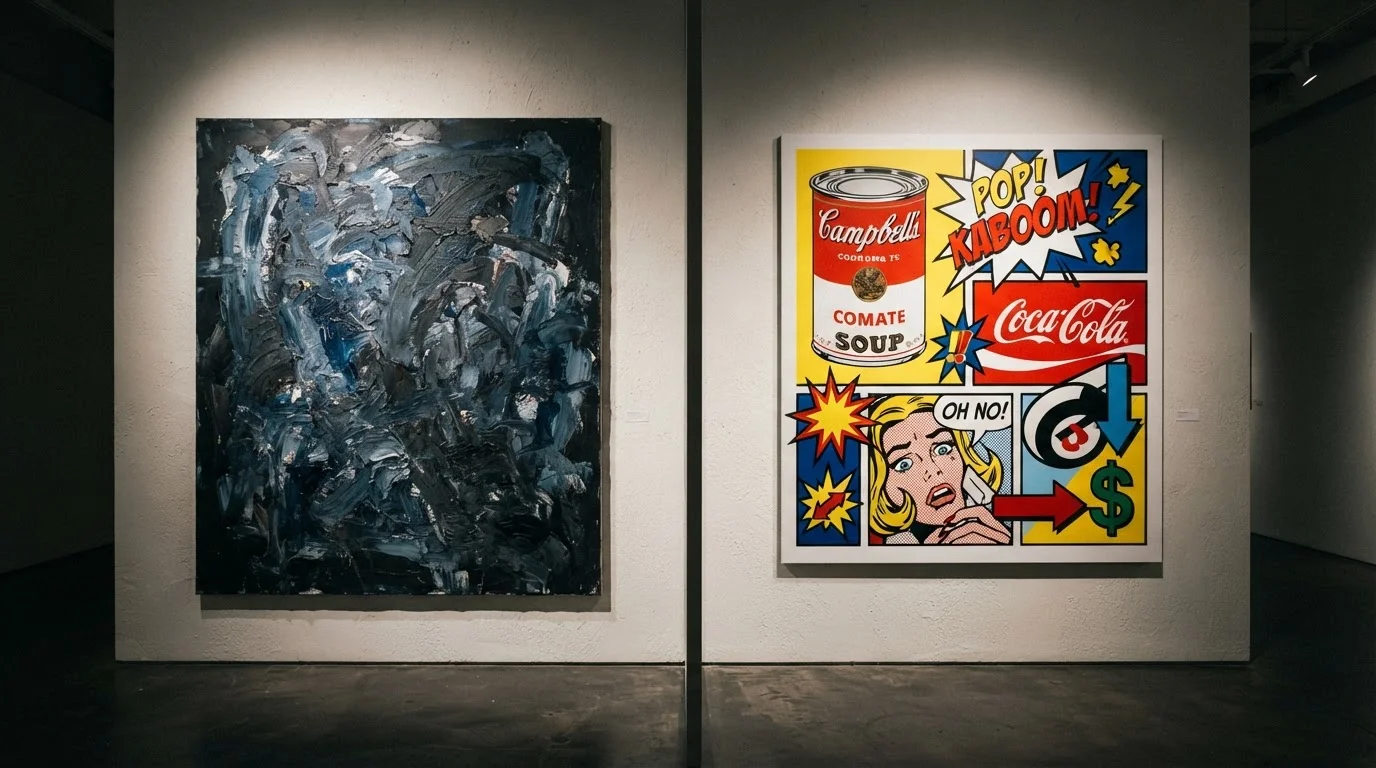
Imagine two paintings hanging side by side: one is a vast, churning field of layered black and gray, its surface alive with the physical record of an artist's struggle. The other is a crisp, oversized rendering of a Campbell's Soup can, rendered so perfectly flat it could be mistaken for a billboard. These two images did not just come from different artists - they came from different Americas.
Abstract Expressionism took root in New York during the 1940s, as artists like Jackson Pollock, Mark Rothko, and Willem de Kooning tried to process the anxieties of the postwar world through paint itself. Their canvases were battlegrounds for the unconscious. Scale mattered enormously - these were not pictures to hang over a sofa, but environments meant to envelop and unsettle the viewer. The movement owed debts to European Surrealism, but its ambition was distinctly American: to create art that felt universal through being intensely personal.
Pop Art arrived roughly a decade later, and it did so with a smirk. Artists like Andy Warhol, Roy Lichtenstein, and Jasper Johns looked at the supermarket shelves, the movie magazines, and the television screen and said: this is what America actually looks like. Where Abstract Expressionism turned inward, Pop Art turned outward - toward the shiny, disposable, celebrity-saturated surface of postwar consumer life.
| Criterion | Abstract Expressionism | Pop Art |
|---|---|---|
| Era | 1940s-1950s | Late 1950s-1960s |
| Core focus | Inner emotion, the unconscious | Consumer culture, mass media |
| Visual style | Gestural, layered, non-representational | Flat, graphic, image-based |
| Relationship to the hand | Celebrated - marks show the artist's body | Minimized - mimics mechanical reproduction |
| Tone | Serious, existential, introspective | Ironic, playful, detached |
| Key figures | Pollock, Rothko, de Kooning | Warhol, Lichtenstein, Johns |
| Audience assumption | Art requires deep engagement | Art can meet viewers in everyday life |
Style, Technique, and What Each Movement Believed About Art
The visual differences between the two movements are immediate and striking. Abstract Expressionism celebrated the hand - the drip, the smear, the impulsive mark. Pollock's drip paintings were made by moving across an unstretched canvas on the floor, his whole body part of the creative act. Rothko's luminous color-field rectangles invited sustained, meditative looking. The process was the point: authenticity came from letting the inner life spill directly onto the surface.
Pop Art, by contrast, deliberately erased the hand. Warhol famously used silkscreen printing to reproduce images mechanically, mimicking the logic of the factory. Lichtenstein borrowed the Ben-Day dot technique - the tiny colored dots used in commercial printing - and blew it up to monumental scale. The message embedded in that technique was pointed: if mass production defines modern life, then art should look like mass production.
A Word on the British Connection
Pop Art didn't start in New York. British artists - including Richard Hamilton and the Independent Group - were exploring similar ideas in London during the early 1950s, influenced by American advertising imagery imported after World War II. The American branch of the movement, however, is what gained global dominance and shaped the movement's lasting definition. Both strains are worth knowing, even though American Pop Art tends to dominate the conversation.
These competing ideas about what art should do reflect a genuine philosophical split. Abstract Expressionism inherited a Romantic belief in the artist as a tortured, visionary individual. Pop Art was more skeptical - even cynical - about that mythology. Warhol's persona of deliberate blankness was itself a kind of performance, a rebuke to the idea that art required suffering and sincerity.
For a broader look at how these movements fed into what came next, see our explainer on what contemporary art really means - a useful companion to understanding where both movements ultimately led.
Legacy, Influence, and Why Both Still Matter
Abstract Expressionism handed American art its first real claim to international leadership. By the early 1950s, New York had displaced Paris as the center of the art world - a cultural shift with consequences that still shape how museums are organized and which works command the highest prices at auction. The movement's emphasis on personal expression seeded everything from Color Field painting to the expressive figuration that thrives today.
Pop Art's legacy is arguably even more visible in everyday life. Its aesthetics - bold outlines, flat color, the appropriation of commercial imagery - run through graphic design, fashion, music video, and digital culture. When you see an album cover that turns a celebrity into a silkscreen icon, or a meme that repeats an image in a grid, you're seeing Pop Art logic at work.
Together, the two movements map a tension that never fully resolved in American culture: the pull between depth and surface, between the interior life and the marketplace, between art as spiritual practice and art as cultural commentary. That tension, it turns out, is productive. Understanding both movements gives viewers a richer lens for approaching art made since - including the thriving regional art scenes across America that carry these legacies forward in surprising directions.