

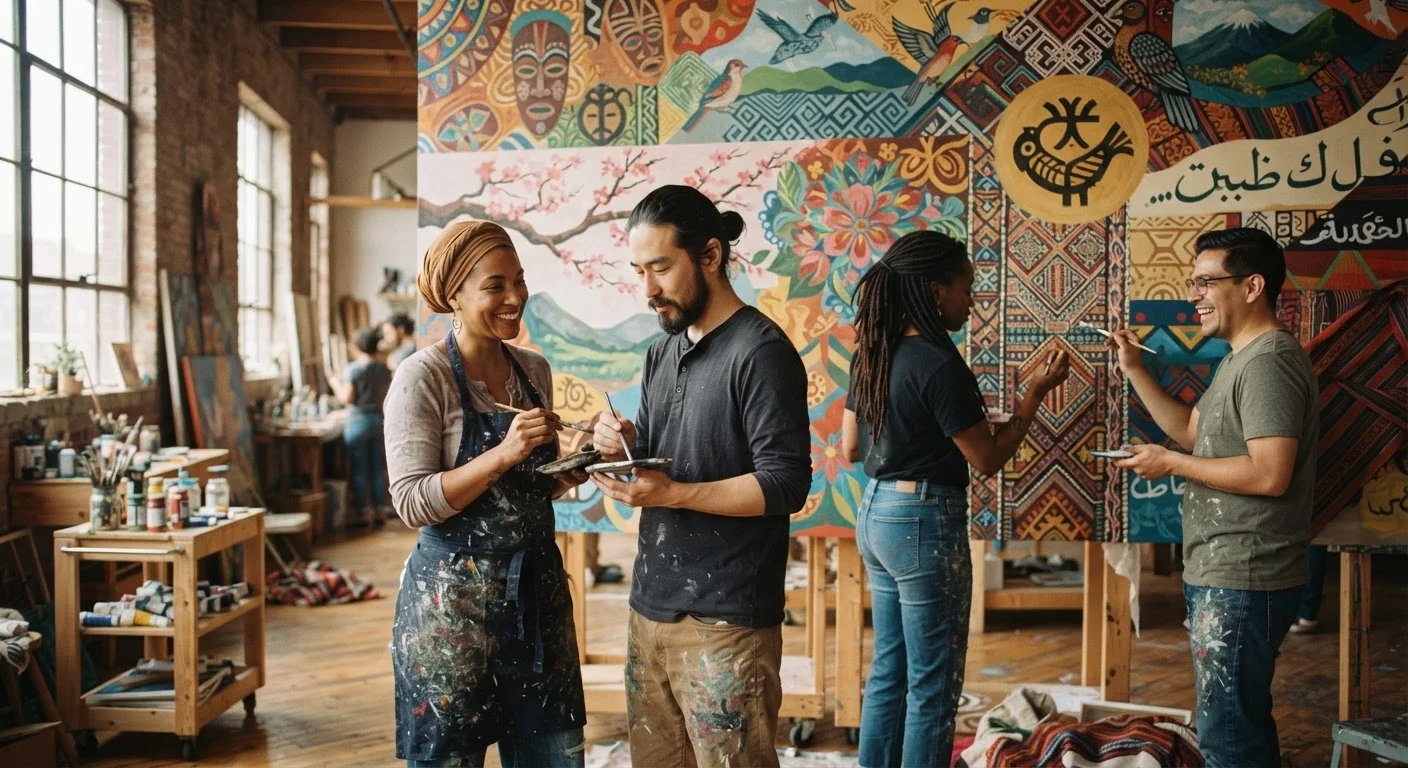
Key Takeaways
- Cultural exchange involves mutual respect, credit, and reciprocity between communities; appropriation typically does not.
- Power dynamics - who profits, who is harmed, whose voice is centered - are central to how critics evaluate these situations.
- Context, consent, and compensation are practical benchmarks for distinguishing appreciation from exploitation.
- Many artists and scholars see exchange as essential to artistic evolution when done thoughtfully.
- Indigenous and marginalized communities often bear the highest costs when their cultural symbols are misused.
Our Verdict
Cultural exchange and cultural appropriation occupy opposite ends of a spectrum defined by power, consent, and credit. Exchange enriches art and connects communities when it's approached with humility and accountability. Appropriation diminishes communities by stripping their practices of meaning while concentrating the resulting recognition and profit elsewhere. Neither label is applied the same way in every case, and thoughtful engagement with context is the most reliable guide.
| Best for | Recommended |
|---|---|
| Artists drawing inspiration across cultural boundaries | Cultural Exchange - with credited collaboration and community dialogue |
| Institutions curating art from outside their own cultural tradition | Cultural Exchange - guided by community consent and shared storytelling |
| Readers trying to evaluate a specific controversy in the arts | Apply the power-consent-credit framework before forming a judgment |
Why This Conversation Keeps Coming Up
Few debates in the contemporary arts world generate as much heat - or as much confusion - as the one over cultural appropriation versus cultural exchange. A pop star performs in a costume borrowed from a non-Western tradition; a gallery shows paintings inspired by Indigenous motifs; a film score fuses musical elements from multiple continents. In each case, someone celebrates the creativity while someone else raises a concern. Who's right? Often, both are asking the right questions.
The friction exists because art has always traveled. Cultures have influenced each other through trade, migration, conquest, and curiosity for as long as human beings have made things. What's changed is that we now have the language and the platforms to examine those exchanges critically - asking not just what was borrowed, but how, by whom, and at whose expense. For a deeper look at how the art world frames and debates these questions, see our guide to how the art world works.
Defining the Terms
Cultural exchange generally describes a process where people from different backgrounds share, learn from, and are inspired by each other's traditions - with acknowledgment, respect, and ideally some form of reciprocity. Think of jazz's documented cross-pollination of African, European, and Caribbean musical traditions, or the centuries-long dialogue between Japanese and Western visual art that shaped both.
Cultural appropriation, by contrast, is most often used to describe situations where elements of a marginalized culture are adopted by members of a dominant culture - particularly when that adoption strips away meaning, erases credit, or generates profit that doesn't flow back to the source community. A fashion brand selling headdresses as costume accessories is a frequently cited example: a sacred object reduced to a product, disconnected from its meaning, and sold by people with no relationship to the tradition it comes from.
The distinction is not always clean. Critics and scholars widely agree that power dynamics matter enormously. The same cultural element can be honored in one context and exploited in another depending on who is doing it, how, and why. This is why the debate rarely has a simple answer.
| Cultural Exchange | Cultural Appropriation | |
|---|---|---|
| Power dynamic | Typically mutual or equitable | Often dominant culture borrows from marginalized |
| Consent | Source community is consulted or involved | Rarely sought or considered |
| Credit & attribution | Source clearly acknowledged | Credit frequently absent or obscured |
| Economic benefit | Shared or returned to source community | Concentrated with the adopting party |
| Cultural meaning | Context and significance respected | Often stripped away or distorted |
| Community response | Generally welcomed by source culture | Often opposed or protested |
Where Artists and Communities Draw the Line
Practitioners and cultural critics often point to three practical benchmarks: consent, credit, and compensation. Did the originating community agree to have their traditions used? Is the source culture clearly acknowledged? Does economic benefit flow back, even partially, to those who created the tradition?
Many Indigenous artists and advocates have been particularly vocal about these standards. Ceremonial symbols, sacred designs, and traditional knowledge are not just aesthetic choices - they carry legal, spiritual, and community significance. When those elements are reproduced without permission or understanding, the harm is concrete, not merely theoretical. Our coverage of Indigenous art in American museums explores how institutions are actively rethinking their responsibilities in this space.
A Practical Question to Ask
Before engaging with another culture's artistic tradition, ask: Would a member of that community recognize what I'm doing as respectful? Have I learned its history and meaning, or only borrowed its surface? Seeking out artists and voices from within the tradition - reading, listening, and compensating - transforms inspiration into genuine dialogue rather than one-way extraction.
It's also worth noting that artists from marginalized groups frequently navigate this debate from the inside. Many work deliberately across cultural lines, citing their own complex, hybrid identities as their creative material. Their work resists easy labeling - and that's often the point.
The Same Question Across Art Forms
This debate plays out differently depending on the medium. In music, live arts and popular music have long been testing grounds - from early rock and roll's debated relationship to the blues, to contemporary discussions about who gets to lead Afrobeats crossover moments in the mainstream. In visual art, the conversation often focuses on motifs, symbols, and techniques. In street art, the question of who has the right to make marks in whose neighborhood adds a geographic and community dimension - a tension explored in our piece on where street art ends and graffiti begins.
Across all these forms, the most durable principle critics offer is this: exchange enriches; extraction diminishes. When an artist enters another culture's tradition as a student, a collaborator, and a creditor - the result tends to be generative for everyone. When they enter as a consumer extracting raw material, the communities left behind often have little to show for it.
Debates like this one share DNA with similar tensions in food culture. Our look at fusion cuisine in America traces comparable fault lines between creative crossover and cultural flattening.