

Key Takeaways
- Southeast Asia is one of the most accessible international regions for first-time travelers from the US.
- Visa rules, health requirements, and entry conditions vary significantly by country - always verify before you go.
- Budget travelers and those with more to spend will both find options across the region.
- Cultural awareness - particularly around temples, dress, and behavior - matters and is easy to practice.
- Low-cost flights connect most major destinations within the region, making multi-country trips practical.
Why Southeast Asia Works for First-Time International Travelers
Southeast Asia has a reputation for being both adventurous and approachable - and for first-time international travelers, that balance matters. The region spans eleven countries across a geographic area roughly comparable to the continental United States, yet it's served by a well-developed network of budget airlines, guesthouses, and tourism infrastructure that makes navigation manageable even for newcomers.
English is widely spoken in tourist corridors throughout Thailand, Vietnam, Bali (Indonesia), Cambodia, and the Philippines, which eases the communication barrier considerably. Local currencies stretch further for travelers earning US dollars, meaning even a modest travel budget goes a long way. And the food - whether you're eating street noodles in Hanoi or a beachside seafood dinner in Koh Samui - is frequently cited as one of travel's great highlights.
That said, Southeast Asia is not Europe. Flight times from the US typically range from 16 to 24 hours with at least one connection, jet lag is real, and the tropical climate, unfamiliar food, and different sanitation standards require some preparation. If you're starting from scratch on international planning, the ground-up planning guide covers the foundational steps - passports, visas, and budgeting - before you dive into region-specific logistics.
Start with one or two countries rather than attempting a six-country loop. A focused itinerary means you actually absorb a place rather than just transit through it.
First-time international travelers frequently underestimate how tiring long travel days, time zone adjustment, and constant decision-making can be. Depth beats breadth on a first trip.
Download offline maps (Google Maps allows this) and the Grab ride-hailing app before you arrive - both work without a local SIM and are immediately useful on day one.
Having navigation and transportation tools ready before landing reduces friction and anxiety significantly, particularly in busy arrival airports.
A Country-by-Country Snapshot
The region is diverse enough that choosing the right countries for your first trip matters more than trying to see everything at once.
- Thailand is the classic first stop. Bangkok delivers urban energy, world-class temples, and chaotic night markets. Chiang Mai offers a slower pace with mountain scenery and cultural depth. The southern islands - Phuket, Koh Lanta, Koh Tao - range from party-oriented to peaceful.
- Vietnam rewards travelers who enjoy history, food, and varied landscapes. Hanoi's Old Quarter, Hoi An's lantern-lit streets, and Ha Long Bay are each distinctive. The country is long and narrow; domestic flights save significant time compared to bus travel.
- Bali, Indonesia functions almost as its own destination. Ubud draws those interested in culture and wellness; Seminyak and Canggu attract surfers and café-hoppers; Uluwatu offers dramatic clifftop temples and uncrowded beaches.
- Cambodia is compact and meaningful. Angkor Wat - the world's largest religious monument - is a genuine wonder. Siem Reap, the gateway city, is easy to navigate and increasingly well-served by direct regional flights.
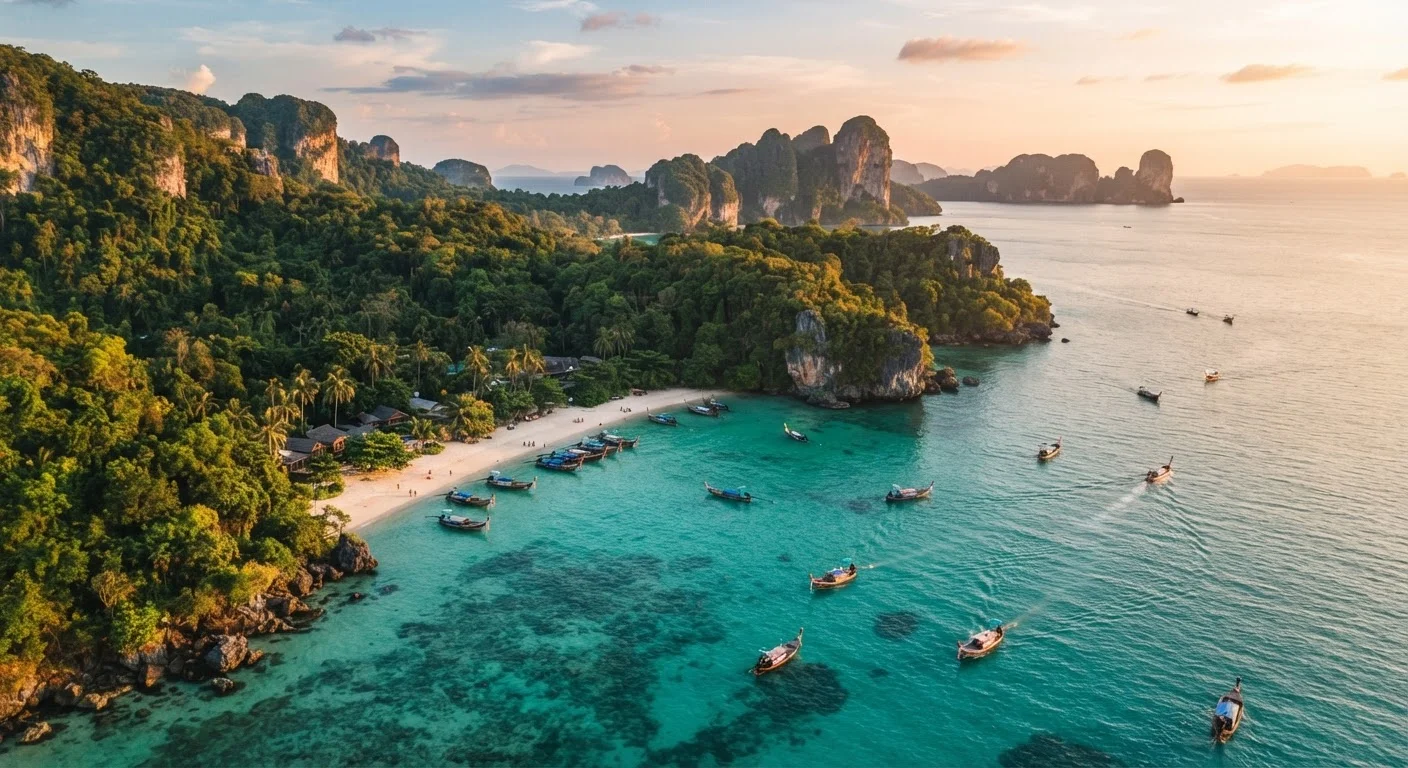
- The Philippines is an archipelago of over 7,000 islands. Palawan - particularly El Nido and Coron - consistently ranks among the world's most beautiful coastal destinations. Inter-island travel requires domestic flights, which adds planning complexity but also flexibility.
For a different kind of first international trip focused closer to East Asia, our overview of Japan vs. South Korea explores how those destinations compare in pace and culture.
~135M
International tourist arrivals in Southeast Asia annually
The UNWTO has consistently ranked Southeast Asia among the world's fastest-growing tourism regions in pre-pandemic and recovery-period data.
16-24 hrs
Typical US-to-Southeast Asia flight time
Most US departures require at least one connection; total travel time varies significantly by departure city and destination country.
10
ASEAN member countries in the region
The Association of Southeast Asian Nations groups Brunei, Cambodia, Indonesia, Laos, Malaysia, Myanmar, Philippines, Singapore, Thailand, and Vietnam.
Entry Requirements, Visas, and Health Prep
Visa rules across Southeast Asia vary - and they change. US citizens currently receive visa-on-arrival or visa-free access in Thailand, Bali, Cambodia, Vietnam (for stays within certain limits), and the Philippines, but the specific terms, fees, and durations shift periodically. Always verify current requirements with the destination country's official embassy or consulate and the US State Department before booking.
Health preparation is another area where first-timers often underestimate lead time. Vaccines recommended for travel in the region - such as hepatitis A, typhoid, and in some cases Japanese encephalitis or rabies - may require multiple doses over several weeks. Malaria risk also varies by country and specific region within a country. Consult a travel medicine clinic or your healthcare provider at least four to six weeks before departure. This is general guidance only - specific recommendations depend on your itinerary, health history, and other individual factors that only a qualified provider can assess.
Mosquito protection (DEET-based repellents, long sleeves at dawn and dusk) is broadly advisable across much of the region regardless of malaria risk, given dengue fever prevalence. Drinking bottled or purified water rather than tap water is standard practice in most destinations.
Getting Around Within the Region
Budget airlines - AirAsia, Vietjet, Cebu Pacific, and others - connect major Southeast Asian cities at fares that frequently undercut train or bus options for the time saved. Booking these flights a few weeks in advance generally yields reasonable prices, though last-minute fares can be unpredictable. Always verify baggage allowances before booking, as carry-on restrictions on budget carriers differ from US domestic norms.
Within cities, ride-hailing apps (Grab is the dominant platform across much of the region) provide metered, cashless rides that sidestep fare negotiation entirely - a genuine relief for first-timers. Tuk-tuks and motorbike taxis remain common and are often faster in traffic, though agreeing on a price before boarding is important where metered rides aren't standard.
Overnight sleeper trains in Thailand and Vietnam are an enjoyable and practical option - they cover long distances while you sleep and are generally reliable. For travelers curious about what day-to-day international movement actually feels like on the ground, our article on solo travel abroad day-to-day offers an honest picture of navigating unfamiliar places independently.
Budgeting and Money Basics
Southeast Asia accommodates a wide range of budgets. A traveler staying in guesthouses, eating local food, and using public transportation can travel comfortably in Thailand or Vietnam on roughly $40-$60 USD per day, though actual costs depend heavily on destination, season, and personal habits. Bali and Singapore sit at higher price points; Cambodia and Laos tend to be lower. These are general ranges - not guarantees - and should be used for rough planning only.
ATMs are widely available in cities and tourist areas, though fees for foreign-card withdrawals add up. Many travelers carry a debit card with no foreign transaction fees and withdraw larger amounts less frequently to minimize charges. Credit cards are accepted at mid-range and upscale establishments but are rarely accepted at street vendors and local markets, where cash remains king.
Currency exchange at airports tends to offer less favorable rates than in-city exchange booths or bank ATMs. Arrive with enough USD (in small, clean bills) to cover your first day's needs while you orient yourself.
Get a Local SIM Card at the Airport
Prepaid SIM cards with generous data allowances are available at arrival airports across Thailand, Vietnam, Bali, and the Philippines - often for just a few dollars. Reliable data makes maps, translation apps, and Grab work seamlessly from the moment you land. Check that your phone is unlocked before departure.
Cultural Respect and Safety Awareness
Southeast Asia is deeply tied to Buddhist, Hindu, and Muslim traditions depending on the country and region. Temples and religious sites - which are among the region's greatest attractions - typically require covered shoulders and knees. Shoes are removed before entering most sacred spaces. Touching religious statues, climbing on ruins, or behaving disruptively at sites that matter deeply to local communities causes real offense and is increasingly regulated.
Dress codes in Muslim-majority areas (much of Malaysia, Aceh in Indonesia, and parts of the Philippines) extend beyond tourist sites into everyday public life. Researching local norms for each destination, rather than assuming uniformity across the region, reflects both respect and practical self-interest.
On safety: Southeast Asia is generally safe for tourists, but petty theft - bag snatching, particularly from motorbikes in busy areas - is a real concern in some cities. Keep bags on the side away from traffic, use hotel safes for passports and valuables, and apply the same situational awareness you would anywhere unfamiliar. The US State Department maintains up-to-date travel advisories by country; checking these before departure is a straightforward habit worth building. For a broader look at how international trip planning differs from booking a domestic trip, see our guide on domestic vs. international trip planning.