

Key Takeaways
- Aeration relieves soil compaction that suffocates grass roots and blocks water absorption.
- Core aeration is generally more effective than spike aeration for most lawn types.
- Cool-season grasses benefit most from fall aeration; warm-season grasses do better in late spring.
- You can skip aeration if your lawn is newly seeded, recently aerated, or showing no signs of compaction.
- Aeration is most effective when followed by overseeding and topdressing with compost.
Relieves compaction for healthier root growth
Opening up compacted soil allows grass roots to extend deeper into the ground, giving them better access to water and nutrients and making the lawn more drought-resilient over time.
Improves water and fertilizer absorption
Channels created by core aeration allow irrigation and rainfall to penetrate the root zone rather than running off the surface, reducing waste and making fertilizer applications more effective.
Reduces thatch buildup naturally
Aeration introduces soil microbes to the thatch layer, which accelerates organic decomposition and helps keep thatch at manageable levels without chemical treatments.
Creates ideal conditions for overseeding
The open plugs left by aeration provide excellent seed-to-soil contact, boosting germination rates when overseeding is done immediately after the process.
Equipment is widely available to rent
Core aerators are commonly available at equipment rental centers, making the process accessible for homeowners without needing to purchase or store specialized machinery.
Lawn looks rough for one to two weeks
Soil plugs scattered across the lawn surface are unattractive for a short period after aeration. While they break down on their own, this appearance can be off-putting before an event or in a front-facing yard.
Unnecessary on healthy, uncompacted turf
Aerating a lawn that doesn't have a compaction problem adds stress without benefit. Disturbing healthy root zones and creating entry points for weeds is counterproductive when the soil is already in good condition.
Timing errors can stress the lawn
Aerating during peak summer heat or drought, or outside the correct window for your grass type, can slow recovery and leave the turf more vulnerable than before the process.
Rental equipment requires physical effort
Walk-behind core aerators are heavy machines and can be physically demanding to operate, particularly on larger yards or uneven terrain. Professional service is an option but adds to overall cost.
May temporarily increase weed germination
The disturbed soil and open channels can provide a foothold for weed seeds if overseeding isn't done promptly to fill the gaps with desirable grass.
Our Verdict
Lawn aeration is a genuinely useful maintenance tool - but only when the conditions call for it. Used at the right time on compacted, struggling turf, it can meaningfully improve root health, water uptake, and grass density. Used on a lawn that doesn't need it, it's unnecessary effort with some short-term cosmetic downsides.
Homeowners with heavy clay soil, high foot traffic areas, or thin, slow-recovering turf will see the most benefit from aeration done at the correct seasonal timing.
What Lawn Aeration Actually Does
Lawn aeration is the process of creating small openings in the soil to reduce compaction and improve the movement of air, water, and nutrients down to the root zone. Over time - especially in yards with clay-heavy soil or heavy foot traffic - soil particles press together, leaving grass roots without enough oxygen and making it harder for water and fertilizer to penetrate.
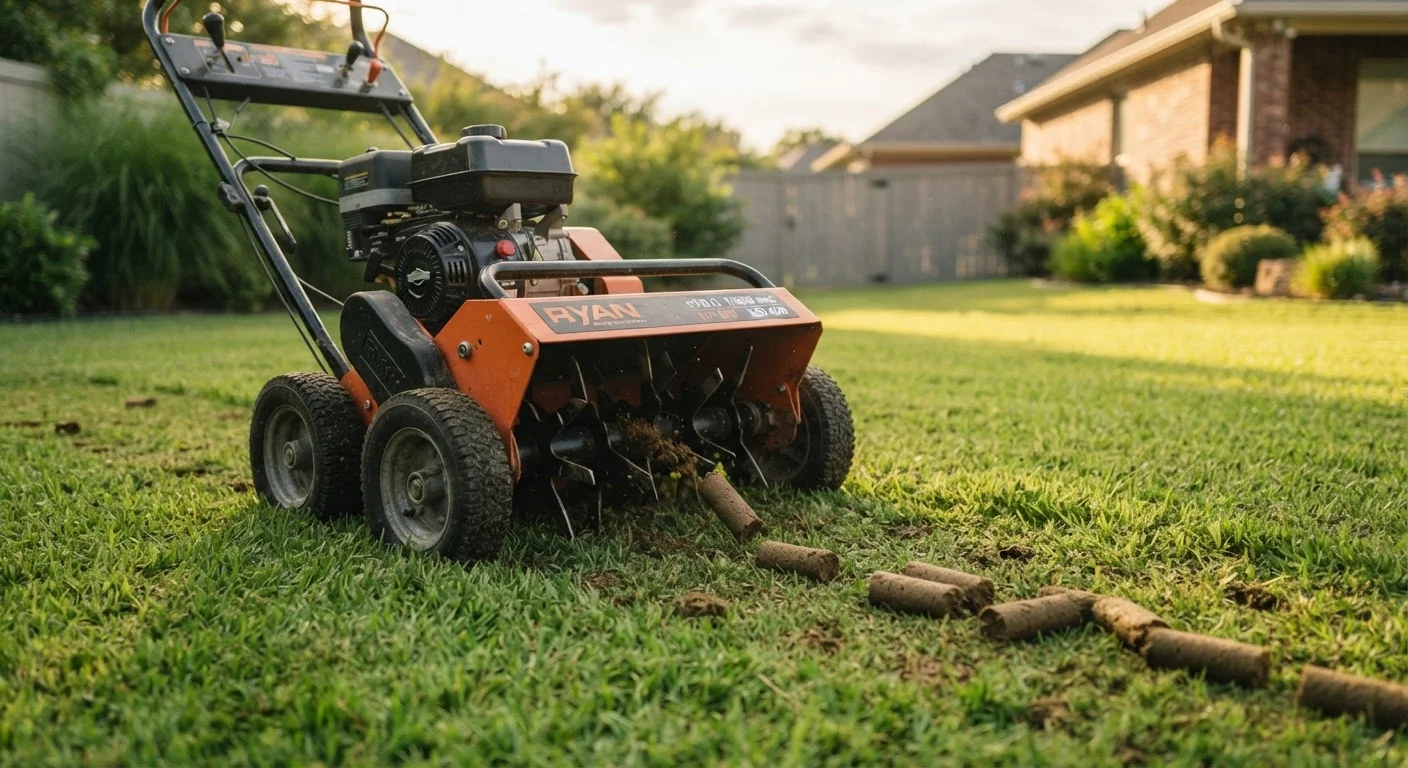
There are two main aeration methods: core aeration and spike aeration. Core aeration (also called plug aeration) uses hollow tines to remove small cylinders of soil, leaving behind open channels. Spike aeration simply pokes holes without removing material. Most turf experts consider core aeration more effective because it actually decompresses the soil rather than just displacing it.
The soil plugs left behind by core aeration may look untidy for a week or two, but they break down on their own and return organic matter to the lawn surface. Aeration also creates an ideal environment for seed-to-soil contact, making it a natural pairing with overseeding - see our guide on overseeding a thin lawn for timing and technique details.
Spike vs. Core Aeration: A Key Distinction
Spike aerators - including sandals with tines and rolling spike tools - poke holes without removing soil. This can actually increase compaction around the hole by displacing soil particles sideways. Core (plug) aeration removes material and genuinely decompresses the soil. For most homeowners dealing with real compaction issues, core aeration is the method worth using.
Signs Your Lawn Actually Needs Aeration
Not every lawn needs to be aerated every year. Before renting equipment, take a few minutes to read your turf. These are reliable indicators that compaction is the real problem:
- Water pools or runs off instead of soaking in after moderate rain or irrigation.
- The lawn feels spongy due to a thick thatch layer - more than half an inch of accumulated organic debris between soil and grass blades.
- A screwdriver or pencil won't push 2-3 inches into moist soil without significant resistance - a simple, practical field test.
- Grass is thin, yellowing, or slow to recover in areas that receive consistent foot traffic, such as paths between play areas and entrances.
- The lawn grows on clay soil or was established on heavily graded fill soil, both of which compact more readily than loamy ground.
If your lawn passed a wet spring without drainage issues and the grass is filling in well, compaction likely isn't a limiting factor - and aeration can be skipped this season without consequence.
½ inch
Thatch depth that signals a problem
Turf management guidelines generally recommend aeration when thatch accumulation exceeds half an inch, as thicker layers begin to block water and nutrient movement.
1-3 years
Typical aeration frequency for most lawns
Most residential lawns benefit from aeration once every one to three years, with clay-heavy or high-traffic lawns often needing annual treatment.
Pros and Cons of Aerating Your Lawn
Aeration has real benefits, but it also comes with trade-offs worth understanding before you commit to the process.
Relieves compaction for healthier root growth
Opening up compacted soil allows grass roots to extend deeper into the ground, giving them better access to water and nutrients and making the lawn more drought-resilient over time.
Improves water and fertilizer absorption
Channels created by core aeration allow irrigation and rainfall to penetrate the root zone rather than running off the surface, reducing waste and making fertilizer applications more effective.
Reduces thatch buildup naturally
Aeration introduces soil microbes to the thatch layer, which accelerates organic decomposition and helps keep thatch at manageable levels without chemical treatments.
Creates ideal conditions for overseeding
The open plugs left by aeration provide excellent seed-to-soil contact, boosting germination rates when overseeding is done immediately after the process.
Equipment is widely available to rent
Core aerators are commonly available at equipment rental centers, making the process accessible for homeowners without needing to purchase or store specialized machinery.
Lawn looks rough for one to two weeks
Soil plugs scattered across the lawn surface are unattractive for a short period after aeration. While they break down on their own, this appearance can be off-putting before an event or in a front-facing yard.
Unnecessary on healthy, uncompacted turf
Aerating a lawn that doesn't have a compaction problem adds stress without benefit. Disturbing healthy root zones and creating entry points for weeds is counterproductive when the soil is already in good condition.
Timing errors can stress the lawn
Aerating during peak summer heat or drought, or outside the correct window for your grass type, can slow recovery and leave the turf more vulnerable than before the process.
Rental equipment requires physical effort
Walk-behind core aerators are heavy machines and can be physically demanding to operate, particularly on larger yards or uneven terrain. Professional service is an option but adds to overall cost.
May temporarily increase weed germination
The disturbed soil and open channels can provide a foothold for weed seeds if overseeding isn't done promptly to fill the gaps with desirable grass.
When to Aerate - and When to Wait
Timing is critical. Aerating at the wrong point in the growing season stresses grass rather than helping it recover.
- Cool-season grasses (Kentucky bluegrass, fescue, ryegrass): Aerate in late summer to early fall, typically August through October depending on your region. The grass is entering a period of active root growth and can heal quickly.
- Warm-season grasses (Bermuda, zoysia, St. Augustine): Aerate in late spring through early summer when the grass is actively growing and temperatures are consistently warm.
Avoid aerating during drought stress or extreme heat - the disturbed turf will struggle to recover without adequate moisture. If your lawn is headed into a difficult summer, the guide to keeping a yard healthy through summer heat covers supportive practices to use in tandem.
Newly seeded lawns should not be aerated until they have completed at least one full growing season. Aeration disturbs young root systems before they can establish. Similarly, if you aerated last year and your lawn has recovered well, annual aeration is rarely necessary - most lawns benefit from aeration every one to three years based on soil type and use patterns.
Fall is also an excellent window to complete aeration as part of a broader seasonal routine. Our fall yard prep checklist outlines how aeration fits alongside other end-of-season tasks that set up stronger spring growth.
Making the Most of Aeration
Aeration works best when it's part of a broader approach rather than a standalone fix. Here's how to get the most out of the process:
- Mow slightly shorter than normal before aerating - this improves tine penetration and makes plugs easier to break down later.
- Water deeply the day before if the soil is dry. The tines penetrate moist soil more effectively and pull cleaner plugs.
- Overseed immediately after aerating if your lawn is thin. The open channels created by the tines give seed direct contact with soil, which significantly improves germination rates.
- Topdress with compost after aerating and overseeding to add organic matter and help the plugs break down. This is a low-cost step that improves long-term soil structure - a principle explored further in our composting guide.
- Fertilize after aerating to take advantage of improved nutrient uptake pathways while they're open.
Leave the soil cores on the lawn. They'll break apart within one to two weeks with regular mowing and rainfall, returning nutrients to the surface without any extra cleanup effort.