

Key Takeaways
- Falls are the leading cause of injury-related emergency room visits for Americans of all ages, not just older adults.
- The bathroom, staircase, and bedroom account for a disproportionate share of home fall injuries.
- Most fall risk factors - poor lighting, loose rugs, cluttered pathways - are inexpensive and straightforward to address.
- Grab bars, non-slip surfaces, and improved lighting are among the highest-impact interventions supported by research.
- Individual health factors like vision, medication side effects, and footwear also contribute meaningfully to fall risk.
Why Falls Deserve Serious Attention in Every Household
Falls are not just a concern for older adults. According to the Centers for Disease Control and Prevention (CDC), falls are a leading cause of both fatal and nonfatal injuries across age groups in the United States. Young children, adults carrying laundry downstairs, and older individuals navigating a dim hallway at night all face meaningful risk inside their own homes.
Research consistently points to a combination of environmental and personal factors that, when addressed together, substantially reduce fall likelihood. Understanding which household conditions matter most - and why - is the foundation of any effective prevention strategy. For a broader look at keeping your home safe overall, see our complete home safety overview.
36 million
Older adult falls in the U.S. each year
According to the CDC, approximately 36 million falls are reported among older adults annually, resulting in around 32,000 deaths.
~80%
Of falls occurring in the home
Public health research consistently finds the majority of fall-related injuries for older adults occur inside or immediately around the home.
3 in 4
Bathroom falls occur during routine activities
Research published in injury prevention literature indicates most bathroom falls happen during everyday tasks such as bathing, getting on or off the toilet, or stepping over a tub edge.
The Household Conditions That Increase Fall Risk
Environmental hazards account for a large portion of preventable home falls. Research and public health data have repeatedly identified the following conditions as high-risk:
- Poor or inadequate lighting: Dark stairwells, unlit hallways, and missing night lights near beds and bathrooms make it difficult to see level changes, obstacles, or wet surfaces.
- Loose rugs and unsecured mats: Area rugs without non-slip backing and bath mats that shift underfoot are among the most commonly cited tripping hazards in injury reports.
- Cluttered pathways: Items left on stairs, power cords crossing walking paths, and crowded living areas limit safe movement, particularly at night.
- Wet or slippery surfaces: Bathrooms are especially hazardous - smooth tile floors, tub surrounds without grip strips, and water splashed near sinks create slip conditions.
- Missing or inadequate handrails: Stairs without continuous, secure handrails on both sides significantly increase fall risk, especially when carrying objects.
Learn more about the three highest-risk zones in a typical home and what specific features make each one dangerous.
Personal Risk Factors That Interact With Your Environment
Home conditions don't exist in isolation - they interact with individual physical factors that either amplify or buffer risk. Key personal contributors identified in fall research include:
- Vision changes: Reduced contrast sensitivity, depth perception difficulties, and slower adaptation to lighting changes all affect the ability to navigate safely. Annual vision checks matter more than many people realize.
- Medication effects: Several classes of medications - including blood pressure drugs, sedatives, and some antidepressants - can cause dizziness, orthostatic hypotension (a drop in blood pressure upon standing), or slowed reaction times. Anyone taking multiple medications should discuss fall risk with their healthcare provider.
- Footwear: Socks on hardwood floors, loose slippers, and worn-out soles are frequently involved in household falls. Well-fitting shoes with low heels and non-slip soles reduce risk considerably.
- Balance and strength: Reduced lower-body strength and balance - which can result from inactivity, certain health conditions, or age - make it harder to recover from a stumble before a fall occurs.
Talk to a Doctor About Medication and Fall Risk
If you or someone in your household takes multiple medications - particularly blood pressure drugs, sleep aids, or muscle relaxants - bring a complete medication list to the next healthcare appointment and ask specifically about fall risk. A healthcare provider or pharmacist can often identify combinations that affect balance or blood pressure and suggest alternatives or adjustments. This is general guidance only; never change or stop a medication without professional direction.
For households where aging in place is a consideration, this guide to adapting your home as mobility and vision change offers targeted modifications beyond general fall prevention.
Proven Practices for Reducing Fall Risk at Home
The following changes are consistently supported by home safety research as effective fall prevention measures. Many require minimal cost or effort, while others - such as installing grab bars in a tiled shower - may benefit from professional installation to ensure they're anchored into wall studs.
Install night lights along nighttime travel paths from bedroom to bathroom.
Many falls occur at night when residents move through darkened spaces in a sleep-groggy state. Consistent, low-level lighting along these routes gives eyes enough input to detect obstacles and surface changes. Motion-activated models remove the inconvenience of manually switching lights.
Secure or remove loose rugs throughout the home.
Rugs that slide, curl at the edges, or bunch underfoot are among the most frequently cited tripping hazards in home injury data. Double-sided carpet tape or non-slip rug pads effectively anchor most area rugs; bath mats should have strong suction backing rated for wet surfaces.
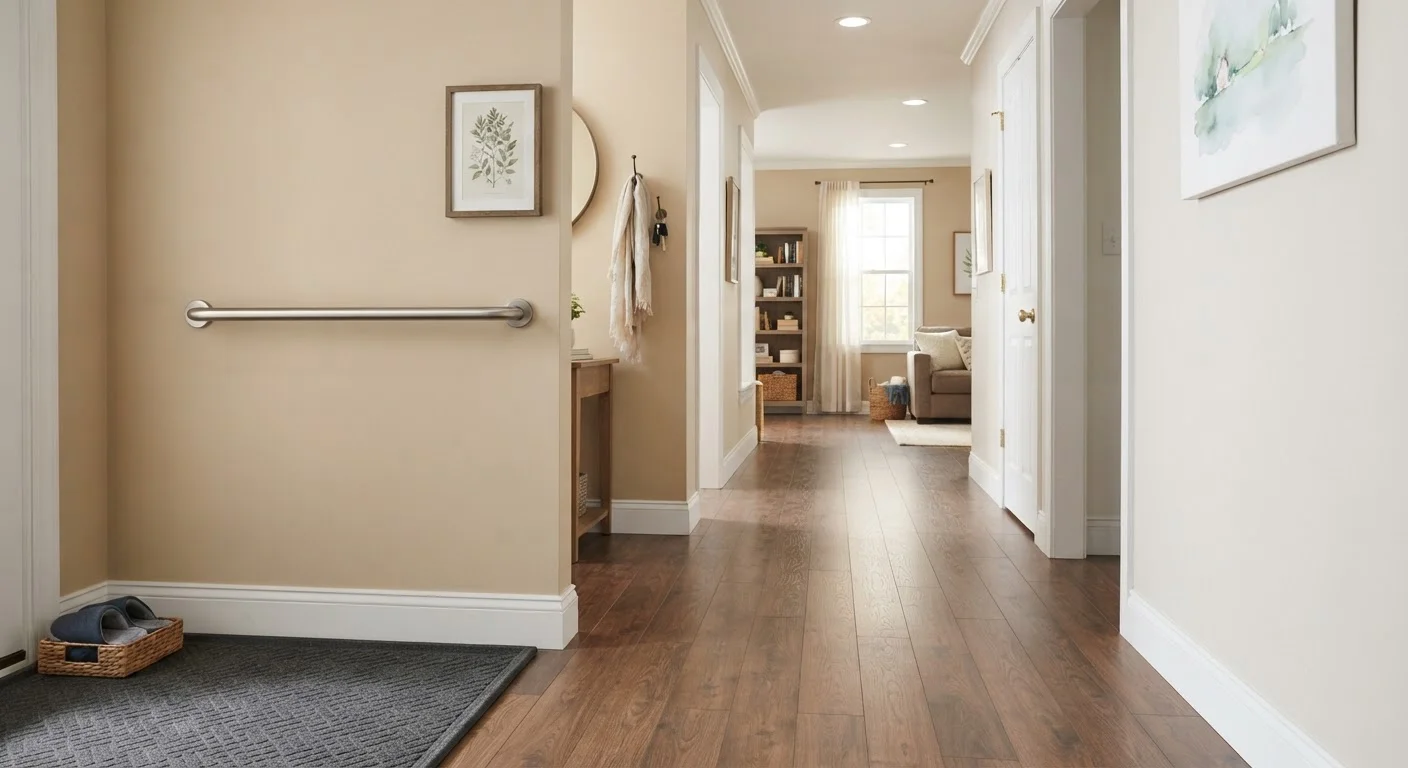
Install grab bars in bathrooms near the toilet and inside the shower or tub.
Bathrooms combine wet surfaces, small spaces, and awkward body movements - a high-risk combination. Grab bars provide a stable handhold when entering or exiting a tub, standing from the toilet, or recovering balance on a slick floor. They must be anchored into wall studs or with appropriate wall anchors to be effective.
Keep stairways clear and verify that handrails are secure and continuous.
Stair falls frequently involve carrying items that obstruct vision, or gripping a rail that shifts or ends before the bottom step. A continuous handrail on at least one side - ideally both - that users can grip firmly is one of the most evidence-supported stairway safety features.
Clear clutter from all high-traffic walking paths, including around beds and in hallways.
Items on the floor - shoes, bags, power cords, children's toys - are easily overlooked during normal movement and nearly invisible in low light. Maintaining clear walking lanes, especially near furniture people use to stand or sit, dramatically reduces the chance of catching a foot on an unexpected obstacle.
Add non-slip strips or texture mats to tub floors and high-risk tile surfaces.
Smooth tub and shower floors become extremely slippery when wet and soapy. Adhesive non-slip strips or fitted bath mats create friction that helps maintain footing during showering and bathing - one of the most common fall scenarios in the home.
To put these practices into a structured review of your own home, the room-by-room home safety audit checklist walks you through each space systematically.
Start With Quick Wins Today
Some of the highest-impact changes take less than an hour and cost very little. Begin with the actions below to immediately reduce risk in your home before moving on to larger modifications.
If you're establishing safety habits in a new space, this overview for new homeowners and renters covers the foundational checks every household should complete from day one.