

Key Takeaways
- Smaller venues offer closer proximity to performers and more organic crowd interaction.
- Mid-size theaters and halls often deliver the best balance of acoustics and intimacy.
- Arenas and stadiums prioritize spectacle and production value over sonic detail.
- Outdoor amphitheaters add a seasonal, open-air dimension that changes atmosphere entirely.
- Venue choice often reflects where an artist is in their career and what kind of show they're building.
- Knowing what each venue type offers helps you choose shows that match what you're looking for.
Concert Venue Scale
Concert venue scale refers to the capacity and physical size of a live music space - ranging from tiny clubs that hold fewer than 300 people to outdoor stadiums that seat 80,000 or more. The scale of a venue shapes nearly every part of the audience experience, including sound quality, sightlines, crowd energy, and even how personally connected you feel to the performer. Different venue sizes tend to attract different genres, career stages of artists, and types of audiences.
In the US live music industry, venues are broadly categorized into clubs (under 1,000 capacity), theaters and mid-size halls (1,000-5,000), arenas (5,000-20,000), amphitheaters (5,000-30,000 outdoors), and stadiums (20,000+). These tiers also influence production budgets, ticketing structures, and touring economics.
The Club: Where Music Feels Personal
Walk into a 300-capacity club on a Tuesday night and something shifts immediately. The ceiling is low, the stage is close enough to touch, and the room smells like decades of spilled beer and ambition. This is where careers begin and where die-hard fans go to reconnect with artists they've followed since the beginning.
At this scale, the performer and audience exist in something close to the same space. A singer can make eye contact with people in the back row. A guitarist's foot movement is visible. Mistakes are audible - and so is the electricity when everything clicks. The absence of production spectacle forces the music itself to carry the room.
These venues - think the 9:30 Club in Washington, D.C., or the Troubadour in Los Angeles - serve as proving grounds. An act that can hold a 500-person room without a light show or pyrotechnics has earned something. For concertgoers, that rawness is often the point.
Research the Venue Before You Buy
Before purchasing tickets, look up the venue's seating chart and read recent audience reviews focused on sightlines and acoustics. Many dedicated music forums have venue-specific threads where fans share which sections offer the best experience. A little research before checkout can make a significant difference in what you get on the night.
Theaters and Mid-Size Halls: The Sweet Spot
Step up to a 2,000- or 3,000-seat theater and the experience gains architecture. You get assigned seating, a real sound system calibrated for the room, and a stage elevated enough that sightlines actually work. These venues - historic movie palaces repurposed for concerts, purpose-built performance halls, seated ballrooms - occupy the middle ground between scrappy and grand.
Acoustically, this tier is often where live music sounds its best. The room is large enough to justify serious engineering but small enough that a single, well-tuned system can fill every corner without echo decay. When an artist is touring behind a critically acclaimed album and wants audiences to hear every layer, a 2,500-seat theater is frequently the choice.
The social contract also changes here. There's less of the mosh pit mentality and more of the hushed-attention-then-eruption dynamic. Crowds tend to be attentive in a way that rewards the subtleties in a performance. If you've ever wondered about the trade-offs between standing-room energy and seated comfort, the case for each seating format is worth understanding before you choose your next show.
~1,800
Average capacity of US mid-size concert theaters
Industry estimates place the sweet spot for acoustically optimized concert halls between 1,500 and 2,500 seats, balancing sound design and audience proximity.
82,500
Capacity of Rose Bowl Stadium (Pasadena, CA)
One of the largest concert venues in the US, the Rose Bowl has hosted some of the most attended individual concerts in American history.
Top 3
Venue types most attended by US concertgoers
According to Pollstar data, arenas, amphitheaters, and clubs consistently rank as the three most common live music venue formats by ticket sales volume in the US.
Arenas, Amphitheaters, and Stadiums: The Spectacle Tier
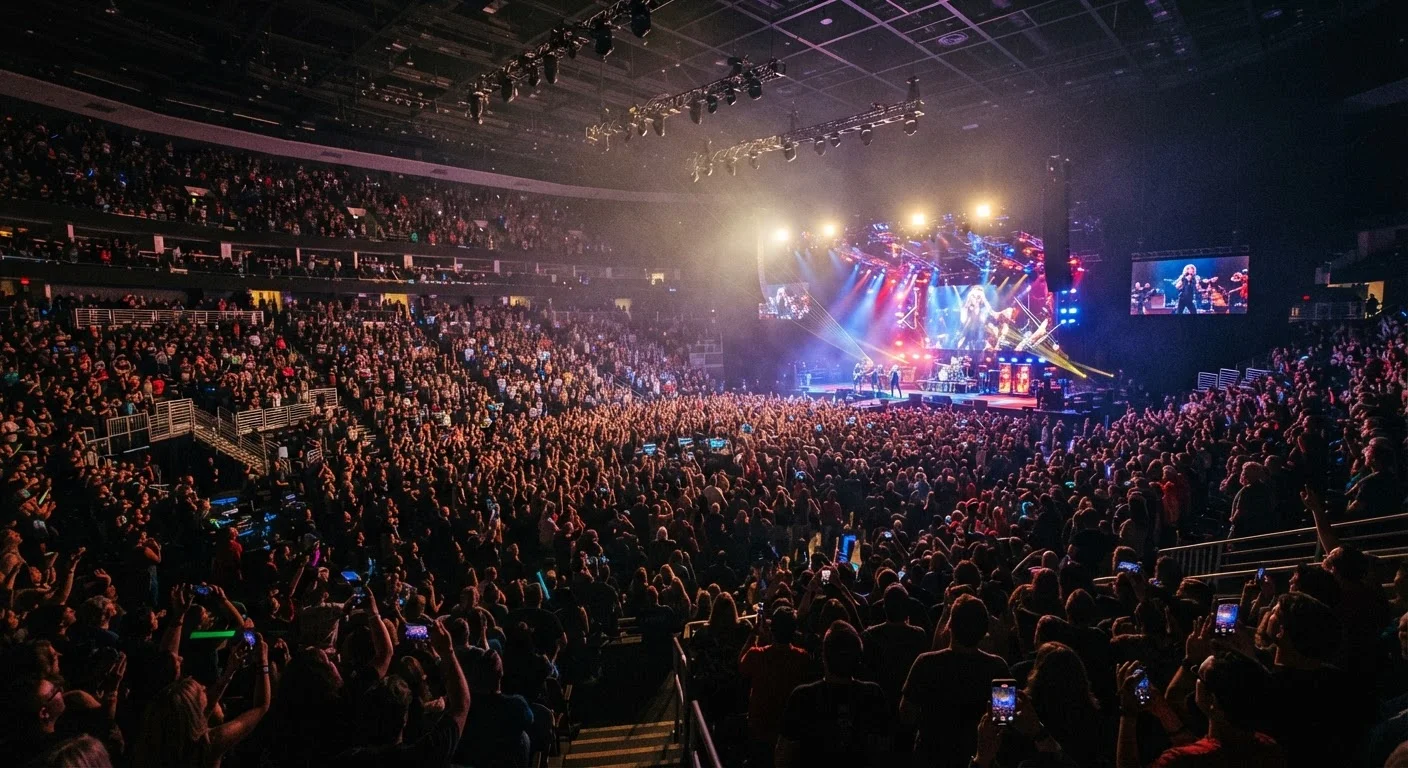
Once a show moves into an arena - 10,000 to 20,000 seats - the entire visual and sonic language has to scale up to match the space. Massive LED screens carry close-up camera feeds because the performer on stage is now the size of a thumbnail from the upper deck. The music becomes one part of a larger production: choreography, pyrotechnics, lighting rigs, and elaborate stage designs take on equal weight.
This is where the blockbuster tours live - the kind that generate cultural moments that people reference years later. The tradeoff is real, though. You are further from the performer, always. The sound may be powerful but loses textural detail in the cavernous air. And navigating 20,000 fellow fans from parking to your seat is its own logistical event.
Outdoor amphitheaters add a seasonal layer to all of this. A summer night under open sky, grass sloping down to a covered stage, the sound of crickets mixing with a bass line - it's a genuinely different atmosphere from any enclosed space. It tends to feel more relaxed, almost festive in a way that connects to the festival format many Americans already love.
Stadiums represent the ceiling - Super Bowl-sized events where the artist must become mythic just to be legible at that scale. The experience can be genuinely thrilling, but it's worth going in with calibrated expectations. If you've wondered whether staying home with a good livestream makes more sense for shows at that scale, that comparison is worth thinking through carefully.
Choosing the Right Scale for You
There's no universally correct venue size - only the right one for what you're looking for on a given night. Chasing an artist into a small club before they graduate to theaters can feel like witnessing something rare. Seeing that same artist two years later in an arena with a full production is a different kind of thrill entirely.
What tends to go wrong is mismatched expectations. Arriving at an amphitheater expecting the intimacy of a club show, or going to a tiny venue hoping for stadium-scale pyrotechnics, sets you up for disappointment that has nothing to do with the music itself. Understanding what commonly undermines a live show can help you get more out of whatever venue you choose.
Pay attention to the venue before you buy tickets - look at its capacity, read reviews about acoustics and sightlines, and consider where you'll be standing or sitting. The music is the reason you're there, but the room is the instrument it plays through.