

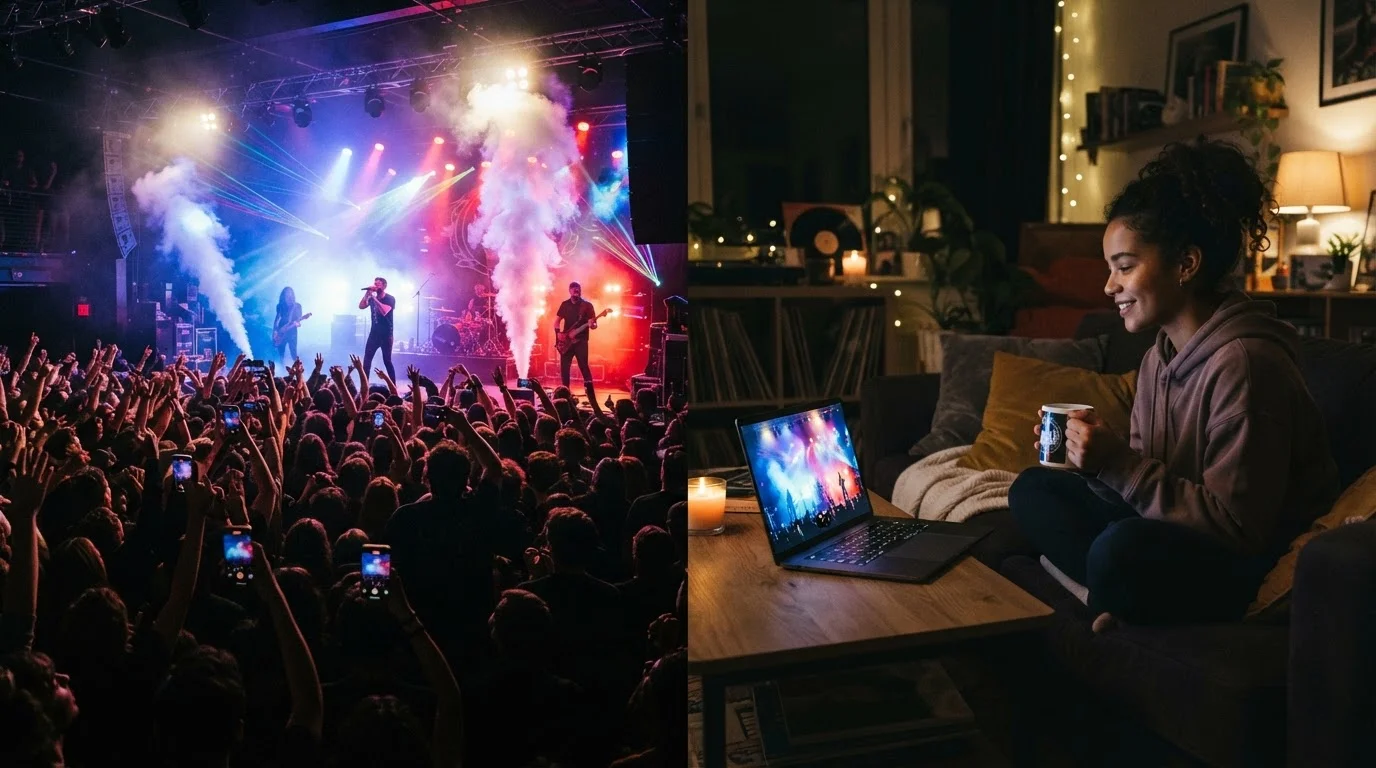
Key Takeaways
- Streaming offers lower cost and zero travel, but sacrifices physical atmosphere and spontaneous crowd energy.
- In-person attendance delivers sound pressure, communal excitement, and memories that recordings rarely replicate.
- Audio and video quality in streams vary widely depending on the platform and the production budget behind the broadcast.
- Ticket costs, service fees, and travel expenses make in-person concerts a significant financial commitment.
- Many artists now use streaming as a complement to touring, not a replacement — so both formats are increasingly available.
- Your choice often comes down to the specific artist, your budget, and what kind of evening you want.
Option A
Streaming a Concert
The flexible, accessible front-row seat — from anywhere.
Best for: Music lovers who want to catch a performance without travel, cost, or scheduling friction.
Option B
Attending in Person
The full sensory, communal live-music experience.
Best for: Anyone who wants to feel the music physically and share the moment with a crowd.
If budget is your primary concern
Streaming a Concert
Platform subscriptions or one-time pay-per-view fees are a fraction of ticket, travel, and parking costs. You can watch from home without additional spending.
If you want to feel genuinely moved by music
Attending in Person
Bass frequencies, crowd electricity, and the unpredictability of a live performance create an emotional impact that a screen simply cannot reproduce.
If you can't access a major venue due to location or mobility
Streaming a Concert
Streaming removes geographic barriers entirely, making world-class performances available to anyone with an internet connection.
If you're a dedicated fan experiencing a milestone tour
Attending in Person
Once-in-a-generation tours or farewell shows carry a weight that only deepens when experienced live, surrounded by equally devoted fans.
If you're exploring an unfamiliar artist or genre
Streaming a Concert
Watching a streamed performance is a low-stakes way to gauge whether an artist's live show is worth the investment of an in-person ticket.
The Case for Streaming: Access Without the Hassle
There's something quietly remarkable about watching a symphony orchestra perform in Vienna, or catching a sold-out arena show in Nashville, without leaving your living room. Streaming concerts — through dedicated platforms, artist websites, or major services that broadcast live events — has shifted from a pandemic-era workaround into a genuine format of its own.
The most obvious advantage is access. Geography, disability, childcare, or simply the prohibitive cost of tickets no longer have to stand between a listener and a great performance. For fans of niche genres or international artists who rarely tour certain regions, streaming may be the only realistic option.
Cost is another real factor. In-person concerts, especially at large venues, often involve ticket fees, service charges, transportation, parking, and food. A streamed event typically runs far less — sometimes free on YouTube or artist channels, sometimes a modest pay-per-view fee. If you're curious about an artist before committing to a full night out, streaming is a sensible first step.
That said, streaming quality varies enormously. A professionally produced broadcast with multi-camera direction and mastered audio is a genuinely impressive experience. A shaky phone stream uploaded to social media is not. Knowing who produced the stream matters almost as much as knowing who's performing.
| Criterion | Streaming a Concert | Attending in Person |
|---|---|---|
| Cost | Low to moderate (free–$30 typical) | Moderate to high (tickets + fees + travel) |
| Access | Anywhere with internet | Limited to venue location |
| Sound experience | Depends on platform production quality | Physical, immersive — but venue-dependent |
| Crowd atmosphere | Absent | Central to the experience |
| Visual experience | Close-up, directed camera work | Wide view; varies by seat position |
| Spontaneity | Low — edited or produced | High — anything can happen |
| Scheduling flexibility | Often available on-demand after broadcast | Fixed date and time only |
| Artist revenue impact | Varies by platform and deal | Direct, significant |
The Case for Going: What a Screen Can't Transmit
Ask almost anyone who's stood in a crowd as their favorite song begins, and they'll struggle to fully explain what happens. Live concerts operate on a physical level that recordings — however high-fidelity — can't replicate. Sound pressure from a large PA system is literally felt in the chest. Crowd energy shifts the emotional register of familiar music in ways that feel almost chemical.
There's also the element of shared experience. Being in a room with thousands of people who love the same music as you is its own kind of belonging. That communal dimension is something streaming explicitly removes. You might watch with friends or family at home, which helps, but the anonymous solidarity of a concert crowd is genuinely different.
Live performance also carries risk — in the best sense. Artists improvise, extend songs, respond to audiences, make mistakes, recover brilliantly. That aliveness is part of what draws people back show after show. If you want to understand why venue scale shapes these dynamics so dramatically, our piece on how US venue sizes shape the concert experience breaks down exactly how a 300-cap club differs from a 20,000-seat amphitheater.
The financial and logistical investment is real, though. Attending a major show often means planning weeks in advance, navigating service fees, and potentially arranging travel or overnight stays. For readers weighing those costs, supporting local music scenes without spending a fortune offers a useful counterpoint — smaller, local shows can deliver enormous live-music satisfaction at a fraction of the price.
~$150
Average US concert ticket price (major tours)
According to Pollstar data, average ticket prices for top-grossing tours have risen substantially over the past decade, with premium events often exceeding this figure before fees.
67%
US adults who attended a live music event in the past year
National Endowment for the Arts surveys consistently show live music as one of the most widely participated-in performing arts activities among American adults.
3x
Growth in paid live-stream events since 2019
Industry analysts have tracked rapid expansion of paid concert streaming, a trend accelerated by the pandemic and sustained by audience appetite for at-home access.
Sound Quality, Atmosphere, and the Real Trade-Offs
It's tempting to frame this as a simple quality-vs-convenience debate, but the honest picture is more nuanced. In-person concerts are not automatically better-sounding. Venue acoustics vary wildly — a badly mixed arena show can be a muddy, fatiguing listen, while a well-produced stream from a world-class hall can be revelatory. Your position in the crowd matters enormously, too. For a deeper look at that specific choice, our comparison of general admission vs. reserved seating at live concerts explores the sound and experience differences between floor and fixed seats.
Streaming, meanwhile, has an intimacy advantage people rarely mention: you can see the performer's face clearly. Close-up camera work during a broadcast often captures emotional moments that even front-row attendees miss. The visual experience of a well-directed stream is in some ways more detailed than standing 200 feet from the stage.
The honest answer is that these aren't competing formats so much as different experiences that serve different needs. A truly engaged music fan might stream an unfamiliar artist, attend a local show on a casual weekend, and save up for one significant in-person event per year. Neither choice requires defending. What matters is knowing what you're actually trading when you make it.