

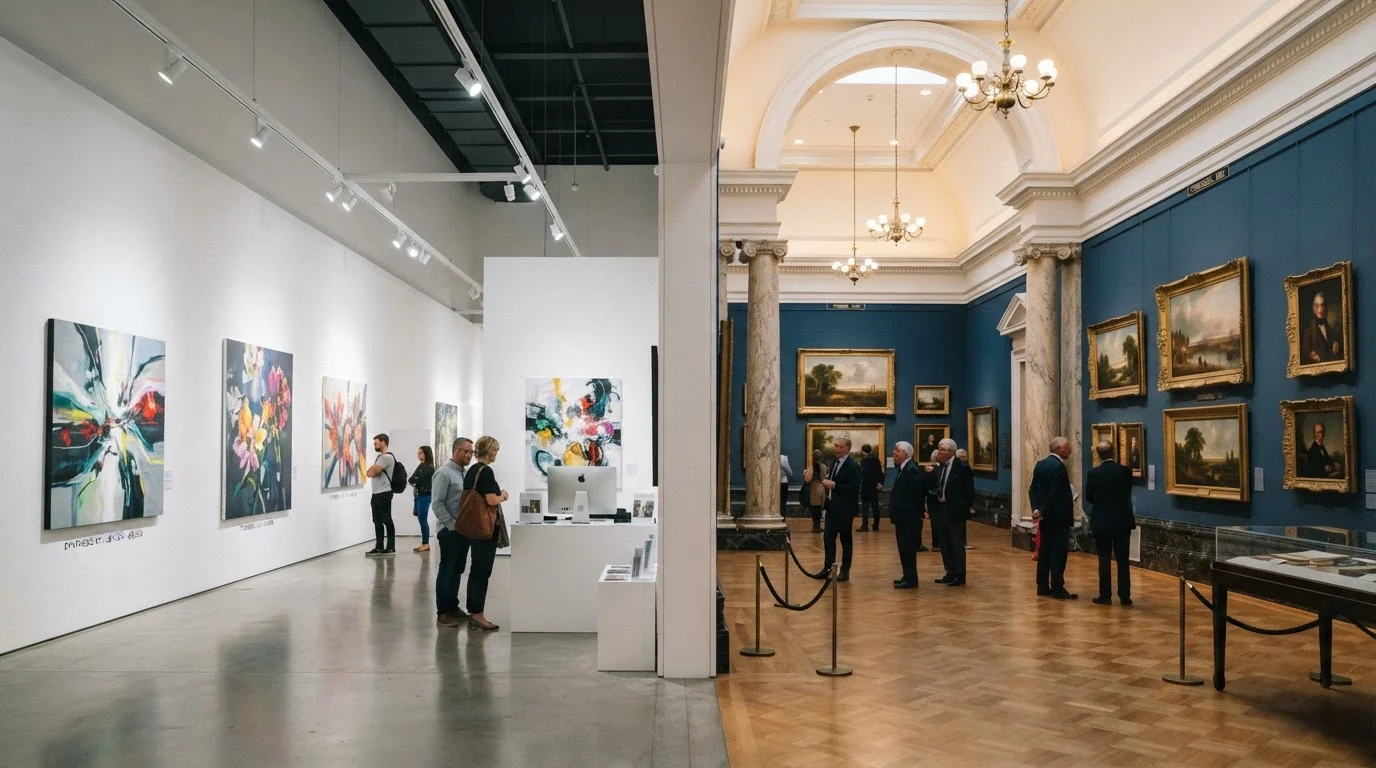
Key Takeaways
- Museums are typically nonprofit institutions focused on preservation, education, and public access to art and culture.
- Galleries are usually commercial spaces where art is displayed with the primary goal of facilitating sales.
- Both spaces are open to the public, but admission policies and pricing vary widely between them.
- Understanding the difference helps visitors know what to expect - and how to engage - in each setting.
- Many museums contain rooms called 'galleries,' which adds to the common confusion between the two terms.
Our Verdict
Museums and galleries both offer meaningful encounters with art, but they serve different masters. Museums prioritize preservation and public education; galleries prioritize the market. Neither is inherently better - they simply operate on different terms, and knowing that changes how you experience them.
| Best for | Recommended |
|---|---|
| Those wanting historical context, breadth, and educational programming | Museum |
| Those curious about emerging artists and the contemporary market | Commercial Gallery |
| Those seeking free or low-cost art experiences | Commercial Gallery (most are free to enter) |
| Those interested in community events, school programs, and rotating exhibitions | Museum |
Two Rooms, Two Very Different Worlds
Walk into the Metropolitan Museum of Art in New York and you'll pass through grand halls filled with objects spanning five thousand years of human creativity. Walk into a Chelsea gallery a few miles downtown, and you might find a single artist's new body of work - white walls, discreet price lists, a staff member ready to discuss commissions. Both experiences center on art. Both feel like they belong to a similar world. And yet the institutions behind them operate on fundamentally different principles.
The confusion is understandable, partly because the word "gallery" gets used inside museums - a wing devoted to Impressionism, for example, is often called a gallery. But a commercial gallery and a museum are not the same thing, and the distinction matters for how you understand what you're seeing, who paid for it to be there, and what happens to it next. For anyone looking to engage more deeply with the visual arts, understanding how these institutions work is a useful first step.
What Museums Are - and What They're For
A museum, in the traditional American model, is a nonprofit institution whose core mission revolves around collecting, preserving, researching, and displaying objects or works of art for the public benefit. Major institutions like the Smithsonian, the Art Institute of Chicago, or the Los Angeles County Museum of Art are governed by boards of trustees and funded through a combination of endowments, government grants, philanthropic donations, and admission fees.
Because museums don't exist to turn a profit, their collections are meant to be held in perpetuity - removed from the commercial market and kept accessible across generations. A painting acquired by a major museum typically stays there, stewarded by conservators who work to ensure it survives. Deaccessioning (selling works from a collection) happens, but it's carefully regulated and often controversial in the museum world.
The educational mission is equally central. Museums invest in programming - lectures, school group visits, audio guides, wall text - to help visitors understand context. If you've ever stood in front of a centuries-old object and read a placard explaining the civilization that made it, you've experienced that mission in action. Getting more out of a museum visit is a learnable skill that this structure actively supports.
| Museum | Commercial Gallery | |
|---|---|---|
| Primary purpose | Preserve, educate, and display for public benefit | Sell artwork and represent artists |
| Legal structure | Typically nonprofit (501(c)(3)) | Usually a for-profit business |
| Funding sources | Endowments, grants, donations, admission fees | Art sales commissions |
| Admission cost | Often charged; some free or by donation | Almost always free to enter |
| Art ownership | Acquires and holds works permanently | Displays work owned by artists or collectors for sale |
| Educational programming | Central to the mission | Minimal or incidental |
| Artist relationship | Acquires work; may not have ongoing representation | Represents artists; takes commission on sales |
What Commercial Galleries Are - and What They're For
A commercial gallery is, at its core, a business. It represents artists - often exclusively - and earns revenue by selling their work to collectors, corporations, and institutions. The gallery typically takes a commission (often around 50 percent) on each sale, while the artist receives the remainder. This is how most working artists, particularly those at the beginning or middle of their careers, reach buyers.
That commercial function shapes everything about the experience. The works on display are actively for sale. The exhibition schedule is curated partly to attract buyers and press attention. The relationships between gallerists, collectors, critics, and artists form the connective tissue of the contemporary art market.
None of this makes galleries less culturally valuable. Many galleries have launched careers that later reshaped art history, and the best gallerists function as genuine advocates for their artists - shepherding creative vision into public view. Entry to commercial galleries is almost always free, making them surprisingly accessible spaces. But visitors should understand the context: the art on the wall has a price, and someone is hoping you'll ask what it is.
How to Read a Gallery Visit
When you enter a commercial gallery, look near the entrance or front desk for a printed checklist - a simple sheet listing the works on view with titles, materials, dates, and prices. These are rarely posted on walls, but staff will almost always provide one if you ask. It's a normal, expected request, not a commitment to buy. Knowing the price of a work can actually enrich how you think about the artist's career stage and the gallery's positioning in the market.
Where the Lines Blur
The clean distinction between museums and galleries gets complicated in practice. Nonprofit artist-run spaces, university galleries, and kunsthalles (exhibition spaces that show art without collecting it) don't fit neatly into either category. Some are nonprofit but don't maintain permanent collections. Others are commercial but prioritize experimental work that doesn't sell easily.
Museums have also grown more conscious of their relationship to the market, particularly around questions of which artists get collected and whose stories get told. The growing presence of Indigenous art in American museums reflects broader reckonings about whose work has historically been preserved - and whose hasn't.
Meanwhile, some collectors and foundations blur the line further by opening private museums that function publicly but are controlled by individual interests rather than community governance. The legal and ethical debates around these spaces are ongoing.
For visitors simply trying to engage with visual art, the practical takeaway is this: before you walk in, it's worth asking - is this space trying to sell something, educate me, or both? The answer will shape what you encounter, what questions to bring, and how to connect with the work on the walls regardless of your background.