

Key Takeaways
- Graffiti is rooted in text-based mark-making tied to hip-hop culture; street art leans toward image-driven, often concept-led work.
- The distinction often hinges on permission: sanctioned murals are generally called street art, unauthorized tags remain graffiti.
- Both forms have entered galleries and museums, complicating any clean separation between "vandalism" and "fine art."
- Cities treat the two very differently in law and policy, even when the visual line between them blurs.
- Many working artists move fluidly between both practices, making the boundary more a spectrum than a hard line.
Option A
Street Art
The image-driven, often permitted face of urban visual culture.
Best for: Readers interested in large-scale murals, public commissions, and art-world crossover that transforms city spaces intentionally.
Option B
Graffiti
The text-rooted, subculture-driven practice that built the urban art tradition.
Best for: Readers exploring the origins of urban art, hip-hop culture, and the raw, community-coded language of tags and throw-ups.
If you want to understand the cultural roots of urban art
Graffiti
Graffiti's origins in 1970s New York and its deep ties to hip-hop give it a richer subcultural history that explains how urban art became a global force.
If you're exploring art that engages public spaces intentionally
Street Art
Street art's image-first approach and frequent collaboration with communities and city governments make it the more accessible entry point for public engagement.
If you're curious about art-world crossover and gallery recognition
Street Art
Artists working in the street art tradition have more frequently transitioned into institutional recognition, though graffiti pioneers have also made that leap.
If you want to understand urban subculture on its own terms
Graffiti
Graffiti has its own internal rules, hierarchies, and vocabulary that predate any mainstream validation - studying it reveals how subcultures build identity.
Two Practices, One Wall
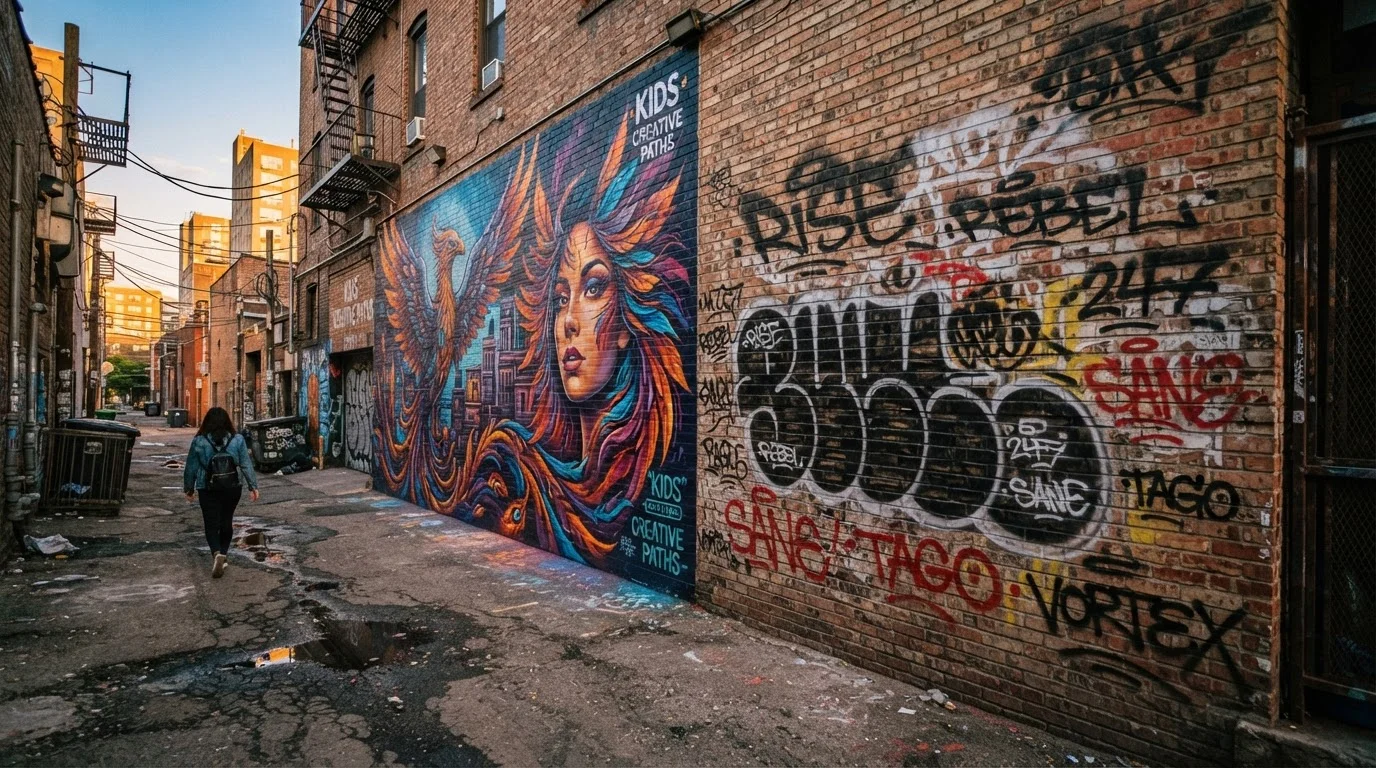
Walk through almost any major American city and you'll encounter both: the towering, permission-granted mural that transforms a blank building into a community landmark, and the looping tag sprayed fast and low near a freight rail line. Passersby often lump both under the same casual label - "graffiti" - but artists, scholars, and city planners would push back on that shorthand.
The distinction between street art and graffiti isn't just semantic. It touches on questions of permission, intent, cultural origin, and who gets to decide what belongs in public space. Understanding the difference helps explain why one artist gets a city contract and another gets a fine - and why both can end up in the same gallery show.
To explore how urban art fits into the broader landscape of contemporary creativity, our guide to the art world is a helpful starting point for the curious newcomer.
Origins: Where Each Practice Comes From
Graffiti, in its modern urban form, emerged from New York City in the late 1960s and early 1970s. Writers - as practitioners call themselves - developed a culture of tagging subway cars and city surfaces with stylized names and crew identities. It was inseparable from the birth of hip-hop, sharing space and energy with breakdancing, DJing, and rapping in the South Bronx and beyond. The practice had its own internal language: a tag is the simplest signature; a throw-up is a quick two-color bubble letter; a piece (short for masterpiece) is a full, elaborately rendered composition.
Street art arrived as a somewhat later, broader category - harder to pin to a single moment or city. It absorbed influences from graphic design, fine art, political poster traditions, and conceptual art. Where graffiti writers prioritized name recognition within a subculture, street artists often led with images, symbols, or messages aimed at a general public. Think of stencil work, wheat-paste posters, or large figurative murals - these are the visual signatures of street art's more image-centered vocabulary.
| Criterion | Street Art | Graffiti |
|---|---|---|
| Primary visual language | Images, symbols, characters | Stylized text, tags, lettering |
| Cultural roots | Design, fine art, political art | Hip-hop, New York subway culture |
| Typical authorization | Often permitted or commissioned | Typically unauthorized |
| Intended audience | General public | Fellow writers and subculture |
| Institutional reception | Frequently exhibited in galleries | Recognized but less consistently shown |
| Legal status | Usually legal | Often a civil or criminal offense |
The Permission Question - and Why It's Complicated
The most commonly cited dividing line is permission. Street art, in many definitions, is work made with the consent of the property owner or commissioned by a public body. Graffiti, by this measure, is unauthorized - made in the face of legal risk, which is itself part of the tradition's meaning and appeal.
But this line gets messy fast. Some of the most celebrated street artists built their reputations through unauthorized work before cities began courting them for sanctioned projects. Conversely, some graffiti writers operate in legal walls - designated spaces where writers can practice freely - without losing their graffiti identity.
"Legal Walls" and Gray Areas
Many cities designate specific surfaces where graffiti writing is permitted - sometimes called "legal walls" or "free walls." These spaces allow writers to develop craft without legal risk. However, work made on legal walls occupies an interesting middle ground: it's graffiti in style and tradition, but permitted in practice, which challenges the idea that authorization alone defines the categories.
The legal dimension also plays out differently across cities. Many municipalities have mural programs that fast-track permits for large-scale works while maintaining strict anti-graffiti enforcement. How public art gets commissioned and installed reveals just how layered that approval process can be - a stark contrast to the urgency of an unauthorized tag made in minutes.
When the Categories Overlap - and When They Don't
The most honest answer is that street art and graffiti exist on a spectrum, not in separate boxes. Many artists work fluidly across both - beginning with unauthorized tags, earning recognition, then taking on commissioned murals without abandoning their roots. The work of someone like Jean-Michel Basquiat, who began with text-based street tags in Lower Manhattan before entering the gallery world, illustrates how porous these categories have always been.
Where they diverge most sharply is in reception and intent. Graffiti's core audience has historically been other writers - the work is coded, competitive, and self-referential in ways that don't require a general viewer to decode it. Street art often aims outward, toward a public that may have no familiarity with urban art traditions at all.
That outward reach is also why street art has found more consistent institutional acceptance - in museums, festivals, and city beautification programs. For a sense of how similar acceptance/exclusion dynamics play out across art movements, it's worth reading about how Abstract Expressionism and Pop Art diverged in their cultural ambitions.
What both share is a conviction that art doesn't require a gallery wall - and that public space is a legitimate, even vital, arena for visual expression. That shared belief is what makes the conversation between them so enduring.