

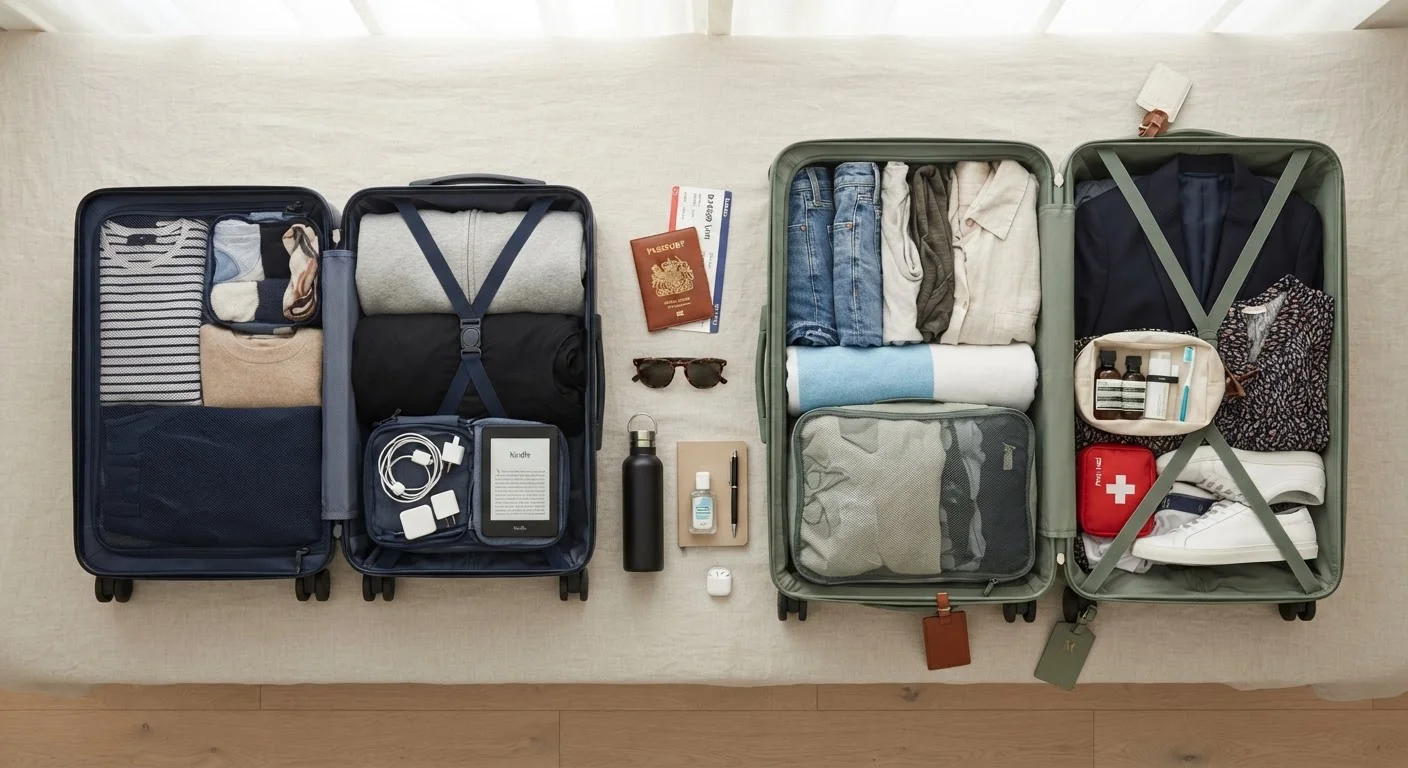
Key Takeaways
- Carry-on bags eliminate checked baggage fees and let you bypass baggage claim entirely.
- Checked bags allow more packing flexibility but add cost, time, and a small risk of delays or loss.
- Airline carry-on size rules vary and are not always enforced uniformly across routes or aircraft.
- Trip length, destination type, and airline policy should drive your decision more than habit.
- Liquids, sharp tools, and certain valuables have specific rules that affect which bag makes sense.
Option A
Carry-On Bag
The fast, flexible, fee-free option for light packers.
Best for: Short trips, frequent fliers, and travelers who want to move quickly through airports without waiting at baggage claim.
Option B
Checked Bag
The roomy, stress-free solution when you need to bring more.
Best for: Longer trips, travelers with gear restrictions, or anyone who needs the freedom to pack without strict volume limits.
If you're taking a weekend trip or a short domestic flight
Carry-On Bag
A carry-on is almost always sufficient for trips of three to four days and saves both money and time at the airport.
If you're traveling for two or more weeks internationally
Checked Bag
Extended trips typically require clothing variety, adapters, toiletries, and gear that exceed practical carry-on limits.
If you're traveling with sporting gear, medical equipment, or specialty items
Checked Bag
Most bulky or regulated items - ski equipment, CPAP machines, large camera rigs - must be checked or require special handling.
If your itinerary involves multiple connecting flights with tight layovers
Carry-On Bag
Checked bags risk missing connections; a carry-on keeps your belongings with you no matter what happens between flights.
The Real Cost of Each Option
Cost is the most obvious factor, but it's easy to miscalculate. Carry-on bags are free on most full-service domestic airlines - but that's not universal. Budget carriers often charge for overhead bin bags, sometimes more than a checked bag on the same flight. Before assuming your carry-on is free, check the specific fare class and airline policy for your route.
Checked bag fees on domestic U.S. flights commonly run between $30 and $40 for a first bag each way, meaning a round trip can add $60-$80 or more before you've left the terminal. On international itineraries, some fares include a free checked bag while others don't - and overage or overweight fees can be steep if your bag exceeds the weight limit, typically 50 lbs for economy class.
If you're budgeting carefully for your trip, baggage fees are worth treating as a real line item rather than an afterthought. They add up quickly on multi-leg trips.
| Criterion | Carry-On Bag | Checked Bag |
|---|---|---|
| Typical fee (domestic) | Free on most full-service airlines | $30-$40 per bag, each way |
| Size limits | Strict (≈22 x 14 x 9 in) | More generous (usually 62 linear in) |
| Weight limits | Varies; often 15-25 lbs | Typically 50 lbs (economy) |
| Liquid restrictions | Yes - TSA 3-1-1 rule applies | No liquid restrictions |
| Risk of loss or delay | None - stays with you | Small but real risk |
| Airport time | Faster - skip bag drop and claim | Slower - drop-off and claim required |
| Best trip length | 1-4 days | 5+ days or gear-heavy trips |
Speed, Flexibility, and What You Can Actually Pack
A carry-on keeps you moving. You skip the checked bag drop line, pass straight through security (with appropriate prep), and walk out of baggage claim while others wait. On a tight schedule or with a short layover between flights, that time advantage is real.
The trade-off is volume. Most airlines allow carry-ons up to 22 x 14 x 9 inches, but overhead bin space on smaller regional aircraft can be limited - and gate-checking is sometimes mandatory at no charge, sometimes not. Liquids remain capped at 3.4 oz per container in a single quart-sized bag through TSA security. Anything beyond that must go in a checked bag.
Checked bags offer freedom from those restrictions. You can pack full-size toiletries, a week's worth of shoes, fragile items with extra padding, or gifts without worrying about fitting within a rigid size envelope. The risk is that checked bags can be delayed, misrouted, or occasionally lost - rare, but worth knowing. Airlines are required to compensate passengers for verifiably lost luggage, but the process takes time and effort.
~0.6%
Rate of mishandled bags globally
According to SITA's 2023 Baggage IT Insights report, the baggage mishandling rate has declined significantly over the past decade but remains a factor on complex itineraries.
50 lbs
Standard checked bag weight limit (economy)
Most major U.S. carriers set the economy class checked bag weight cap at 50 pounds; bags exceeding this typically incur overweight fees of $100 or more per bag.
For solo international travel especially, the choice shapes your entire airport experience. As noted in our look at what solo travel abroad looks like day to day, moving between cities or transit hubs is noticeably easier when you're not managing large bags.
Special Situations That Change the Calculation
A few scenarios shift the math decisively in one direction.
- Traveling with liquids or medications: If you rely on prescription liquids, larger toiletries, or injectable medications that need proper storage, a checked bag may be unavoidable - though TSA has specific exemptions for medically necessary liquids. Always verify current TSA rules at the official TSA website before flying.
- Flying with sharp tools, sporting equipment, or oversized items: These are almost always required to be checked. Firearms, ammunition, and certain tools must follow specific airline and federal protocols when checked.
- Connecting flights vs. direct routes: On a direct flight, checked bag risk is low. On multi-stop itineraries - especially internationally - each additional connection is an opportunity for a bag to be delayed. A carry-on eliminates that variable entirely.
- Airline status or credit card benefits: Many travel credit cards and frequent flier programs include one or more free checked bags. If you have these benefits, the fee argument for carry-on weakens considerably.
Smart packing can also blur the line. Maximizing a well-organized personal item alongside your carry-on can sometimes replace what might have gone into a checked bag entirely.
Airline policies, TSA rules, and baggage fee structures change periodically. Always verify current requirements directly with your airline and the TSA before traveling.