

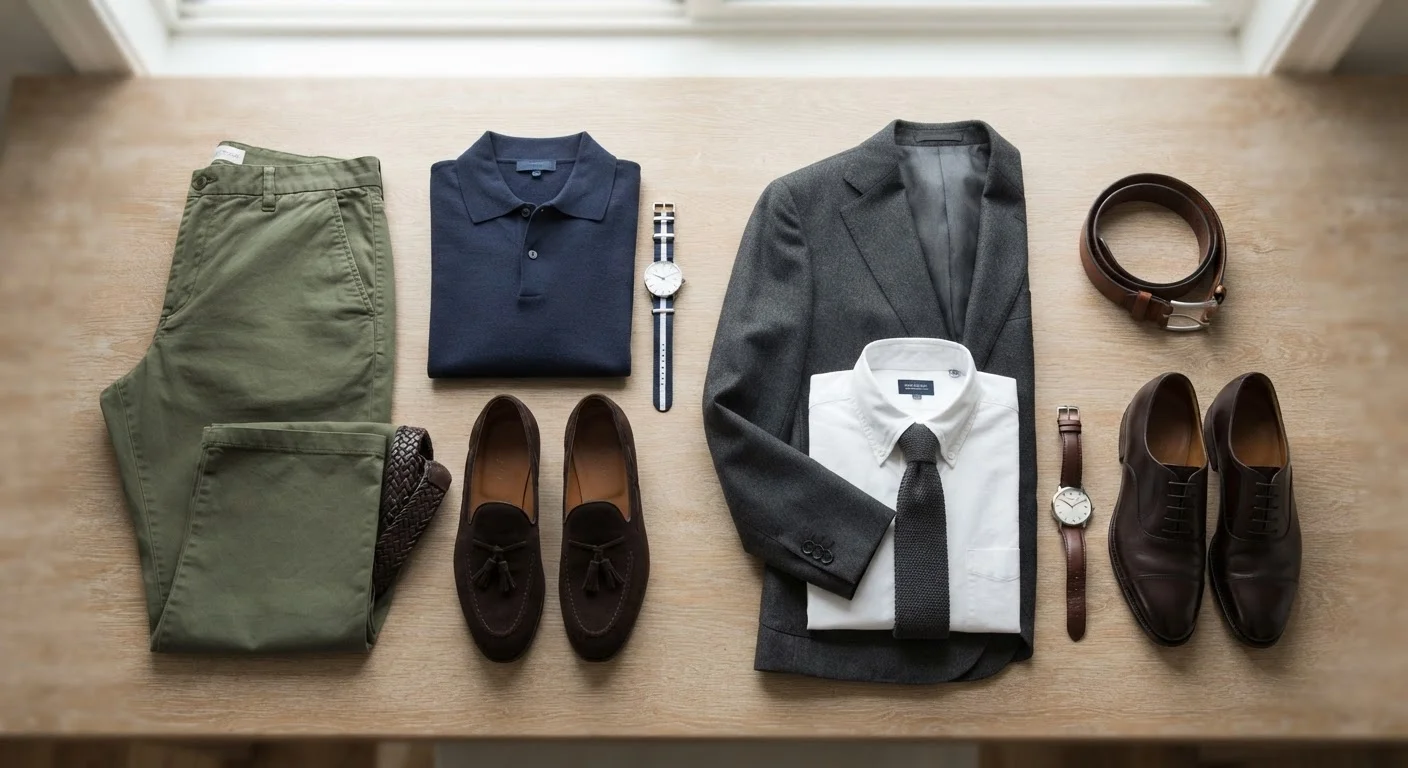
Key Takeaways
- Smart casual prioritizes a put-together look without strict professional rules - it's polished but relaxed.
- Business casual is defined by the workplace context and leans toward professional-appropriate clothing.
- Both dress codes sit below formal attire but differ meaningfully in formality and setting.
- Blazers and tailored trousers can work for both, but sneakers and jeans read differently depending on the code.
- When in doubt about which applies, err toward the more formal interpretation of the dress code given.
Option A
Smart Casual
The polished-but-relaxed everyday standard.
Best for: Social events, casual dining, creative workplaces, and any occasion where you want to look intentional without being overly formal.
Option B
Business Casual
The professional middle ground between suits and jeans.
Best for: Office environments, client meetings, interviews at non-corporate companies, and professional networking events.
If you're heading to a Friday evening dinner or rooftop event
Smart Casual
Smart casual gives you more expressive freedom - a nice blouse, dark jeans, and clean loafers hit exactly the right note without looking like you came from the office.
If you're attending a client presentation or office interview
Business Casual
Business casual signals professional credibility. Tailored trousers, a button-down, and polished shoes communicate readiness and respect for the professional setting.
If your workplace describes itself as 'business casual'
Business Casual
Treat business casual as the baseline and observe what colleagues and leadership actually wear - workplace norms vary significantly by industry and company culture.
If you're attending a casual wedding or garden party
Smart Casual
Smart casual is the most common invitation code for semi-relaxed social events. A sundress, linen trousers, or a sport coat without a tie all work well here.
The Core Difference: Context Is Everything
Both dress codes occupy the comfortable middle ground between jeans-and-a-tee and a full suit - which is exactly why they get confused. The key distinction comes down to context: one is rooted in social settings, the other in professional ones.
Smart casual is a social dress code. It signals that an occasion is more elevated than everyday casual, but doesn't demand the structure of formal or professional attire. Think of it as intentional - every piece looks chosen rather than grabbed.
Business casual is a workplace dress code. It asks you to look professional and appropriate for a work environment without going full suit-and-tie. The guardrails are set by the professional context, not personal style expression.
Knowing which context you're dressing for solves most of the confusion before you even open your closet. For a broader overview of occasion-specific expectations, see our occasion dressing reference guide.
| Criterion | Smart Casual | Business Casual |
|---|---|---|
| Primary setting | Social events, casual dining | Office, professional meetings |
| Jeans | Dark, well-fitted - usually yes | Often excluded; context-dependent |
| Sneakers | Clean leather/suede - often fine | Generally too casual |
| Blazer | Optional but elevates the look | Frequently expected or appreciated |
| Tie required | No | No |
| Formality level | Between casual and semi-formal | Between casual and formal/business |
| Expressive leeway | Higher - personality encouraged | Moderate - professionalism first |
What Each Dress Code Actually Allows
Here's where the real nuance lives - in the specific garments each code tends to welcome or exclude.
Smart Casual
- Dark or well-fitted jeans are generally acceptable, especially paired with elevated tops or blazers.
- Clean leather or suede sneakers often work - but beat-up athletic shoes typically don't.
- Casual dresses and skirts are a strong fit, particularly in relaxed fabrics like linen or cotton.
- Unstructured blazers add just enough polish over a simple shirt or blouse.
Business Casual
- Chinos or dress trousers are the standard; jeans are a gray area and often excluded unless the company culture explicitly allows them.
- Collared shirts, blouses, and button-downs are the expected top layer.
- Closed-toe dress shoes or smart flats are typical; sneakers are usually too casual.
- A sport coat or blazer is often optional but frequently elevates the look appropriately.
The overlap zone - blazer over a neat shirt with tailored pants - works for both dress codes, which is what makes a few versatile wardrobe staples genuinely useful. Our guide to classic vs. trendy pieces explores which items offer the most flexibility across dress codes.
~50%
U.S. workers in business casual environments
Surveys by workplace research organizations have consistently found that business casual is the most common dress code policy across American offices, particularly post-pandemic.
3-5
Versatile pieces to cover both dress codes
Style experts generally suggest a small core of well-fitted transitional pieces - a blazer, tailored trousers, a crisp button-down - covers the majority of smart casual and business casual situations.
Common Mistakes - and How to Avoid Them
Most dress code missteps come from defaulting to one interpretation when the other was expected. A few patterns show up repeatedly:
- Treating smart casual as just casual: Ripped jeans, graphic tees, and flip-flops don't clear the bar. The word "smart" is doing real work here.
- Treating business casual as business formal: A full suit to a business casual office can feel out of place. The lack of a tie is intentional, not an oversight.
- Ignoring industry norms: Business casual at a law firm and business casual at a design agency can look quite different. When starting a new job, observe before assuming.
- Forgetting fit: Either dress code looks stronger when clothes fit well. A well-fitted casual outfit consistently reads as more intentional than an ill-fitting formal one.
When the Invitation Doesn't Specify
If you receive an invitation with no dress code listed, consider the venue and time of day as your guide. An evening event at a restaurant or bar typically implies smart casual at minimum. A daytime work function with no code noted usually defaults to business casual. If you're genuinely unsure, asking the host or checking with a colleague is always a reasonable move - most people appreciate the care.
If you're experimenting with how color can reinforce or undercut a polished look, our color in everyday dressing guide breaks it down accessibly.