

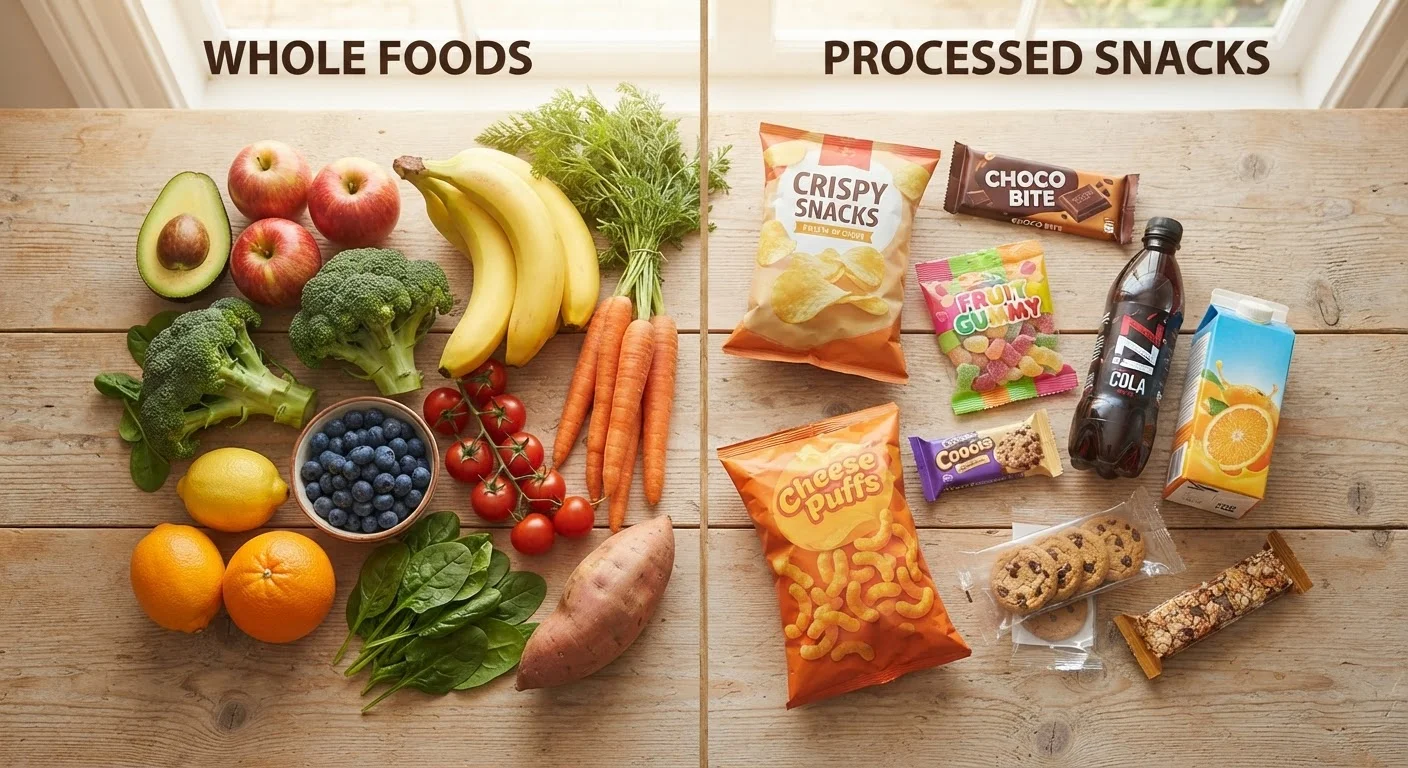
Key Takeaways
- Natural sugars come packaged with fiber, vitamins, and minerals that slow absorption and add nutritional value.
- Added sugars provide calories but little to no accompanying nutritional benefit.
- The FDA requires nutrition labels to list added sugars separately so consumers can track intake.
- Health guidelines suggest limiting added sugars, not the natural sugars found in whole produce or dairy.
- The distinction matters because the full food matrix - not just the sugar molecule - determines health impact.
Option A
Natural Sugars
Sugars found inherently within whole, unprocessed foods.
Best for: Anyone eating whole fruits, vegetables, dairy, or legumes as part of a balanced diet.
Option B
Added Sugars
Sugars and syrups incorporated into foods during processing or preparation.
Best for: Understanding food labels, managing overall sugar intake, and making more informed packaged food choices.
If you're eating whole fruit and wondering whether to cut back
Natural Sugars
Whole fruit delivers fiber, vitamins, and antioxidants alongside its sugar, making it nutritionally very different from a sweetened snack. General dietary guidance does not recommend limiting whole fruit intake for most healthy adults.
If you're trying to reduce overall sugar consumption for better health
Natural Sugars
Targeting added sugars - found in sodas, sweetened yogurts, sauces, and packaged snacks - is where most experts recommend focusing. Swapping added-sugar sources for whole-food alternatives is a practical, evidence-supported starting point.
If you're scanning a nutrition label and want to know what to watch
Added Sugars
The 'Added Sugars' line on the Nutrition Facts label is the figure most closely tied to discretionary intake. Keeping it well within the daily recommended limit is a concrete, actionable target.
What Makes a Sugar 'Natural' or 'Added'?
Both natural and added sugars are composed of the same basic molecules - primarily glucose, fructose, and sucrose. At a chemical level, a gram of fructose from an apple and a gram of fructose from high-fructose corn syrup are structurally identical. So why does nutrition science treat them differently?
The answer lies in context, not chemistry. Natural sugars are those that occur inherently within an unprocessed food: the lactose in milk, the fructose in a peach, the sucrose in a raw beet. They arrive in your body alongside fiber, water, protein, vitamins, and minerals that are already present in the food. Added sugars, by contrast, are any sugars or caloric sweeteners - including honey, maple syrup, agave, corn syrup, and plain white sugar - that are introduced into a food during processing or preparation. They add sweetness and energy, but they typically arrive without the nutritional company that whole-food sugars bring.
This distinction is why added sugars are tracked separately on nutrition labels - regulators and nutrition scientists recognize that the surrounding food matrix fundamentally changes how the body handles sugar.
How the Food Matrix Changes Everything
When you eat a whole apple, the sugar it contains is bound up in a cellular structure rich in pectin and dietary fiber. That structure slows digestion, moderates how quickly glucose enters your bloodstream, and contributes to feelings of fullness. You also get vitamin C, potassium, and polyphenols. The sugar doesn't travel alone.
Drink an equivalent amount of sugar as apple juice - even 100% juice with no added sugar - and much of that fiber buffer is gone. The sugar enters your bloodstream more quickly. Drink a sugar-sweetened soda and there is no nutritional accompaniment at all: just calories and fluid.
| Criterion | Natural Sugars | Added Sugars |
|---|---|---|
| Origin | Inherent in whole foods | Added during processing or prep |
| Common sources | Fruit, milk, vegetables | Soda, baked goods, sauces, cereals |
| Nutritional companions | Fiber, vitamins, minerals | Typically few or none |
| Effect on blood sugar | Generally moderated by fiber | Can be more rapid without fiber buffer |
| Dietary guideline status | Not restricted for most healthy adults | Specific daily limits recommended |
| Appears on nutrition label | Included in 'Total Sugars' | Listed separately as 'Added Sugars' |
This is why whole-food sources of natural sugar are treated permissively in most dietary guidelines, while added sugars are the target of specific limits. The DGA and the American Heart Association both recommend limiting added sugars - not because sugar molecules are inherently toxic, but because high intakes of added sugars tend to displace more nutrient-dense foods and are associated with increased risk of weight gain, dental decay, and metabolic conditions. That said, all dietary decisions are highly individual - consult a registered dietitian if you have specific health concerns.
Understanding this also helps decode the numbers on a nutrition facts panel: total sugars minus added sugars equals the naturally occurring sugars in that product.
Practical Ways to Apply This Distinction
The most useful application of this knowledge is in everyday food choices - particularly when reading ingredient lists and nutrition labels.
17 tsp
Average daily added sugar intake for U.S. adults
According to CDC data, average American adults consume roughly 17 teaspoons of added sugar per day - well above the AHA's recommended ceiling of 6-9 teaspoons.
10%
Daily calorie limit from added sugars
The Dietary Guidelines for Americans recommend that added sugars account for less than 10% of total daily calories for adults and children over age 2.
~65%
Share of added sugars from beverages and snacks
Research published in nutrition surveillance studies consistently finds that sugar-sweetened beverages and sweet snacks account for the majority of added sugar intake in the U.S. diet.
- Look for the Added Sugars line on the Nutrition Facts label. The FDA mandated its inclusion so consumers have a meaningful figure to track, separate from naturally occurring sugars in dairy or fruit ingredients.
- Scan ingredient lists for sugar synonyms. Added sugars appear under dozens of names: dextrose, maltose, evaporated cane juice, fruit juice concentrate, brown rice syrup, and many others. If any of these appear in the first few ingredients, the product is likely high in added sugars.
- Don't equate "natural" with "low in added sugar." Honey and maple syrup are natural sweeteners, but once added to a food during production, they count as added sugars nutritionally - not natural sugars in the dietary-guidelines sense.
- Keep whole-food fruit and dairy in perspective. Most public health guidance does not call for reducing whole fruit or plain dairy consumption on the basis of their sugar content - the accompanying nutrients make them worthwhile trade-offs.
If you're working to understand how carbohydrates more broadly fit into your plate, the comparison between whole and refined grains follows the same underlying logic: processing removes the nutritional context that surrounds the energy-providing component.
This article is for general informational and educational purposes only and is not a substitute for personalized medical or nutrition advice. Speak with a qualified healthcare provider or registered dietitian for guidance specific to your health needs.