

Key Takeaways
- The American diner traces its roots to horse-drawn lunch wagons of the 1870s in New England.
- Prefabricated diner manufacturing boomed between the 1930s and 1960s, shaping their iconic look.
- Diners have historically served as democratizing spaces, welcoming workers, travelers, and diverse communities.
- Regional diner cultures vary significantly, from New Jersey's chrome palaces to Southern meat-and-three spots.
- Many diners today blend heritage aesthetics with updated menus reflecting changing American tastes.
Origins: From Lunch Wagon to Diner
The story of the American diner begins not in a building, but on wheels. In 1872, a Rhode Island entrepreneur named Walter Scott began selling sandwiches and coffee from a horse-drawn wagon to factory workers and newspaper employees working late shifts in Providence. That practical idea - bringing affordable, hot food to people who couldn't easily access a sit-down restaurant - planted the seed for what would become one of America's most beloved institutions.
By the 1890s, lunch wagons had multiplied across New England cities. Operators soon realized that stationary wagons drew complaints from local businesses and city officials, so many converted them into fixed structures. The earliest true diners - elongated, narrow, and often repurposed railroad cars - allowed owners to serve more customers and operate around the clock. The resemblance to railroad dining cars was both aesthetic and intentional: trains represented efficiency, modernity, and democratic access to food.
To understand what made the diner so distinctly American, it helps to first explore why Americans eat the way they do - geography, immigration, and industrial patterns all played a role in creating demand for fast, affordable, communal eating spaces.
The Golden Age of the American Diner
Between roughly the 1930s and 1960s, the diner entered its golden era. Manufacturers in New Jersey and other northeastern states began mass-producing prefabricated diner structures - gleaming stainless-steel buildings assembled off-site and delivered complete. Companies like the Silk City Diner Company and the O'Mahony Company shipped diners by flatbed truck across the country, making the format accessible to small-business owners who needed a turnkey operation.
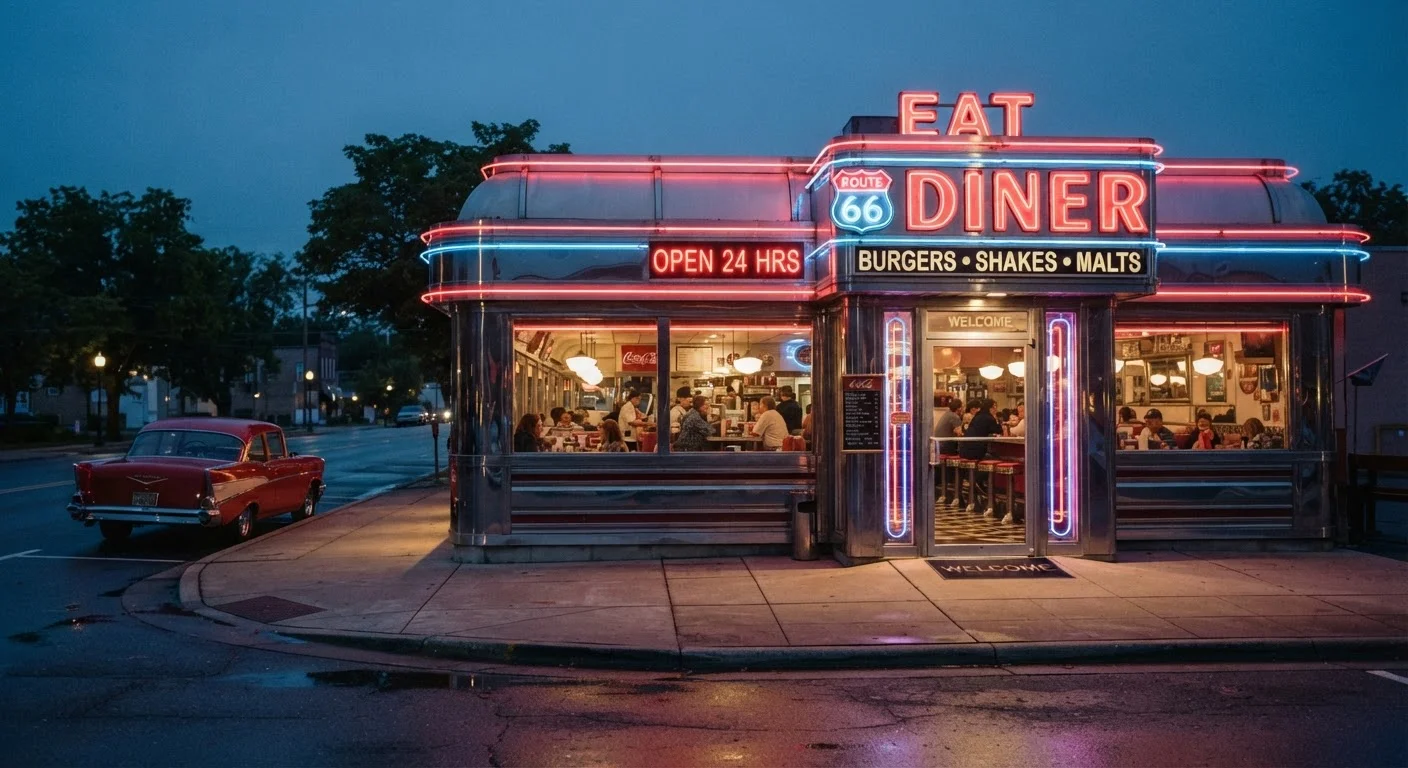
This era produced the visual vocabulary most Americans still associate with diners: chrome exteriors, neon signage, vinyl booths, Formica countertops, rotating pie displays, and a long counter with swivel stools. The post-World War II economic boom, the expansion of the American highway system, and the rise of car culture made roadside diners magnets for traveling families, long-haul truckers, and suburban commuters alike.
~6,000
Diners operating in the U.S. today
Industry observers estimate roughly 6,000 traditional diners remain open across the country, down from a peak of tens of thousands in the mid-20th century.
1872
Year the first lunch wagon appeared
Walter Scott's Providence, Rhode Island lunch wagon is widely credited as the direct ancestor of the American diner format.
New Jersey
State with the most diners per capita
New Jersey has long been recognized by food historians and travel writers as having the highest concentration of diners of any U.S. state.
The diner's menu during this period was unapologetically hearty: eggs cooked any style, blue plate specials, fresh-brewed coffee refilled without question, and slices of pie wide enough to satisfy. Prices remained accessible by design - the diner's identity was built on feeding ordinary people well.
What Makes a Diner a Diner
Despite decades of evolution, certain qualities define the diner as a category. Architectural historians and food writers generally point to a handful of consistent traits: a counter with stools that allows a short-order cook to work in full view of customers, a menu broad enough to serve breakfast all day alongside lunch and dinner staples, hours that extend into the early morning or run around the clock, and pricing that keeps the space genuinely accessible.
The open kitchen is especially significant. Unlike fine dining, where the kitchen is hidden, the diner makes cooking visible and performative. Regulars often know their cook by name and can watch their eggs being cracked. That transparency builds a kind of trust that more formal restaurants rarely replicate.
When evaluating a diner's quality, look at the pie case first. A well-maintained rotating display stocked with fresh, house-made pies is often the clearest signal that a kitchen takes pride in its work across the whole menu.
Pie requires consistent effort and signals kitchen discipline - it's a low-margin item that only survives on a menu when an operator genuinely cares about the craft.
Ask for the "blue plate special" or whatever the daily special is - even if it's not posted prominently. Diners that still run a rotating daily special are typically operating closer to their original mission of fresh, affordable cooking.
Daily specials require cooks to work with what's available and in season, reflecting the practical, waste-conscious ethos that defined early diner cooking.
It's worth noting that the word "diner" is sometimes used loosely to describe any casual, no-frills eatery. Purists distinguish between true diners - those with prefabricated origins or deliberate architectural homage - and generic diners that simply share a menu style. The distinction matters less to most customers than the experience itself.
The Diner's Role in American Social Life
The American diner has never been purely about food. At its best, it functions as a third place - somewhere between home and work - where people from different economic backgrounds sit side by side at the same counter. That egalitarian quality has cultural weight. A factory worker and a local attorney might both occupy stools at the same lunch counter, ordering the same $4 cup of coffee.
Diners have also served as sites of social history. During the Civil Rights Movement, lunch counters - many of them diner-style - became flashpoints for nonviolent protest. The 1960 Greensboro sit-ins, where Black college students requested service at a segregated Woolworth's lunch counter, illustrated how powerfully the diner's promise of democratic access could be inverted by discrimination, and how fiercely that promise was worth fighting for.
Immigrant communities have long shaped diner menus as well. Greek-American families became especially prominent diner operators throughout the mid-20th century, particularly in New York and New Jersey, weaving elements of their own culinary heritage into menus otherwise dominated by American standards. This blending echoes broader patterns explored in our look at how immigrant food changes when it crosses borders.
Decline, Revival, and Reinvention
The rise of fast-food chains in the 1970s and 1980s hit the independent diner hard. Franchised burger and breakfast chains offered standardized menus, lower prices in some markets, and heavy advertising that individual diner owners couldn't match. Many classic diners closed during this period, particularly in suburban areas where chain restaurants dominated newly built commercial strips.
Yet the diner proved resilient. A wave of nostalgia in the 1980s and 1990s - fueled partly by films and television that romanticized diner culture - helped stabilize many remaining establishments. More recently, a generation of chefs and restaurateurs has embraced the diner format as a canvas for culinary creativity, introducing locally sourced ingredients, expanded vegetarian options, and craft coffee programs while preserving the counter seating and all-day breakfast that define the genre.
This revival stands in interesting contrast to newer dining formats. Food halls have surged in American cities offering curated, vendor-driven experiences quite different from the diner's single-operator, full-menu model. Both reflect Americans' appetite for communal eating - just expressed differently across generations.
Not Every "Diner" Is the Real Thing
The word "diner" has been widely adopted as a marketing term by chain restaurants and fast-casual concepts that share little with the original format. If a diner is part of a national franchise, features a corporate menu with no daily specials, or lacks counter seating, it may use the name more as branding than as a description of heritage. Genuine independently owned diners, while harder to find, typically offer a meaningfully different experience.
Regional Variations Across America
No single diner looks or tastes the same coast to coast. New Jersey, often called the diner capital of the world, claims more diners per capita than any other state, and many of them are large, ornate establishments with menus running dozens of pages. The New York City coffee shop - a cousin of the classic diner - evolved its own hybrid identity serving Greek-American staples alongside BLTs and avocado toast.
In the South, the "meat-and-three" restaurant occupies a similar cultural niche: a counter-service institution offering a daily protein with a choice of several vegetable sides, served in a no-fuss environment at working-class prices. In the Midwest, small-town diners often anchor the main street, serving as gathering points for local farmers, retirees, and high school students in communities that may have few other public gathering spaces.
These regional flavors connect to the broader story of how communal eating rituals sustain identity across America - a theme that also emerges in traditions like the Sunday dinner, which similarly binds people through shared food and familiar surroundings. The American diner, in all its regional forms, endures because it meets a need that transcends menu trends: the simple human desire for a reliable place to eat, be recognized, and belong.