

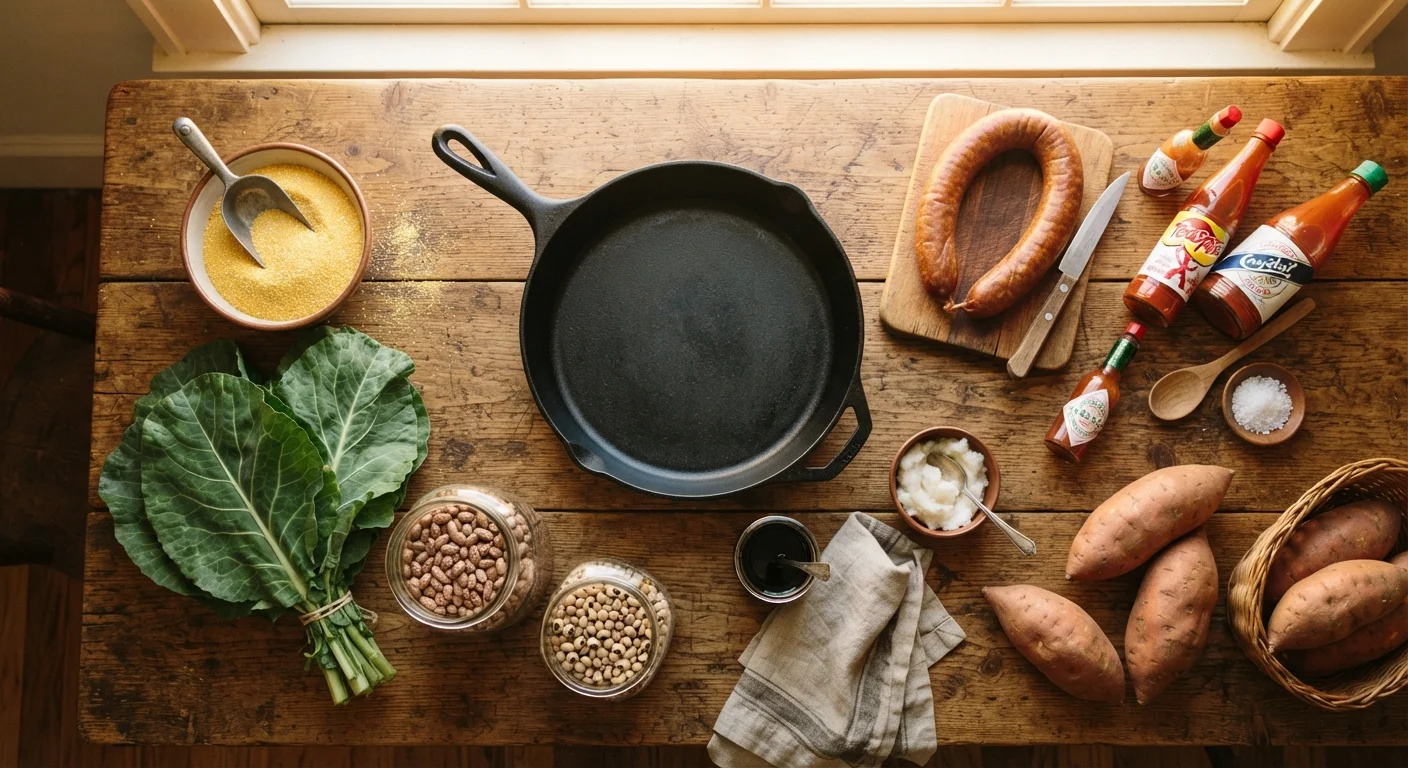
The Pantry Backbone: Grains, Legumes, and Fats
Southern cooking draws its character from a relatively small set of pantry staples that appear across hundreds of dishes. Understanding what these are - and why they matter - gives you a genuine window into one of America's most influential regional food traditions. For a broader look at how food culture has shaped American kitchens, see why Americans eat the way they do.
Cornmeal
Stone-ground cornmeal is the foundation of cornbread, hush puppies, and grits. In Southern cooking, cornmeal is almost always used without sweetener - a distinction that marks the regional style apart from Northern-style sweet cornbread. White cornmeal is traditional in many Deep South kitchens; yellow cornmeal is more common further north and west.
Dried Beans and Field Peas
Dried black-eyed peas, crowder peas, butter beans, and pinto beans have been staples since the colonial era, with roots in West African agricultural traditions. They are most commonly cooked low and slow with smoked pork, aromatics, and pot liquor (the flavorful cooking liquid). How aromatics shape flavor directly applies to this technique.
Lard and Bacon Fat
For generations, rendered pork fat was the primary cooking fat in Southern kitchens. Many cooks still keep a container of saved bacon drippings near the stove. These fats contribute a savory depth to everything from skillet cornbread to sautéed greens that vegetable oils alone cannot replicate.
Vegetables and Proteins That Define Southern Tables
Collard Greens and Leafy Cooking Greens
Collards, mustard greens, and turnip greens are among the most emblematic vegetables in Southern cuisine. They are typically braised for extended periods with smoked pork or ham hocks, onion, and a splash of apple cider vinegar. The pot liquor left behind is considered by many to be as valuable as the greens themselves - it is often sopped up with cornbread or drunk straight from the bowl.
Pot liquor
The nutrient-rich broth left over after cooking greens or beans with smoked pork. In Southern cooking, pot liquor is prized on its own or as a dipping liquid for cornbread.
Stone-ground cornmeal
Cornmeal produced by grinding dried corn between two stones, preserving more of the grain's germ and hull. It has a coarser texture and fuller flavor than steel-milled alternatives.
Field peas
A broad category of legumes - including black-eyed peas, crowder peas, and zipper peas - historically grown in Southern fields and central to the region's traditional diet.
Fatback
A cut of salt-cured or fresh pork fat taken from the back of the pig. Used in small quantities to season beans, greens, and other slow-cooked Southern dishes.
Mucilaginous
Having a thick, gel-like quality when cooked. Okra is the most commonly cited mucilaginous vegetable in Southern cooking, where this property acts as a natural thickener in gumbo and stews.
Country ham
A dry-cured, often smoked ham leg traditional to the American South. Produced through salt-curing over weeks or months, it has an intensely salty, concentrated flavor distinct from wet-cured ham.
Okra
Okra, likely introduced through the West African slave trade, appears in gumbo as a thickener, fried as a side dish, and stewed with tomatoes. Its natural mucilaginous (gel-forming) quality is central to the body of many Creole and Cajun soups and stews.
Sweet Potatoes
Sweet potatoes have been grown throughout the South for centuries and are used in savory and sweet applications alike - roasted as a side, mashed into casseroles, and baked into pies. They are nutritionally dense and historically were a critical crop for both subsistence and commercial farming in the region.
Smoked and Cured Pork
Smoked ham hocks, salt pork, fatback, and country ham are used less as primary proteins and more as seasoning agents throughout Southern cooking. A small amount cooked into a pot of beans or greens imparts smokiness, salinity, and richness. This approach to "seasoning meat" reflects a tradition of using the whole animal economically and flavorfully. For practical guidance on building a well-stocked kitchen, see stocking a flexible pantry.