

Why the Distinction Matters
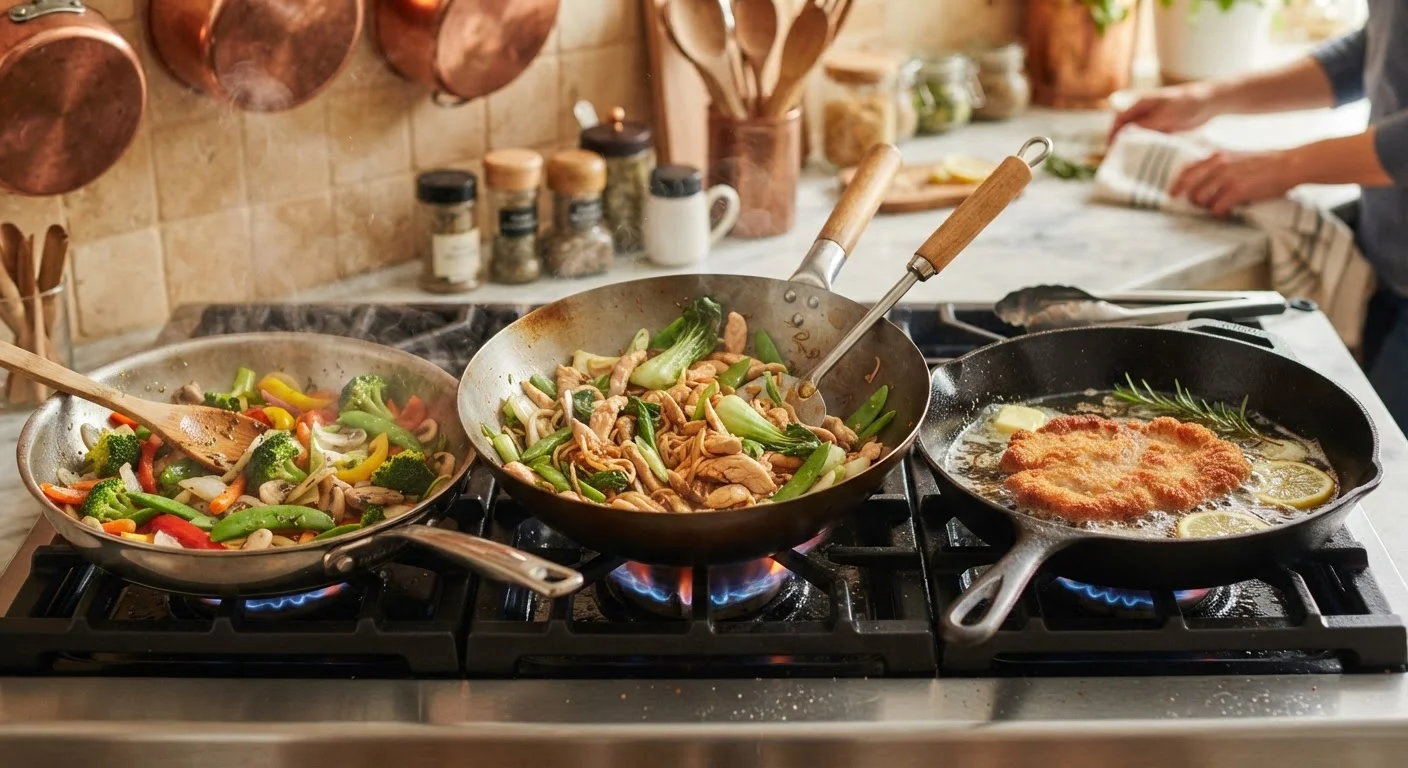
Sautéing, stir-frying, and pan-frying all involve a hot pan and fat, yet each produces meaningfully different textures, flavors, and results. Mixing them up is one of the most common reasons home-cooked food turns out soggy, unevenly cooked, or bland. Once you understand what separates these three methods, you can match the right technique to any ingredient and get consistently better results.
Heat level, fat quantity, the size of your ingredients, and how often you move them - these four variables define each method. See the quick reference below, then read on for the details that make each one work.
Sautéing: Fast Heat, Minimal Fat, Frequent Tossing
Sautéing (from the French sauter, meaning "to jump") uses medium-high to high heat, a thin film of fat, and near-constant motion. The goal is to cook small, uniform pieces of food quickly while developing a light golden color without deep browning or crisping. Think sliced mushrooms, diced onions, shrimp, or tender strips of chicken breast.
The pan should be hot before the food goes in. If you crowd the pan, the temperature drops and the food steams rather than sautés - this is where many cooks go wrong. Work in batches if needed, and keep ingredients moving steadily. A wide, shallow skillet works best; heavy-bottomed pans like stainless steel distribute heat evenly and give you good control. Choosing between cast iron and stainless steel comes down to what you're cooking and the heat response you need.
Sautéing is also a flavor-building step. A well-sautéed aromatics base - onion, garlic, celery - is the foundation of countless sauces and braises. For tips on building flavor at every stage, see our guide on seasoning throughout the cooking process.
Stir-Frying: Extreme Heat, Very Little Fat, Constant Motion
Stir-frying shares DNA with sautéing but operates at a significantly higher temperature - often as hot as your home burner will go - and demands near-nonstop stirring or tossing. The technique originates in Chinese cooking and is designed for a wok, whose sloped, thin walls concentrate intense heat at the base while allowing food to be tossed up the cooler sides.
That extreme heat creates what cooks call wok hei - a slightly smoky, charred aroma that you cannot replicate at lower temperatures. Ingredients must be cut small and uniformly, completely dry before they hit the pan (any moisture causes steaming and kills the char), and added in a sequence based on cook time - dense vegetables first, proteins next, leafy greens last.
Because everything happens in 60 to 90 seconds, mise en place - having every ingredient prepped and within arm's reach - is non-negotiable. Stir-frying rewards preparation and penalizes improvisation.
Sautéing
A dry-heat cooking method using a small amount of fat over medium-high to high heat, with frequent movement of food in the pan. Best for small, tender cuts that cook quickly.
Stir-frying
A high-heat method originating in Chinese cooking that uses a wok or wide pan and requires constant motion. Produces a lightly charred, smoky quality in food known as wok hei.
Pan-frying
A dry-heat method using moderate heat and enough fat to partially submerge the food. Food is placed undisturbed to develop a crispy crust, then flipped once.
Wok hei
A Cantonese term meaning 'breath of the wok.' It refers to the slightly smoky, charred flavor and aroma that develops when food is cooked at very high heat in a seasoned wok.
Mise en place
A French culinary term meaning 'everything in its place.' It refers to the practice of prepping and organizing all ingredients before cooking begins - essential for fast techniques like stir-frying.
Pan-Frying: Moderate Heat, More Fat, Minimal Movement
Pan-frying uses significantly more fat than the other two methods - typically enough to come a third to halfway up the side of the food - and a lower, steadier heat. The goal is a deeply browned, crispy exterior while the interior cooks through gently. Classic examples include pan-fried pork chops, chicken cutlets, fish fillets, and crab cakes.
The key here is patience and stillness. Unlike sautéing or stir-frying, you do not keep food moving. You place it in hot fat, leave it undisturbed until a golden crust forms, then flip once. Flipping too early tears the crust; flipping too often prevents it from forming at all. A heavy pan - cast iron is a popular choice - holds heat steadily through the cold shock of the food and helps develop an even sear.
Pan-frying is not deep-frying. Deep-frying fully submerges food in oil; pan-frying does not. This distinction matters for both technique and the final texture of the finished dish.
Understanding these dry-heat stovetop methods also helps you know when a different approach entirely - like braising - is the better fit. Our article on stovetop vs. oven braising explains when low-and-slow wet heat beats any of these fast, dry-heat options.
Choosing the Right Method
Use this as your decision guide:
- Small, tender pieces needing quick color → Sauté
- Thin strips or small cuts needing smoky char in seconds → Stir-fry
- Larger, flatter pieces needing a crispy crust all the way through → Pan-fry
Each method is also sensitive to fat. The role fat plays in cooking goes beyond just preventing sticking - it transfers heat, carries flavor, and contributes to texture in ways that change depending on how much you use and how hot it gets.
Mastering these three techniques gives you a reliable toolkit for the stovetop. Once you can identify which method fits your ingredient, your confidence in the kitchen grows quickly - and so does the quality of the food you put on the table.