

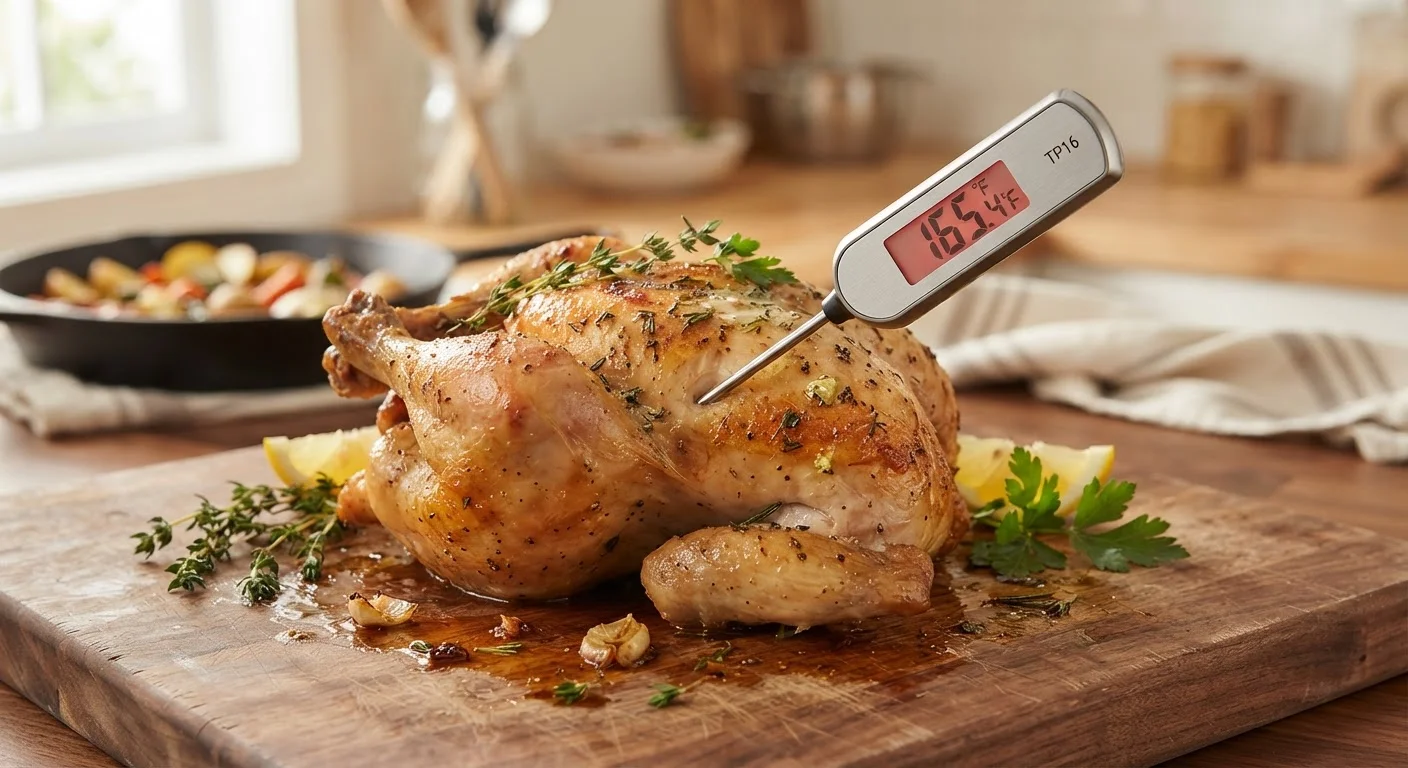
| Minimum safe temp - whole poultry | 165°F (74°C) (USDA Food Safety and Inspection Service) |
| Minimum safe temp - whole cuts of beef/pork/lamb | 145°F (63°C) + 3-min rest (USDA Food Safety and Inspection Service) |
| Minimum safe temp - ground meats (beef, pork, lamb) | 160°F (71°C) (USDA Food Safety and Inspection Service) |
| Minimum safe temp - fish and shellfish | 145°F (63°C) (USDA Food Safety and Inspection Service) |
| Bacterial danger zone | 40°F - 140°F (4°C - 60°C) (USDA FoodSafety.gov) |
| Safe temp for reheated leftovers | 165°F (74°C) (USDA Food Safety and Inspection Service) |
Why Internal Temperature Is the Real Measure of Doneness
Color, texture, and timing are useful cues, but none of them reliably tell you whether a piece of meat is safe to eat or cooked to its best quality. Internal temperature does both. A digital instant-read thermometer removes the guesswork and is one of the most practical investments a home cook can make.
The temperatures below reflect guidelines from the USDA and are widely recognized as the standard for food safety in American home kitchens. Note that "doneness" and "safety" sometimes differ - for example, a medium-rare steak is considered safe by current USDA standards for whole muscle beef, but ground beef requires a higher temperature to eliminate pathogens that may have been introduced during grinding.
For a fuller picture of how heat works in cooking beyond food safety, see our guide to salt, fat, acid, and heat.
| Minimum safe temp - whole poultry | 165°F (74°C) (USDA Food Safety and Inspection Service) |
| Minimum safe temp - whole cuts of beef/pork/lamb | 145°F (63°C) + 3-min rest (USDA Food Safety and Inspection Service) |
| Minimum safe temp - ground meats (beef, pork, lamb) | 160°F (71°C) (USDA Food Safety and Inspection Service) |
| Minimum safe temp - fish and shellfish | 145°F (63°C) (USDA Food Safety and Inspection Service) |
| Bacterial danger zone | 40°F - 140°F (4°C - 60°C) (USDA FoodSafety.gov) |
| Safe temp for reheated leftovers | 165°F (74°C) (USDA Food Safety and Inspection Service) |
Temperature Reference: Proteins, Poultry, Seafood, and Eggs
Use the table below as a quick lookup. Always insert your thermometer into the thickest part of the protein, away from bone, fat, or gristle, which can give misleading readings.
| Food | Safe Internal Temp | Notes |
|---|---|---|
| Whole poultry (chicken, turkey, duck) | 165°F (74°C) | Check thigh, not breast |
| Ground poultry | 165°F (74°C) | Applies to patties and meatballs |
| Whole cuts of beef, pork, lamb, veal | 145°F (63°C) | Rest 3 minutes before cutting |
| Ground beef, pork, or lamb | 160°F (71°C) | No rest time required |
| Ham (fresh/uncooked) | 145°F (63°C) | Rest 3 minutes |
| Ham (pre-cooked, reheating) | 140°F (60°C) | - |
| Fish and shellfish | 145°F (63°C) | Flesh should be opaque and flake easily |
| Eggs and egg dishes | 160°F (71°C) | Yolk and white should be firm |
| Casseroles and leftovers | 165°F (74°C) | Stir and recheck center |
Internal temperature
The temperature measured at the center of the thickest part of a food, used to determine whether it is safe to eat and cooked to the desired level of doneness.
Carryover cooking
The continued rise in internal temperature that occurs after food is removed from a heat source. This effect is more pronounced in large, dense cuts of meat.
Rest time
A period of standing after cooking during which juices redistribute and carryover cooking completes. The USDA recommends a minimum 3-minute rest for whole cuts of beef, pork, lamb, and veal.
Instant-read thermometer
A handheld probe thermometer that displays a temperature reading within a few seconds of insertion. It is not designed to remain in food during cooking, unlike probe or oven-safe thermometers.
Danger zone
The temperature range between 40°F and 140°F (4°C-60°C) in which bacteria multiply rapidly. Food should not remain in this range for more than 2 hours total (1 hour above 90°F ambient temperature).
This guide is for general informational purposes. Always verify current food safety guidance with official sources such as USDA FoodSafety.gov, as recommendations may be updated over time.
How to Take a Temperature Reading Accurately
Even a reliable thermometer gives a bad reading if used incorrectly. Follow these steps every time:
- Insert at the right spot. Place the probe tip in the thickest part of the meat, avoiding bone, fat, and the pan surface. For burgers and thin cuts, insert from the side rather than the top.
- Wait for the reading to stabilize. Most digital thermometers register within 2-5 seconds. Don't pull it out too soon.
- Check multiple spots. Large roasts and whole birds can have uneven heat distribution. Take readings in two or three places.
- Account for carryover cooking. Proteins continue cooking after leaving the heat source. For large roasts, you can pull the meat 5-10°F below the target and let it rest, tented loosely with foil. For poultry and ground meat, always confirm the final temperature after resting before serving.
Building these habits becomes second nature quickly. Pair temperature awareness with solid foundational technique - our end-to-end home cooking guide covers workspace setup, heat management, and more.