

Key Takeaways
- The pinch grip is the single most important hand position for control and safety.
- A sharp knife is consistently safer than a dull one - dull blades require more force and slip more often.
- Mastering just four cuts covers the vast majority of everyday prep work.
- Consistent knife technique reduces prep time and leads to more even cooking.
- You don't need a large knife collection - one well-maintained chef's knife goes a long way.
Start here
Why Knife Skills Matter More Than You Think
Build the base
Your Grip and Stance: The Foundation
Core techniques
The Four Cuts Every Cook Should Know
Stay safe
Keeping Your Knife Safe and Sharp
Apply it
Putting It All Together in Real Cooking
Why Knife Skills Matter More Than You Think
Reaching for a food processor or pre-cut vegetables is tempting - but it often costs more money, more cleanup, and sometimes results in uneven textures that affect how a dish cooks. Learning to use a knife well is one of the highest-return investments a home cook can make.
Even cooking relies on uniform pieces. When vegetables are cut to different sizes, smaller pieces burn before larger ones finish - a frustrating result that better technique prevents. Beyond cooking quality, confident knife handling speeds up prep considerably once the basics become habit.
This guide is part of our broader end-to-end kitchen confidence guide. Whether you're just getting started or looking to tighten up existing habits, these fundamentals are worth building on.
Pinch grip
A knife-holding technique where you pinch the blade between your thumb and index finger for better control and reduced wrist fatigue.
Claw grip
A hand position for the food-holding hand where fingers curl inward, protecting fingertips while guiding the knife with your knuckles.
Honing
Using a honing steel to realign a knife's edge without removing metal - done frequently to maintain sharpness between sharpenings.
Mise en place
A French culinary term meaning 'everything in its place' - the practice of prepping and organizing all ingredients before cooking begins.
Julienne
A knife cut that produces thin, uniform matchstick-shaped strips, commonly used for stir-fries and salads.
Dice
A knife cut producing uniform cube-shaped pieces, typically used for vegetables that need to cook evenly.
Your Grip and Stance: The Foundation
Before any cutting technique makes sense, you need two things in place: how you hold the knife and how you hold the food.
The Pinch Grip
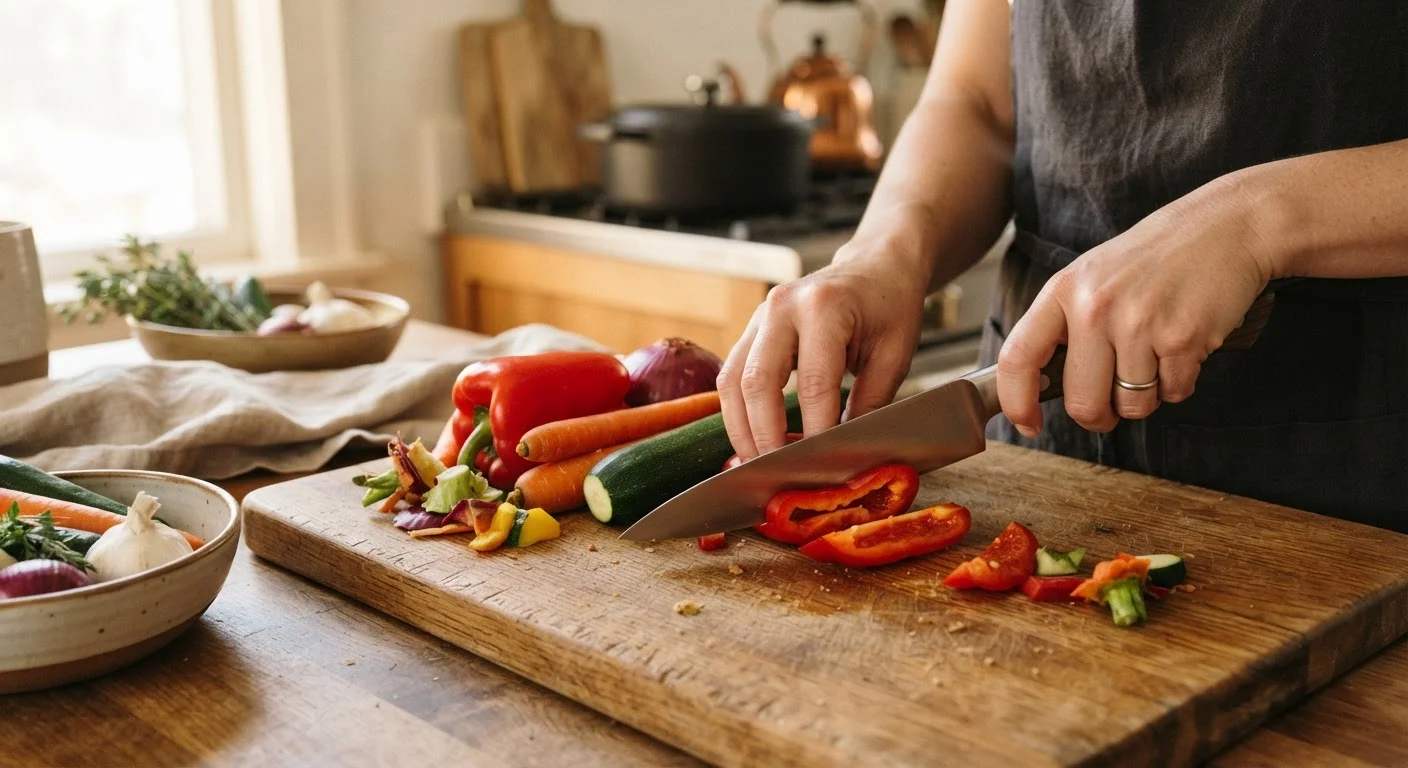
Grip the blade itself - not just the handle - by pinching the flat sides of the blade between your thumb and the side of your index finger, right where the blade meets the handle. Wrap your remaining fingers around the handle. This grip feels unfamiliar at first but provides far more control than a full-handle grip, and reduces fatigue during longer prep sessions.
The Claw Grip
Use your non-knife hand to hold food with fingers curled inward - knuckles facing forward, fingertips tucked safely back. The flat of the blade rests against your knuckles as a guide. This protects your fingertips and gives you consistent control over cut thickness.
Pair these grips with a stable cutting board. Place a damp towel or non-slip mat underneath to prevent sliding - a board that moves is a genuine hazard.
Stabilize Your Board First
Place a damp kitchen towel or non-slip mat under your cutting board before you start. A board that shifts mid-cut is one of the most common causes of kitchen accidents. This simple step takes two seconds and makes a real difference in control and confidence.
The Four Cuts Every Cook Should Know
You don't need a culinary school vocabulary - just a working understanding of the cuts you'll use constantly.
Slice
A basic slice moves the blade forward and down in a single smooth motion. Use it for proteins, bread, tomatoes, and most vegetables. Let the weight of the blade do the work - pushing down hard is a sign the knife needs sharpening.
Dice
Dicing produces uniform cubes. For an onion: halve it through the root, make horizontal cuts parallel to the board, then vertical cuts from tip to root, then crosscuts. The root holds the layers together until the final cuts - a trick worth practicing.
Julienne
Julienne cuts produce thin matchstick strips - useful for stir-fries, salads, and garnishes. Start by squaring off the vegetable, then slice it into planks, and cut those planks into thin strips. Consistency matters more than speed here.
Mince
Mincing reduces garlic, herbs, or ginger to very fine pieces. Chop roughly first, then use a rocking motion - keeping the knife tip on the board while the heel rocks down repeatedly - to work through the pile until pieces are uniformly small.
These four techniques cover the bulk of what's needed for everyday recipes. If you're working toward more efficient weekly prep, our batch cooking guide builds directly on these skills.
Keeping Your Knife Safe and Sharp
Knife safety isn't just about cutting carefully - it also includes how you store, maintain, and handle the tool itself.
- Never leave knives loose in a drawer where the edge contacts other utensils. A magnetic strip or knife block protects the blade and prevents accidental cuts when reaching in.
- Wash knives by hand. Dishwashers expose blades to harsh detergents and rattling that dull edges and damage handles over time.
- Hone before you use it. A honing steel realigns the microscopic edge of a knife blade without removing metal. A few passes before each session keeps the edge performing between sharpenings.
- Sharpen a few times a year. A whetstone or pull-through sharpener removes a small amount of metal to reset the edge. If slicing a ripe tomato requires pressure, the knife likely needs sharpening.
Proper knife care also connects to broader kitchen safety habits. For additional household safety context, see home safety guidance.
A Dull Knife Is a Riskier Knife
It might seem counterintuitive, but a dull blade requires more force to cut through food - and that extra force is what causes the knife to slip. If you're pressing hard to get through a carrot or tomato, your knife likely needs sharpening before your next use. Regular maintenance isn't just about performance; it's a safety habit.
Putting It All Together in Real Cooking
The goal isn't perfection - it's building enough consistency that prep feels less like a chore. Start with forgiving vegetables like zucchini, carrots, or potatoes before moving to trickier items like shallots or butternut squash.
Practice a single technique during one meal rather than trying to apply everything at once. Dice the onion carefully. Julienne the carrots for a salad. Mince the garlic by hand instead of reaching for a press. Small deliberate repetitions build muscle memory faster than occasional ambitious sessions.
Good knife skills also compound with other kitchen habits. A well-organized prep station - paired with a well-stocked pantry - means you spend less mental energy on logistics and more on actually cooking.
Once your cuts are consistent and your mise en place is dialed in, you'll find that techniques that stretch a grocery budget - like using whole vegetables rather than pre-cut - become much more appealing and practical.