

Key Takeaways
- Coastal towns typically offer slower paces, lower crowds, and closer connection to local character.
- Major beach cities provide more amenities, nightlife, dining variety, and organized activities.
- Budget, travel style, and trip length are the most useful filters for choosing between the two.
- Neither option is universally better - the right choice depends on what you want to feel on vacation.
- Many travelers find value in combining both types in a single trip.
Our Verdict
Coastal towns and major beach cities both deliver an ocean backdrop, but the experience around that backdrop is strikingly different. Coastal towns reward travelers seeking quiet, authenticity, and affordable simplicity, while major beach cities suit those who want variety, energy, and plenty of infrastructure. Knowing what you want from a trip - not just where you want to go - is the real deciding factor.
| Best for | Recommended |
|---|---|
| Travelers seeking rest, local flavor, and off-the-beaten-path charm | Coastal Towns |
| Those who want nightlife, diverse dining, and packed activity schedules | Major Beach Cities |
| Families with young children needing accessible amenities and services | Major Beach Cities |
| Budget-conscious travelers willing to trade convenience for character | Coastal Towns |
What Actually Separates These Two Trip Types
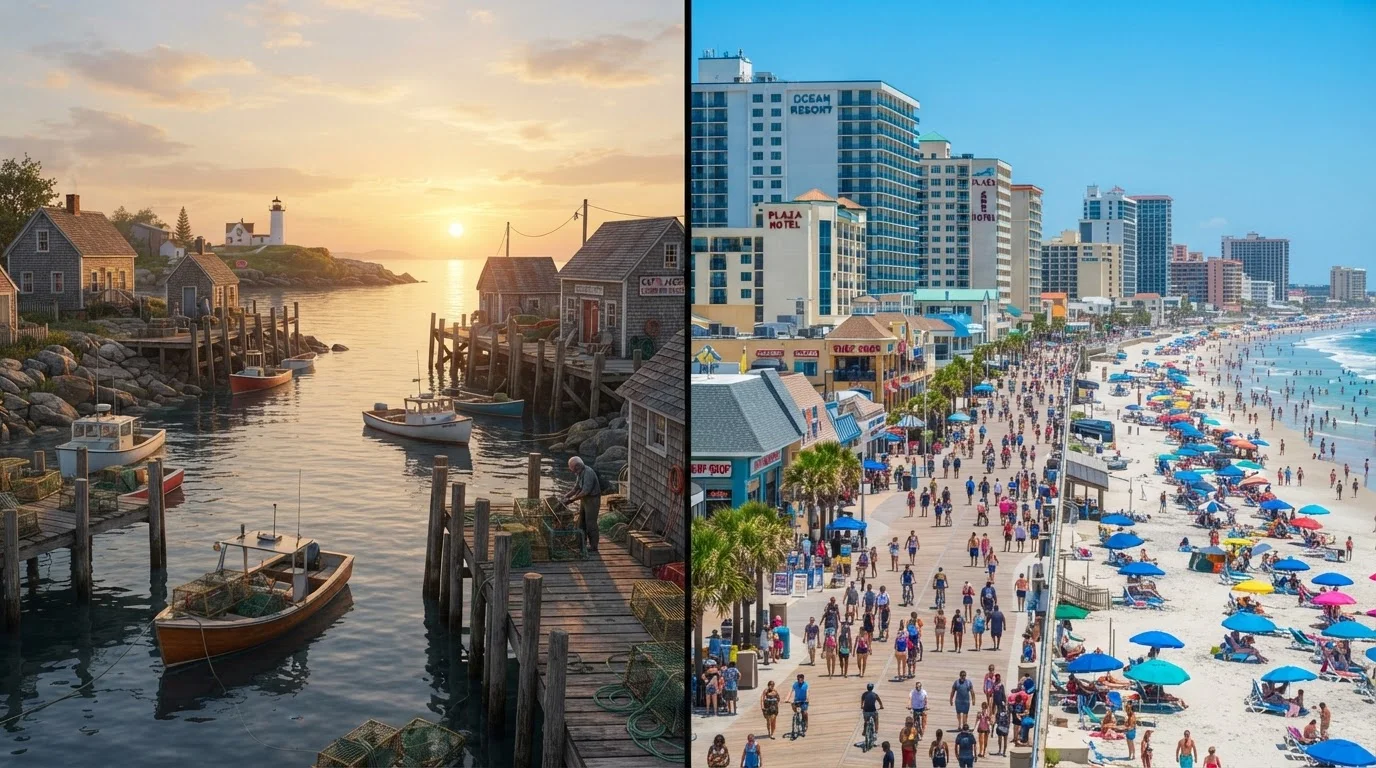
The distinction isn't simply about size. A coastal town might have a beautiful beach and a handful of restaurants, but the rhythm of daily life there is shaped by fishing cycles, tides, and longtime residents rather than tourism infrastructure. A major beach city, by contrast, has built its identity around welcoming visitors at scale - think wide boardwalks, resort hotels, rental shops on every corner, and a nightlife scene that doesn't quiet down until well after midnight.
Think of the difference this way: in a coastal town, you're a guest in someone else's community. In a major beach city, the community has largely organized itself around guests like you. Neither experience is inherently better, but they produce very different feelings by the end of a week. Before you start booking, it helps to work through the key questions that sharpen destination choices.
The Case for a Quiet Coastal Town
Smaller coastal communities tend to offer something harder to find at crowded resort destinations: a sense of place that hasn't been smoothed out for tourist consumption. You'll find local seafood shacks that have been operating for generations, independently owned inns, and beaches where you can actually spread out. Mornings feel unhurried, and evenings often center around a porch, a dock, or a meal that doesn't require a reservation made weeks in advance.
Costs tend to be lower overall, particularly for accommodation and dining - though this varies significantly by region and season. Travelers who prefer nature immersion, independent exploration, and a genuine break from urban stimulation generally find coastal towns more restorative. The tradeoff is real, though: fewer restaurants means fewer choices, public transit is often nonexistent, and some towns essentially close up after Labor Day.
Match the Destination to Your Travel Style
Before committing to either option, think honestly about what you want to feel by day three - rested and unplugged, or stimulated and active. Your honest answer will point you more reliably toward the right destination than any list of amenities. If you're still unsure, our guide on city breaks vs. nature escapes offers a helpful parallel framework.
If you're weighing a nature-focused escape against something more urban, our guide on city breaks vs. nature escapes can help you think through what type of traveler you actually are.
The Case for a Major Beach City
Major beach cities earn their popularity by solving problems. Flights often go directly there. Hotels range from budget-friendly to luxury. When it rains, there's a museum, an aquarium, or an indoor market to absorb the afternoon. When the sun returns, beach chair rentals, surf lessons, and guided boat tours are all a short walk from your hotel. For families with children, this predictability has real value.
The dining and entertainment variety in a large beach city can also be a genuine draw - particularly for groups with different tastes or travelers who want a beach trip that doesn't feel purely like a retreat. The downside is congestion. Peak-season crowds, inflated prices, and the feeling that you're sharing every experience with thousands of strangers can undercut the relaxation you came for. Solo travelers especially may find the logistics of a major beach city less freeing than expected - see how solo and group travel planning differ for more context.
| Coastal Towns | Major Beach Cities | |
|---|---|---|
| Crowd levels | Generally low to moderate | High, especially in peak season |
| Dining variety | Limited, often locally focused | Wide range of cuisines and price points |
| Accommodation options | Inns, B&Bs, vacation rentals | Hotels, resorts, hostels, rentals |
| Typical cost level | Often lower overall | Varies widely; can be high in peak season |
| Nightlife & entertainment | Minimal; community-centered | Robust; bars, venues, organized events |
| Best trip length | Long weekend to one week | Weekend to extended stay |
| Accessibility (transit/flights) | Often requires a car | Usually well-connected by air and transit |
How to Make the Call for Your Trip
Three questions tend to cut through the indecision quickly. First, how much structure do you want? If the answer is very little, a coastal town fits naturally. If you want itinerary options and fallback plans, a beach city provides them. Second, who's coming? Couples and solo travelers often thrive in quieter settings; larger groups or families with varied interests tend to benefit from more options. Third, how long is the trip? A long weekend often suits the simplicity of a smaller town; a full week may feel limiting without the variety a bigger destination offers.
It's also worth noting that these categories aren't mutually exclusive. Some travelers base themselves in a coastal town and day-trip to a nearby city for a dinner or attraction. If you're juggling multiple stops, the multi-city trip planning guide lays out how to sequence that kind of itinerary without overcomplicating it.
Whatever you decide, the most useful reframe is this: pick the environment that supports the version of yourself you want to be for those days - not the one that looks best in photos.