

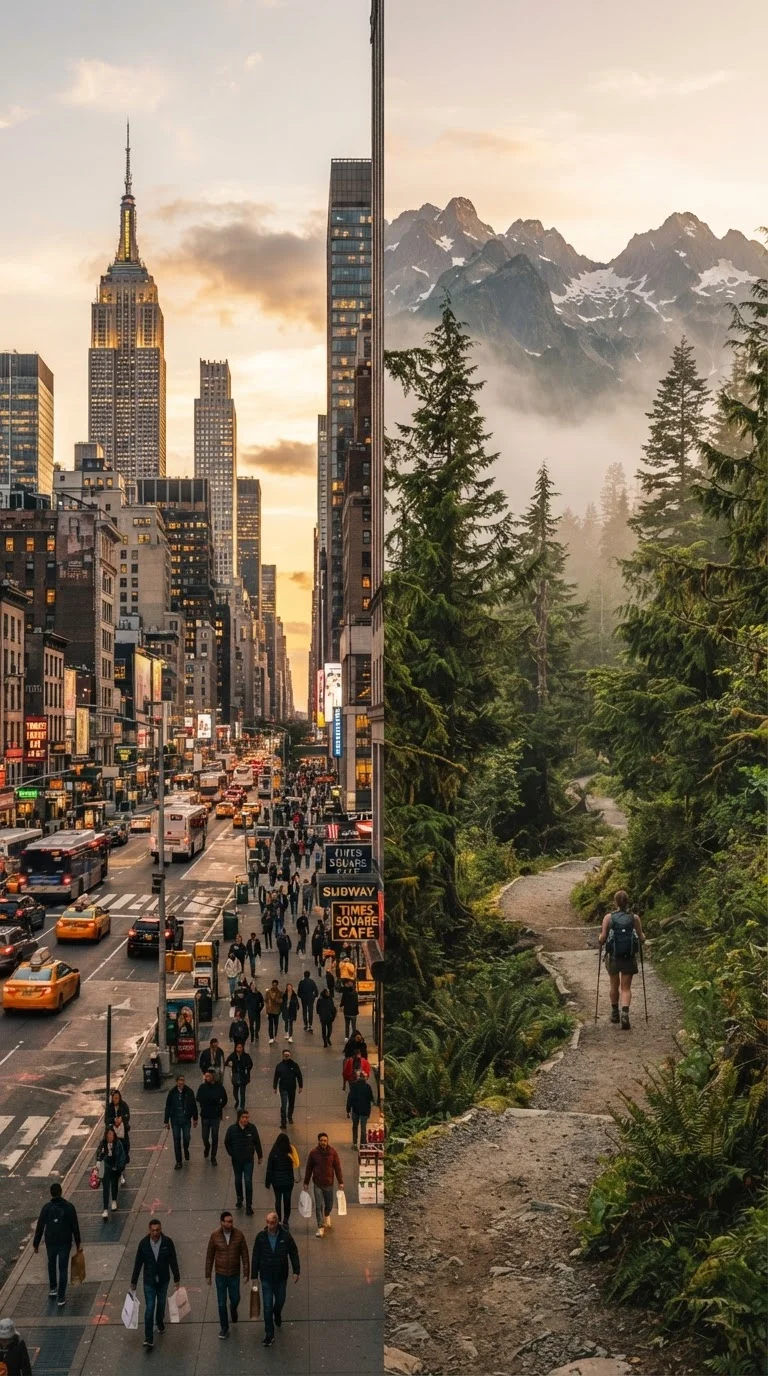
Key Takeaways
- City breaks offer cultural density and convenience; nature escapes offer restoration and physical engagement.
- Your current energy level and daily routine are strong signals for which trip style will actually recharge you.
- Budget differences are real but not always dramatic - gear, permits, and remote lodging can add up outdoors.
- Neither style is inherently superior; matching the trip to your goals matters more than following trends.
- Hybrid options exist, such as national park gateway towns, that blend both experiences.
Option A
City Break
The culturally rich, always-on urban getaway.
Best for: Travelers who want museums, food scenes, nightlife, and dense experiences packed into a short trip.
Option B
Nature Escape
The restorative, slow-paced wilderness retreat.
Best for: Travelers seeking fresh air, physical activity, solitude, and a genuine break from screens and schedules.
If you spend most days at a desk and crave sensory variety
City Break
Urban environments offer constant novelty - food, architecture, art, and neighborhoods - providing strong contrast to a routine office life.
If you feel overstimulated, burned out, or digitally fatigued
Nature Escape
Time in natural settings has been associated with reduced stress and improved mood; a nature trip removes the noise rather than adding to it.
If you have a very short window - a long weekend or less
City Break
Cities are logistically efficient; most attractions, transit, and restaurants are concentrated, so you can see and do more with less travel time between stops.
If physical activity and fresh air are priorities for this trip
Nature Escape
Hiking, kayaking, cycling, or simply walking through wild terrain delivers exercise and immersion that most cities cannot replicate.
If you want flexibility and are unsure which fits
Nature Escape
Gateway towns near national parks and forests often blend access to trails with the comfort of restaurants and accommodations - a practical middle ground.
What Each Trip Style Actually Delivers
A city break is fundamentally about density. In 48 to 72 hours, a traveler can move between neighborhoods, try several cuisines, visit world-class museums, and catch live performances - all without renting a car. The appeal is variety and efficiency. Urban infrastructure handles the logistics, leaving you free to be curious.
A nature escape works differently. The value isn't volume - it's depth and contrast. Whether you're hiking a canyon trail, camping beside a lake, or cycling through forest roads, the experience is about slowing your pace and engaging your senses in a fundamentally different environment. For many people, that contrast with ordinary life is the actual destination.
Understanding what each trip actually delivers - rather than what the Instagram version promises - is the first honest step in choosing. See our questions to ask before choosing a travel destination to clarify your priorities before you start booking.
| Criterion | City Break | Nature Escape |
|---|---|---|
| Primary appeal | Culture, food, variety | Restoration, fresh air, activity |
| Typical trip length | 2-4 days works well | 3-7 days for full benefit |
| Advance planning required | Moderate | Higher (permits, gear, weather) |
| Physical demand | Low to moderate (walking) | Moderate to high (varies by activity) |
| Cell/internet access | Reliable throughout | Often limited or absent |
| Budget predictability | Easier to estimate in advance | Gear and permits add variability |
| Best season flexibility | Year-round in most cities | Strongly seasonal in many areas |
Reading Your Own Signals
The most reliable guide to which trip style fits you right now isn't a personality quiz - it's your current daily life. Ask yourself: what does your average week look like? If your days are loud, screen-heavy, socially demanding, and schedule-driven, adding more stimulation via a packed city itinerary may leave you more drained than rested. A nature escape, with enforced unplugging and physical movement, might be what your nervous system actually needs.
Conversely, if your life is quiet, repetitive, or isolated - remote work with limited social interaction being a common example - a city break can feel genuinely invigorating. New faces, unexpected street scenes, and spontaneous restaurant discoveries become genuinely exciting rather than exhausting.
It's also worth considering your travel companions. Solo and group travel each demand a different planning mindset - and a nature escape with mismatched fitness levels or comfort preferences can create friction that a city trip, with its built-in optionality, tends to handle more gracefully.
87%
Americans who say nature improves their mood
A survey by the American Psychological Association found the vast majority of respondents reported mental health benefits from spending time outdoors.
3-4 days
Average U.S. domestic trip length
According to the U.S. Travel Association, the typical American leisure trip is a short getaway, making both city breaks and accessible nature destinations practical options.
Practical Differences: Budget, Logistics, and Pacing
Budget comparisons between city breaks and nature escapes are less clear-cut than most people assume. City trips carry visible costs: hotels in urban centers, dining out for every meal, museum admissions, and transit fees. Nature trips can appear cheaper on the surface, but gear costs, national park fees, backcountry permits, and remote lodging (which often commands a premium) can close that gap quickly.
Logistics differ significantly. Cities are forgiving - if you miss one thing, there's always another. Nature settings often require advance planning: trailhead permits, equipment checks, weather contingencies, and awareness of cell coverage gaps. If you tend to overload your itinerary, a city trip may actually be the lower-stress option; see why overplanning can undermine any trip for a broader look at this pattern.
Pacing is perhaps the sharpest difference. Nature escapes impose a natural rhythm - sunrise, weather windows, trail length - that city breaks don't. For some travelers, that structure is freeing. For others, it feels restrictive. Knowing which camp you fall into is genuinely useful information before you book.
When the Answer Is 'Both': Hybrid Destinations
The city-versus-nature framing assumes a binary choice, but geography often blurs it. Many American destinations sit at the intersection of both worlds. Towns near national parks - places like Asheville, North Carolina, or Bend, Oregon - offer walkable downtowns with independent restaurants, arts scenes, and comfortable accommodations, while trails and wilderness areas are within easy driving distance.
This hybrid option suits travelers who want restorative outdoor time without fully abandoning urban comfort. It also works well for groups with different preferences, since one person can hike while another browses a farmers market. If this appeals to you, the difference between coastal towns and major beach cities follows similar logic and is worth reading alongside this guide.
Whatever you decide, give yourself room to adapt once you arrive. Pre-booking gives certainty; flexibility lets you adapt - and neither approach is universally correct. The most satisfying trips tend to be the ones planned to match who you are right now, not who you think you should be as a traveler.