

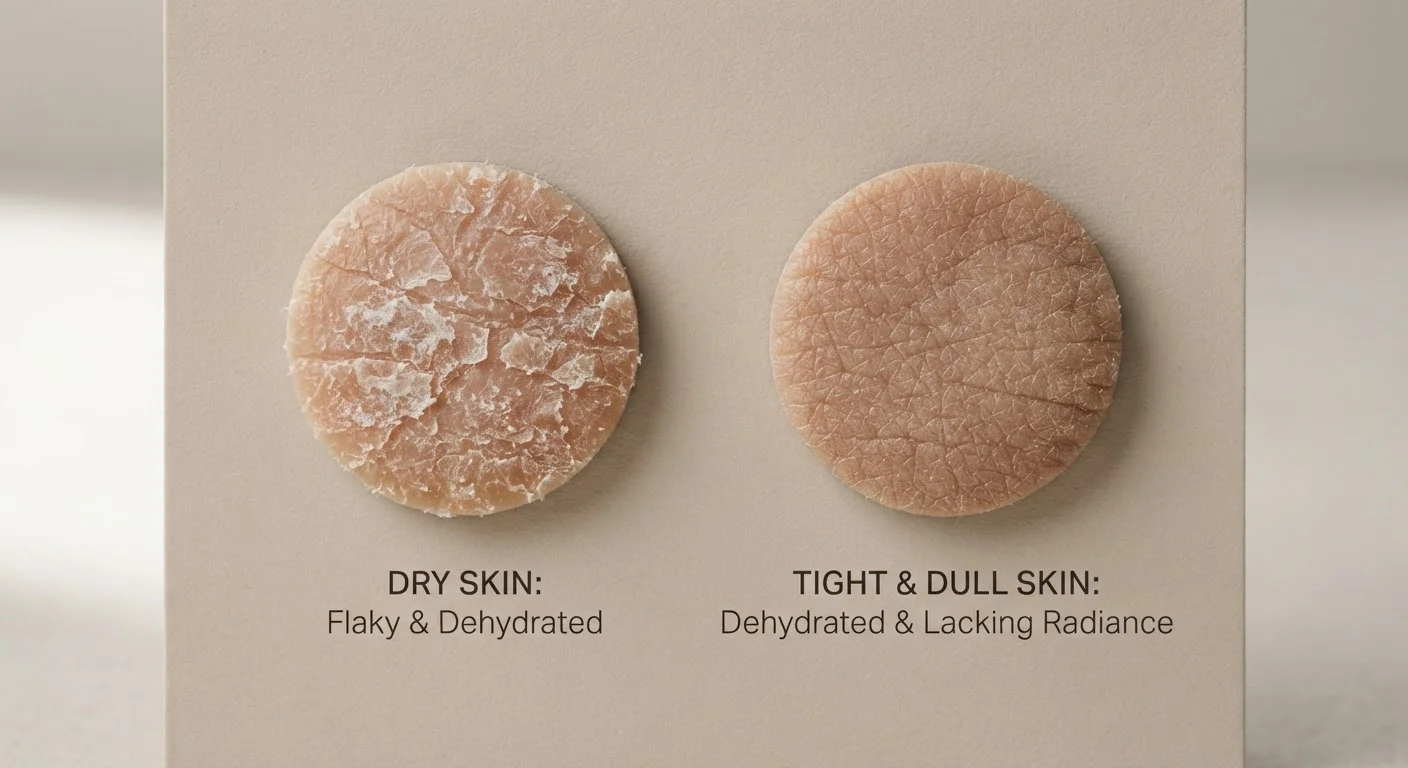
Key Takeaways
- Dry skin is a skin type involving low oil production; dehydrated skin is a temporary condition involving low water content.
- Even oily skin types can experience dehydration - the two issues are not mutually exclusive.
- Dry skin responds best to oil-based emollients and occlusives; dehydrated skin calls for humectants that attract water.
- A simple pinch test can help you distinguish surface dehydration from chronic dryness.
- Environmental factors like low humidity, hot showers, and over-exfoliation are common drivers of skin dehydration.
- Consulting a dermatologist is worthwhile if dryness or irritation is persistent or accompanied by other symptoms.
Option A
Dry Skin
A skin type defined by insufficient natural oil production.
Best for: Understanding if you were born with naturally low sebum output and need long-term oil-replenishing strategies.
Option B
Dehydrated Skin
A temporary skin condition caused by a lack of water in the skin.
Best for: Diagnosing short-term tightness, dullness, or sensitivity triggered by lifestyle, environment, or routine missteps.
If your skin always feels rough and flaky regardless of season or hydration habits
Dry Skin
Persistent low-oil production is a constitutional skin type, not a temporary condition. Focus on emollient-rich moisturizers and gentle, non-stripping cleansers long-term.
If tightness and dullness appear suddenly after travel, weather changes, or a new product
Dehydrated Skin
These are hallmark signs of water loss from external triggers. Adding humectants and reducing harsh actives often resolves the issue within days.
If you have oily or combination skin but still notice tight, congested patches
Dehydrated Skin
Oily skin can absolutely be dehydrated. Stripping cleansers or over-exfoliation are frequent culprits - hydrating serums address the real problem without adding unwanted shine.
If you want to build a long-term routine that prevents both issues
Dry Skin
Start with dry skin fundamentals - barrier support and oil replenishment - then layer in hydration strategies as needed based on seasonal or lifestyle shifts.
The Core Difference: Oils vs. Water
Dry skin and dehydrated skin are often used interchangeably, but dermatologists draw a clear line between them. Dry skin is a skin type - meaning it's largely determined by genetics and how much sebum (natural oil) your skin produces. People with dry skin tend to have it consistently, across all seasons, and often notice it in other areas like elbows and shins, not just the face.
Dehydrated skin, by contrast, is a skin condition - a temporary state in which the skin lacks sufficient water in its outer layer, the stratum corneum. Unlike a skin type, this can affect anyone, including people with oily or combination skin, and it can come and go depending on environment, lifestyle, and routine choices.
This distinction isn't just semantic. It directly shapes what your skin actually needs. Oil-deficient skin requires ingredients that replace and seal in lipids. Water-deficient skin needs humectants - ingredients like glycerin or hyaluronic acid that draw moisture into skin cells. Applying a rich, occlusive cream to dehydrated oily skin can clog pores without solving the real problem; adding a light hydrating serum to dry skin won't provide the barrier repair it needs.
| Criterion | Dry Skin | Dehydrated Skin |
|---|---|---|
| Classification | Skin type (genetic, long-term) | Skin condition (temporary) |
| Root cause | Low sebum (oil) production | Insufficient water in stratum corneum |
| Who it affects | People with naturally low oil output | Any skin type, including oily |
| Common triggers | Genetics, age, certain health conditions | Weather, hot showers, over-exfoliation, diet |
| Key ingredients needed | Emollients, ceramides, occlusives | Humectants (glycerin, hyaluronic acid) |
| Duration | Ongoing - requires consistent management | Resolves when triggers are addressed |
How to Tell Which One You Have
Because both conditions can cause tightness and a dull appearance, self-diagnosis takes a little detective work. A commonly referenced field test is the skin pinch test: gently pinch a small section of skin on your cheek or forearm and release. Skin that snaps back immediately is generally well-hydrated; skin that holds the pinch for a moment before returning to flat may be dehydrated. This isn't a clinical diagnostic tool, but it can offer a useful starting clue.
Look at the full picture, too. Chronically flaky, rough texture that persists through all seasons and doesn't improve with drinking more water points more toward dry skin as a type. Sudden tightness after a long flight, switching to a foamy cleanser, or spending time in cold winter air leans toward dehydration as a condition. You can also have both simultaneously - dry skin that becomes dehydrated in winter is very common.
~50%
Adults reporting some degree of dry or sensitive skin
Population surveys cited in dermatology literature consistently estimate that roughly half of adults experience dry or sensitive skin at some point.
15-20%
Water content threshold for healthy stratum corneum
Dermatologists generally consider the outer skin layer adequately hydrated when its water content stays above 10-15%; below that, barrier function begins to decline.
If you're unsure or if symptoms are severe (intense itching, cracking, or inflammation), a board-certified dermatologist can give you a reliable assessment and rule out conditions like eczema or psoriasis that can mimic dryness.
Building the Right Routine for Each
For dry skin as a type, the priority is replenishing lipids and protecting the skin barrier. Look for cleansers that don't strip natural oils - cream or oil-based formulas tend to work better than foaming ones. In moisturizers, emollients (like ceramides, shea butter, and squalane) fill in the microscopic gaps between skin cells, while occlusives (like petrolatum) form a seal that prevents moisture from escaping. Using these consistently matters more than the exact product you choose.
For dehydrated skin as a condition, humectants are the backbone of recovery. Hyaluronic acid, glycerin, and panthenol all attract water to the skin's surface. The key nuance: humectants work best when there's moisture available to draw from, so applying them to slightly damp skin and following with a moisturizer to seal them in gives better results than applying them alone to very dry conditions.
Both groups benefit from a gentle routine overall. Over-exfoliation is a surprisingly common driver of dehydration - it disrupts the skin barrier and accelerates water loss. If you use chemical exfoliants, understanding how AHAs, BHAs, and PHAs differ can help you choose one that works with, not against, your skin's current state. And since skin does significant repair work overnight, your evening routine is a particularly good place to focus barrier-support efforts.
It's also worth knowing that skin needs shift over time. Skin changes with each decade, and a routine that served you well at 25 may not meet the same needs at 45. Periodic reassessment keeps your approach effective as your skin evolves.
This article is for general informational purposes only and is not a substitute for professional medical or dermatological advice. If you have persistent skin concerns, please consult a qualified healthcare professional.