

Key Takeaways
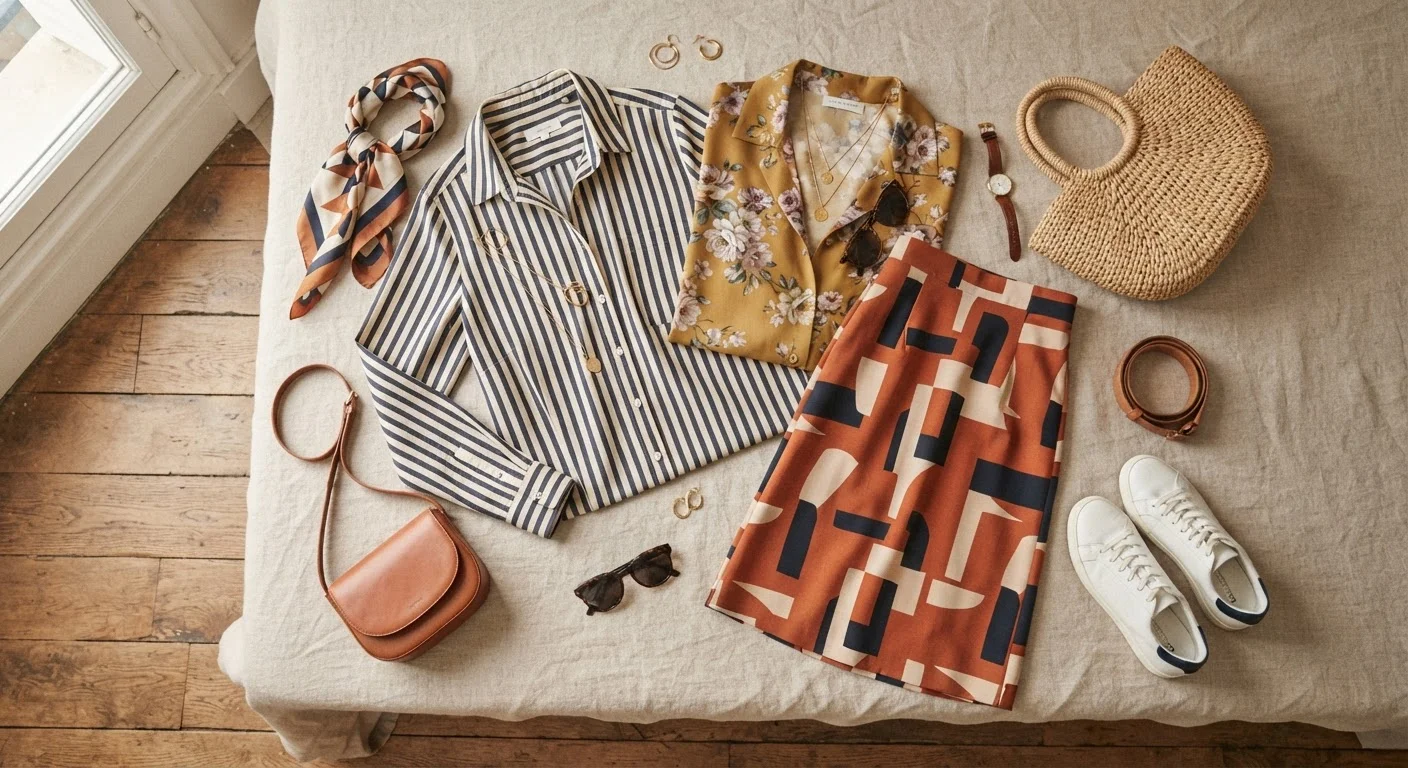
- Vary the scale of prints - pairing a large pattern with a small one prevents visual competition.
- Anchor mixed patterns with a shared color to create cohesion across an outfit.
- Solids act as breathing room, reducing the chaos when two bold prints feel like too much.
- Stripes function almost like a neutral and mix well with most other prints.
- When in doubt, keep the mix to two patterns and let accessories do the rest.
Why Pattern Mixing Feels Risky - and Why It Doesn't Have to Be
Most of us were quietly taught that matching means safe - solid top, solid bottom, done. So the idea of wearing florals with stripes, or plaids with polka dots, can feel like stepping off a ledge. But pattern mixing is actually one of the more forgiving style skills once you understand the logic behind what makes combinations click.
The goal isn't to follow a formula. It's to understand why some combinations feel harmonious and others feel like visual static. Once you see the underlying principles, you can apply them intuitively - and stop second-guessing yourself in the mirror every morning.
Color plays a big role in this, too. Our guide to using color in everyday dressing explains how to identify a shared palette - a skill that directly supports confident pattern mixing.
The Practices That Make Pattern Mixing Work
These aren't rigid rules - think of them as principles that give you a starting point and the confidence to experiment from there.
Vary the scale of your prints deliberately
When two patterns sit at the same visual weight - say, a medium floral and a medium check - they compete for attention and create noise. Pairing a large-scale print with a small-scale one gives each pattern its own role: one leads, one supports.
Find a shared color between the two prints
Color is the invisible thread that ties patterns together. When both prints share even one color - a background tone, an accent - the combination reads as intentional rather than accidental.
Use stripes as your mixing anchor
Stripes are highly versatile because they have a clear geometric structure that doesn't compete with organic patterns like florals or paisleys. They function almost like a patterned neutral - providing interest without overwhelming.
Insert a solid piece as visual breathing room
When two patterns feel like too much, a solid piece between them - a belt, a tucked layer, a jacket - acts as a visual pause. It gives the eye a place to rest and lets each print have its moment.
Keep patterns in the same general mood or era
Prints carry a visual personality - structured geometric patterns feel modern and angular, while vintage florals feel romantic and soft. Mixing prints that share a general aesthetic mood helps an outfit feel cohesive even when the patterns are technically quite different.
When Mixing Goes Wrong - and How to Spot It
Pattern mixing fails most often when two prints compete at the same scale with no shared color and no visual rest between them. The eye doesn't know where to land, and the outfit reads as busy rather than bold. Seasonal mismatches can also cause friction - a heavy tartan plaid next to a breezy tropical print sends conflicting signals that feel more confused than creative.
Pattern Mixing Has No Hard Rules
Style guidelines are starting points, not laws. Some of the most compelling outfits break every scale and color principle described here. The difference is usually intentionality - the wearer knows what they're doing and commits to it fully. Uncertainty reads differently in a mirror than confidence does, so when you're experimenting, lean in rather than hedge.
The fix is usually simple: swap one print for a solid in a color already present in the other pattern. That single change can rescue almost any combination that's tipping into chaos. Learning to recognize when an outfit is one element away from working - versus fundamentally mismatched - is the most useful pattern-mixing skill you can develop.
If you want to build a wardrobe where pattern-friendly pieces integrate naturally with timeless staples, our piece on balancing classic and trendy pieces walks through exactly that kind of thinking.
Quick Wins: Start Mixing Patterns Today
You don't need a wardrobe overhaul to start experimenting. These small steps let you test the principles right away with what you already own.