

Key Takeaways
- Mental wellness challenges shift in character and intensity at each major life stage.
- Young adults face identity formation and financial stress; midlife adults carry compounding responsibilities.
- Older adults show surprising emotional resilience but face distinct risks like grief and isolation.
- Core wellness habits - sleep, connection, and self-awareness - remain foundational at every age.
- Knowing when stress has crossed a line is key; professional support is appropriate at any stage.
Why Mental Wellness Isn't One-Size-Fits-All
Mental wellness is not a fixed destination - it's a moving target shaped by biology, life circumstances, relationships, and the particular pressures of each decade. A 24-year-old navigating their first independent apartment faces fundamentally different emotional demands than a 55-year-old caring for aging parents while managing a career plateau, or a 70-year-old adapting to retirement and the loss of close friends.
Understanding how psychological needs change across the lifespan helps people recognize what's normal, spot warning signs earlier, and find support that actually fits their situation. Just as skin care routines adapt with age, mental wellness strategies benefit from the same kind of life-stage awareness. For a plain-language grounding in key wellness concepts, the wellness vocabulary reference is a useful companion to this guide.
50%
Adults who develop a mental health condition by age 14
The World Health Organization estimates that half of all lifetime mental health conditions begin by the mid-teens, underscoring how early patterns are established.
1 in 5
U.S. adults experiencing a mental illness in any given year
According to the National Institute of Mental Health, approximately 20% of American adults are affected by a mental health condition annually.
26%
Older adults with depression who are diagnosed and treated
Research suggests depression in adults over 65 is significantly underdiagnosed, with a large proportion going untreated due to atypical presentation.
Young Adulthood (Ages 18-35): Identity, Pressure, and Transition
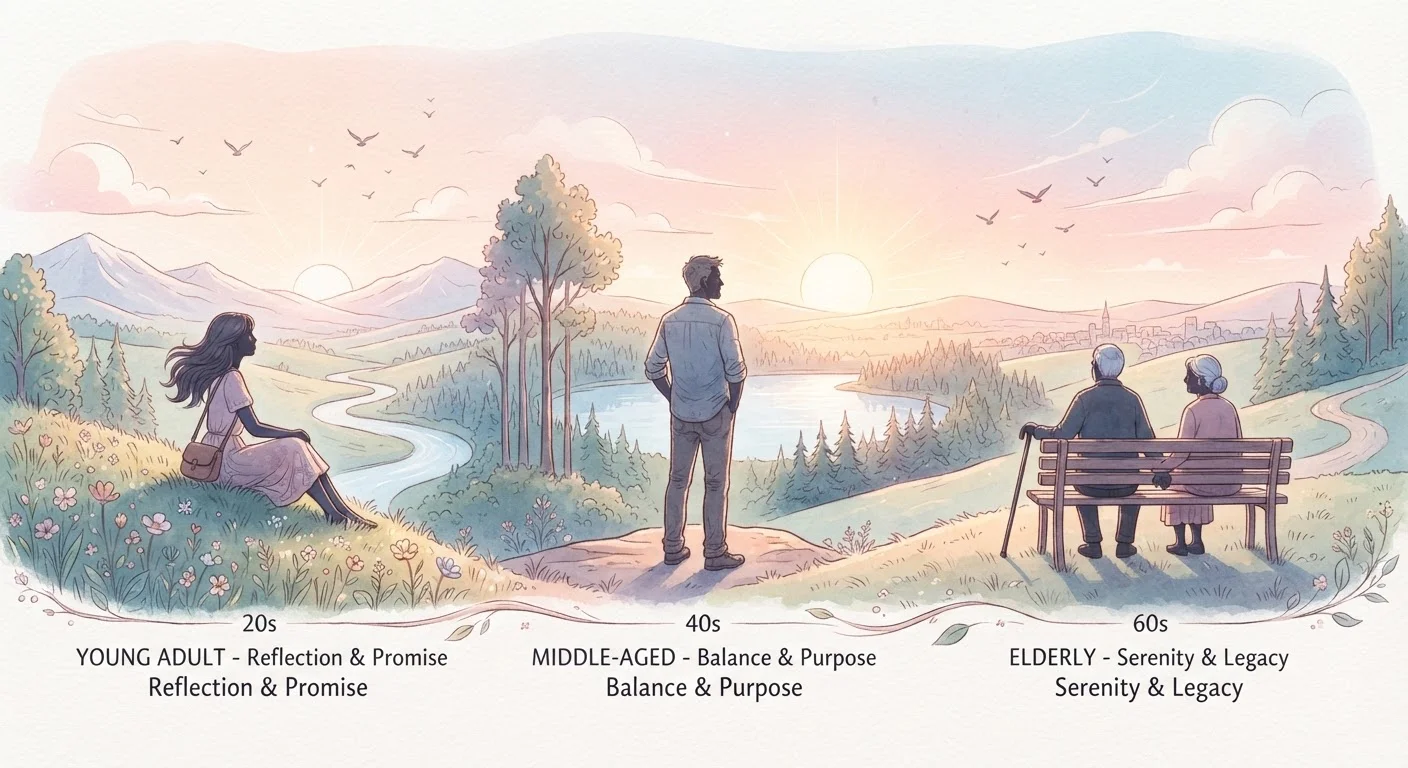
The years between 18 and 35 are among the most psychologically turbulent of adult life. This stage involves constructing a stable identity, navigating romantic relationships, launching careers, and often carrying significant financial stress - frequently all at once.
Research consistently shows that anxiety and depression peak in early adulthood. The transition to independence removes the scaffolding of school structures, and social comparison - amplified by social media - can distort self-perception. Sleep disruption is widespread during this period and meaningfully worsens emotional regulation.
Yet this stage also presents an opportunity: the habits formed now - how someone responds to stress, whether they seek help, how they maintain friendships - tend to persist. Starting wellness habits early, even modestly, creates a lasting foundation.
If you're in your 20s or early 30s, pay attention to how you recover from stress - not just whether you experience it. Recovery capacity is a trainable skill, and building it early pays dividends across every subsequent stage.
Stress reactivity and recovery patterns established in young adulthood often predict long-term mental health trajectories, according to psychophysiological research.
During midlife, schedule social connection the same way you'd schedule a medical appointment - deliberately, not as leftover time. Chronic busyness quietly erodes the relationships that buffer against burnout.
Social support is one of the most robust predictors of emotional resilience in middle-aged adults, yet it is consistently the first thing deprioritized under high-demand conditions.
Midlife (Ages 35-60): Competing Demands and the Quiet Toll
Midlife is often described as the "sandwich generation" era - adults simultaneously managing children, aging parents, career demands, and shifting health realities. The emotional load is real, and it accumulates quietly. Unlike acute crises, midlife stress tends to be chronic and diffuse, which makes it easy to minimize until it crosses into something more serious.
This is when burnout becomes a significant risk. People in this stage frequently deprioritize their own needs in service of others, and the cumulative effect - disrupted sleep, reduced social connection, persistent low mood - can be mistaken for simply "getting older."
Hormonal changes during perimenopause and andropause also affect mood regulation in ways that are often underrecognized. Mental wellness in midlife benefits from deliberate check-ins. Tools like a weekly self-check routine can surface small problems before they compound.
Later Life (60 and Beyond): Meaning, Loss, and Resilience
A counterintuitive finding in psychological research is that emotional well-being often improves in later life. Older adults tend to show better emotional regulation, stronger perspective-taking, and greater appreciation for the present. However, this general trend coexists with real vulnerabilities.
Grief becomes a more frequent experience - loss of a spouse, siblings, close friends, and sometimes one's own physical independence. Social isolation is among the most significant mental health risks for older adults, with evidence linking loneliness to outcomes as serious as cognitive decline. Social connection is not optional at any age, but it requires more intentional maintenance after retirement removes built-in daily structure.
Depression in older adults is often underdiagnosed because it can present differently - as fatigue, withdrawal, or physical complaints rather than overt sadness. Purpose and meaning - through community, creative work, or mentorship - are protective factors supported by substantial research.
What Stays Constant Across Every Stage
Despite the differences between life stages, certain pillars of mental wellness remain relevant throughout adult life:
- Sleep quality: Poor sleep impairs emotional regulation at every age, even when its causes shift (new parenthood in the 30s, hormonal changes in the 50s, pain-related disruption in the 70s).
- Social connection: Isolation takes a measurable toll regardless of age. The form of connection changes; the need does not.
- Sense of agency: Feeling some control over one's circumstances - even in small ways - consistently supports well-being across lifespan research.
- Self-awareness: The ability to recognize emotional states, notice changes, and respond rather than react is a learnable skill at any age.
Foundational wellness habits such as consistent sleep, movement, and intentional social engagement provide a through-line regardless of which stage you're navigating.
When to Seek Professional Support
General wellness information - including this article - is not a substitute for professional care. At every life stage, there are moments when the right move is to consult a qualified mental health professional rather than trying to self-manage.
Signs that warrant professional attention include: persistent low mood or anxiety lasting more than two weeks, significant changes in sleep or appetite, withdrawal from relationships and activities, difficulty functioning at work or home, or any thoughts of self-harm. These are not signs of weakness or failure - they are signals that additional support is appropriate.
Understanding the difference between therapy, counseling, and psychiatric care can help clarify the right starting point. Our guide on therapy, counseling, and psychiatry outlines what each profession offers. Digital tools can supplement professional care in some cases, but they are not a replacement for it.
This article is for general informational and educational purposes only. It is not medical or mental health advice. If you are experiencing mental health concerns, please speak with a qualified healthcare or mental health professional.