

Key Takeaways
- Milling removes the bran and germ from wheat, leaving only the starchy endosperm in refined flour.
- Whole grains retain significantly more fiber, B vitamins, iron, and healthy fats than refined grains.
- Refined grains digest more quickly, producing faster rises in blood sugar compared to whole grains.
- Enrichment adds back some B vitamins and iron but does not restore fiber or all lost micronutrients.
- Dietary guidelines generally recommend making at least half of daily grain servings whole grains.
Option A
Whole Grains
The complete, minimally processed kernel.
Best for: Anyone looking to increase fiber intake, slow carbohydrate digestion, and retain more vitamins and minerals from grain-based foods.
Option B
Refined Grains
The stripped-down, shelf-stable alternative.
Best for: Situations where a lighter texture or longer shelf life is needed, though they provide fewer nutrients than their whole-grain counterparts.
If you want to support digestive health and increase daily fiber
Whole Grains
Whole grains retain the bran layer, which is the primary source of dietary fiber in wheat. Most Americans fall well short of recommended fiber intake, making whole grain choices a straightforward way to close that gap.
If blood sugar management is a concern for you
Whole Grains
The intact fiber and structure of whole grains slow digestion and glucose absorption, resulting in a more gradual rise in blood sugar compared to refined grain products. Always discuss dietary changes with a healthcare provider.
If you need a longer pantry shelf life or very light baked texture
Refined Grains
Removing the germ eliminates the oils that can turn rancid, extending shelf life. Refined flour also produces a lighter crumb in baked goods where that texture is specifically desired.
If you want maximum micronutrient density from grain foods
Whole Grains
Whole grains provide a broader spectrum of naturally occurring vitamins, minerals, and phytochemicals that enrichment processes only partially replicate.
The Three Parts of a Wheat Kernel
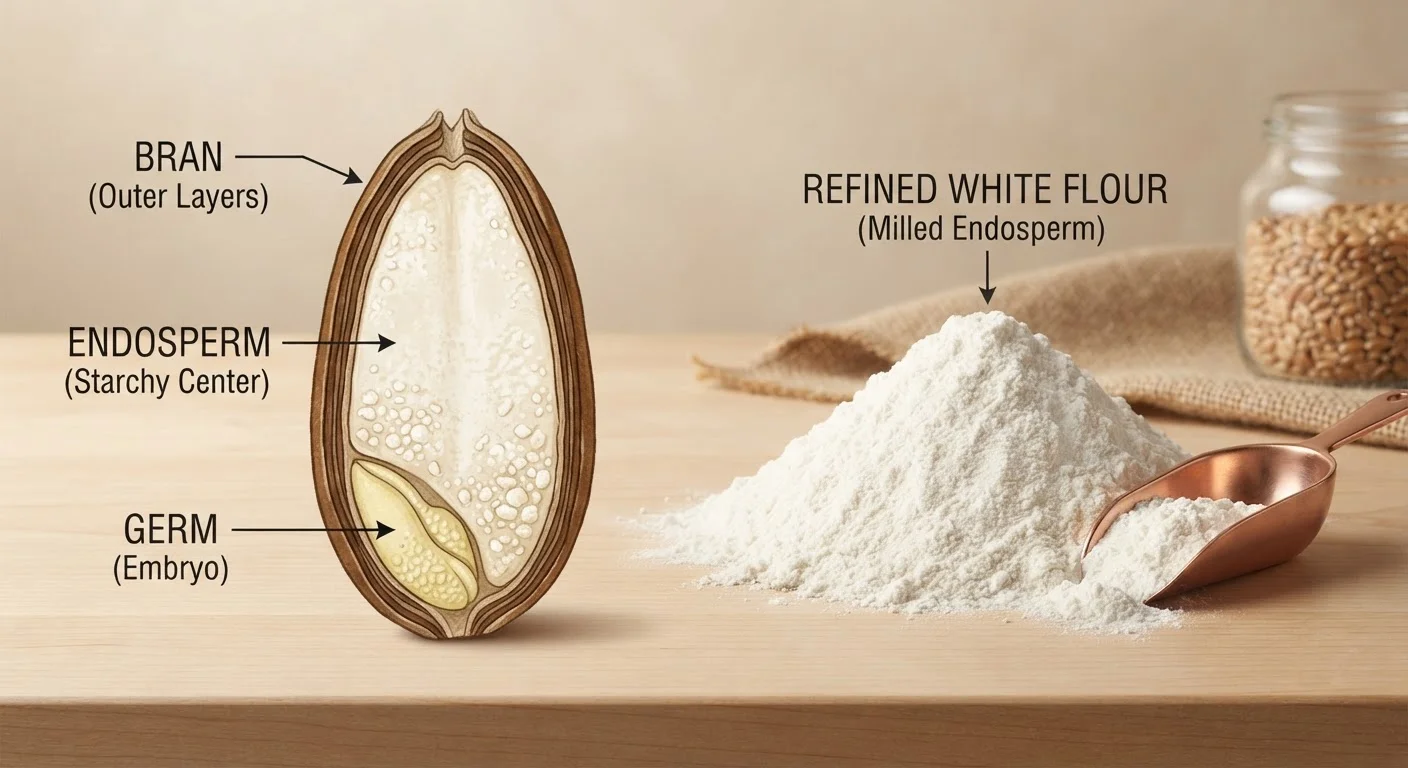
Understanding what happens during milling starts with the kernel itself. A whole wheat kernel - called a wheat berry - is made up of three distinct layers, each with a different nutritional role.
The bran is the tough outer shell. It is the primary source of dietary fiber and contains B vitamins, iron, copper, zinc, and antioxidants. The germ is the small embryo at the base of the kernel - the part that would sprout into a new plant. It is rich in B vitamins (including folate), vitamin E, healthy unsaturated fats, and phytochemicals. The endosperm makes up roughly 83% of the kernel by weight. It is mostly starch and protein, with only small amounts of vitamins and minerals.
When a grain is called "whole," all three layers are present in their natural proportions - whether the grain is milled, cracked, rolled, or cooked. The definition holds regardless of processing method, as long as no part is removed.
| Criterion | Whole Grains | Refined Grains |
|---|---|---|
| Kernel parts retained | Bran, germ, and endosperm | Endosperm only |
| Dietary fiber (per 100g flour, approx.) | 12-15 grams | 2-3 grams |
| B vitamins | Naturally present in full range | Mostly removed; some added back via enrichment |
| Vitamin E | Present (from germ) | Largely absent |
| Digestion speed | Slower (fiber slows absorption) | Faster (starch more quickly accessible) |
| Shelf life | Shorter (germ oils can go rancid) | Longer (no germ oils present) |
| Texture in baked goods | Denser, heartier crumb | Lighter, finer crumb |
What Milling Actually Removes
Conventional milling - the process that produces white flour - strips away the bran and germ entirely, leaving only the endosperm. This dramatically changes the nutritional profile of the resulting flour.
According to the Whole Grains Council, refining wheat can remove roughly 25% of its protein and significant portions of at least 17 key nutrients. Fiber losses are especially steep: whole wheat flour contains roughly 12-15 grams of fiber per 100 grams, while refined white flour typically contains around 2-3 grams per 100 grams. B vitamins including thiamin, riboflavin, niacin, and folate drop sharply. So does iron. The germ's vitamin E and healthy fats disappear almost entirely.
A Note on Glycemic Response
The glycemic index (GI) measures how quickly a food raises blood glucose relative to pure glucose. Whole grain foods generally have a lower GI than their refined counterparts, though cooking method, food form, and what else is eaten at the same meal all influence the actual blood sugar response. GI is one useful data point, but it does not capture the full nutritional picture. Speak with a registered dietitian if blood sugar management is a personal health priority.
The speed at which refined grains digest also changes meaningfully. Without the bran and germ creating physical barriers, enzymes in the digestive tract break down the endosperm's starch much faster. This leads to quicker glucose absorption - a factor that researchers have associated with differences in blood sugar response between whole and refined grain foods. For context on how different types of carbohydrates behave in the body, it helps to also understand how sugars are classified in nutrition science.
Enrichment: What It Does and Doesn't Fix
Since the mid-20th century, refined grain products in the United States have been routinely enriched - a process where manufacturers add back specific nutrients lost during milling. The FDA mandates enrichment of most refined grain products sold in the U.S., requiring the addition of thiamin, riboflavin, niacin, folic acid, and iron.
Enrichment has meaningfully reduced certain deficiency-related conditions. The mandatory addition of folic acid to enriched grain products, introduced in 1998, has been credited with a significant reduction in neural tube defects in the United States.
However, enrichment does not restore everything. Fiber is not added back. Vitamin E, magnesium, zinc, potassium, and a range of phytochemicals remain absent. The restoration is partial by design - it targets specific public health concerns rather than full nutritional equivalence with whole grains.
For a more detailed nutritional side-by-side, see what's actually lost when wheat is refined.
This article is for general informational purposes only and is not a substitute for medical or dietary advice from a qualified healthcare professional.