

Key Takeaways
- Serving size is a reference amount set by the FDA, not a dietary recommendation.
- % Daily Value (% DV) tells you how much a nutrient in one serving contributes to a 2,000-calorie daily diet.
- 5% DV or less is generally considered low for a nutrient; 20% DV or more is considered high.
- Added sugars are listed separately from total sugars to distinguish naturally occurring from added sweeteners.
- The label covers macronutrients, select micronutrients, and calories - not every compound in a food.
Nutrition Facts Label
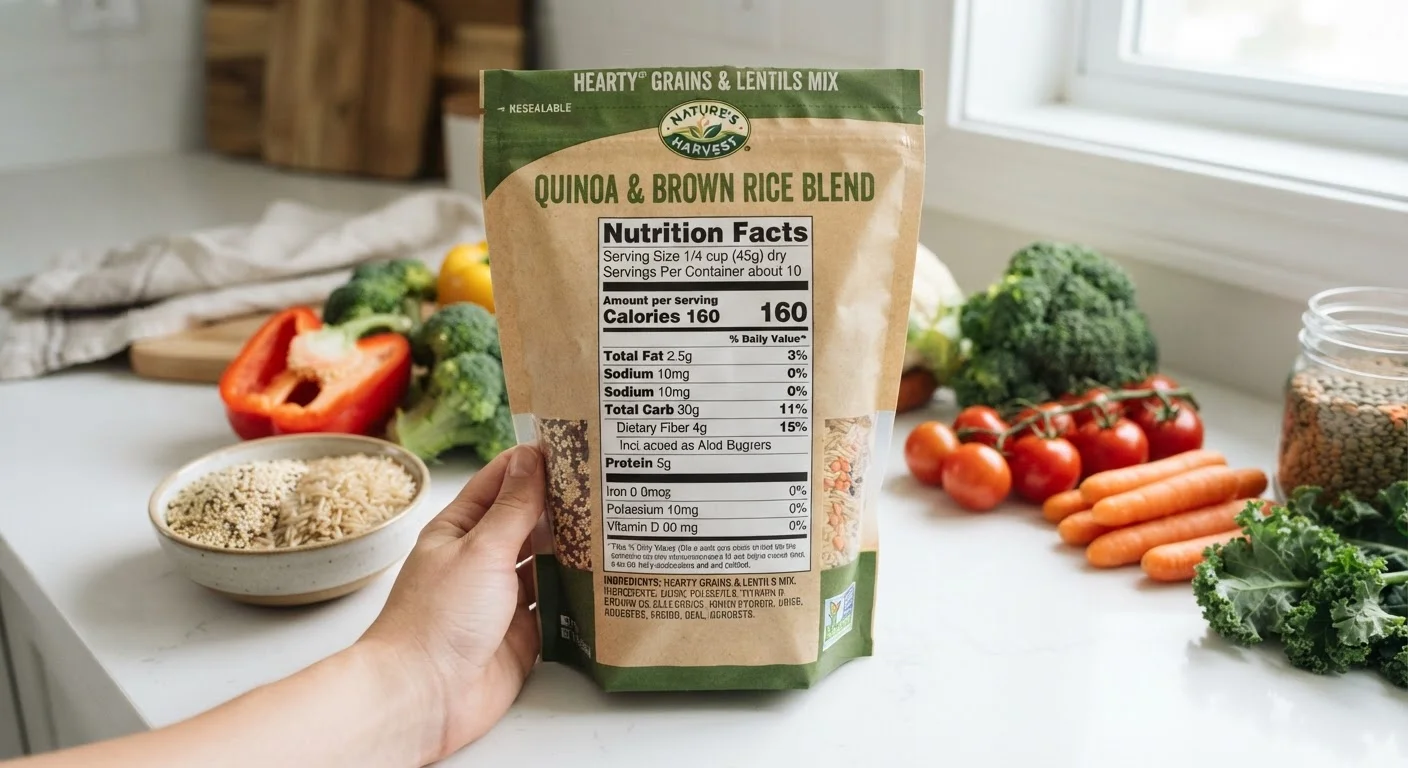
The Nutrition Facts label is the standardized information panel required by the U.S. Food and Drug Administration (FDA) on most packaged foods and beverages. It lists calories, serving sizes, macronutrients, key vitamins, minerals, and the percentage of daily recommended values each nutrient contributes. Its purpose is to help consumers understand what they are eating in a consistent, comparable format across products.
The current label format was updated in 2020 following FDA rules established under the Nutrition Labeling and Education Act, incorporating updated scientific data on nutrition and health.
Start at the Top: Serving Size and Calories
The first two items on any Nutrition Facts label - serving size and calories - set the frame for everything else. Get these wrong, and every other number becomes misleading.
Serving size is expressed in common household measurements (cups, tablespoons, pieces) alongside a gram weight. The FDA establishes these amounts based on what people actually consume in one sitting, not what they should consume. A bag of chips labeled with a serving size of 15 chips is telling you that all the numbers below apply to 15 chips. If you eat 30, double every figure.
Calories measure the total energy one serving provides. The updated 2020 label displays this number in large, bold type for good reason - it is often the most immediate piece of information shoppers want. The label does not show calories from fat anymore; that line was removed because the type of fat matters more than the raw calorie count from fat.
Check Servings Per Container First
Before reading any other number on the label, look at how many servings the package contains. A snack with 200 calories per serving sounds reasonable until you notice the bag holds 3.5 servings. Multiplying the per-serving numbers by how much you actually eat gives you the real nutritional picture.
Nutrients to Limit and Nutrients to Encourage
Below calories, the label divides into two functional groups of nutrients, though it doesn't announce that separation with a header.
Nutrients most Americans consume in excess - saturated fat, trans fat, sodium, and added sugars - appear first. These are linked to increased risk of cardiovascular disease, high blood pressure, and other chronic conditions when consumed well above daily recommendations. The goal for most people is to keep their % DV for these nutrients low across the day.
Nutrients many Americans under-consume - dietary fiber, vitamin D, calcium, iron, and potassium - follow. These support bone health, immune function, oxygen transport, and blood pressure regulation, among other functions. Choosing foods with higher % DVs for these nutrients can help fill common gaps in the American diet.
For a broader look at how these nutrients fit into official dietary guidance, see how federal dietary guidelines translate to everyday eating.
77%
Americans who read nutrition labels at least sometimes
According to the FDA's food labeling consumer research, a large majority of U.S. adults report using the Nutrition Facts panel when shopping, though frequency and depth of use vary.
2,300 mg
Daily sodium limit for most adults
The Dietary Guidelines for Americans recommend limiting sodium to 2,300mg per day - equivalent to about 1 teaspoon of salt - to support heart health.
50 g
Daily added sugars limit (2,000-cal diet)
Based on FDA guidance, the daily reference value for added sugars is 50 grams, representing no more than 10% of total calories for a 2,000-calorie diet.
How to Actually Use % Daily Value
The % Daily Value (% DV) column is arguably the label's most practical tool, yet it's the most misunderstood. It answers one question: how much does one serving of this food contribute to a full day's intake of a given nutrient, based on a 2,000-calorie diet?
The FDA provides a quick rule of thumb: 5% DV or less is low for a nutrient; 20% DV or more is high. Use this to quickly compare products without doing math. A soup with 35% DV sodium per serving is a high-sodium food. A cereal with 25% DV for iron is a meaningful source of that mineral.
Keep in mind that 2,000 calories is a reference figure - individual calorie needs vary based on age, sex, weight, and activity level. People with higher or lower calorie needs will have correspondingly different actual daily values. The % DV is still useful for comparison shopping, even if it isn't a perfect fit for your personal intake.
The Nutrition Facts label tells you what is in a food; the ingredient list tells you where it came from. Both are worth reading. See our guide on reading an ingredient list without getting lost to put the two together.
The Label Doesn't Cover Everything
The Nutrition Facts panel lists nutrients the FDA determined are most significant to public health, but it doesn't capture every compound in a food - phytochemicals, antioxidants, and many trace minerals are not required disclosures. Whole foods like fruits and vegetables often lack labels entirely, but that absence doesn't mean they're nutritionally empty. The label is a tool, not a complete nutritional portrait.
Added Sugars, Total Fat, and a Few Common Confusions
Two areas of the label generate the most confusion in practice: fats and sugars.
Under total fat, the label breaks out saturated fat and trans fat. Unsaturated fats - mono- and polyunsaturated - are sometimes listed voluntarily but are not always present. This means the total fat number will often be higher than the sum of the sub-types shown. That difference represents unsaturated fats, which are generally considered beneficial in appropriate amounts. The label is not hiding anything; it simply doesn't require a breakdown of every fat category.
Under total sugars, the label now separately lists added sugars with their own % DV. This distinction matters because a plain yogurt and a flavored yogurt might both show 12 grams of total sugars, but only one of them has added sugars on top of the naturally occurring lactose. Added sugars have a % DV of their own - the FDA recommends keeping added sugars under 10% of total daily calories for most adults.
For a deeper cross-reference on how these label figures compare across products, reading a nutrition label without the confusion walks through additional practical scenarios.