

Key Takeaways
- Nutrition is how your body extracts and uses substances from food to sustain every function it performs.
- Carbohydrates, proteins, and fats each serve distinct, non-interchangeable roles in the body.
- Vitamins and minerals are needed in small amounts but are critical for hundreds of biological processes.
- Your body converts food energy through digestion and metabolism, not in one simple step.
- No single food provides everything you need - variety across food groups is the foundation of good nutrition.
Start here
What Nutrition Actually Means
Core concepts
The Three Macronutrients and What They Do
Go deeper
Micronutrients: Small but Essential
The science
How Your Body Converts Food to Energy
Apply it
Putting It Together: Eating Patterns That Support Health
What Nutrition Actually Means
Nutrition, at its most basic, is the process by which living things take in and use food. For humans, that means extracting substances from what we eat - substances the body either burns for energy, uses as building material, or deploys to regulate its own chemistry.
The word often gets tangled up in diet culture language, but it has a straightforward scientific meaning: nutrition science studies the nutrients in food, how the body processes them, and how those processes connect to health over time. Understanding this foundation is useful whether you're trying to eat better, manage a health condition under a doctor's guidance, or simply make sense of conflicting headlines. For a broader look at how culture shapes what Americans eat alongside biology, see our companion piece on why Americans eat the way they do.
Nutrient
A substance in food that the body uses to function - for energy, growth, or regulation. Nutrients include carbohydrates, proteins, fats, vitamins, minerals, and water.
Macronutrient
One of the three main categories of nutrients needed in larger amounts: carbohydrates, proteins, and fats. All three provide energy measured in calories.
Micronutrient
Vitamins and minerals the body needs in small amounts to carry out essential functions like immune defense, bone building, and energy production.
Metabolism
The set of chemical processes inside cells that convert nutrients from food into energy and the raw materials the body needs to grow and repair itself.
Essential amino acids
Nine amino acids the body cannot make on its own and must obtain through food. They are found in protein-containing foods like meat, eggs, dairy, and certain plant combinations.
ATP (adenosine triphosphate)
The molecule cells actually use as energy to do work. Digesting food and running it through metabolic pathways is largely a process of producing ATP.
Dietary fiber
A type of carbohydrate found in plant foods that the body cannot fully digest. It supports digestive health, helps regulate blood sugar, and feeds beneficial gut bacteria.
Fat-soluble vitamins
Vitamins A, D, E, and K, which are absorbed along with dietary fat and stored in the body rather than flushed out daily. This makes excess intake from supplements a concern.
The Three Macronutrients and What They Do
The macronutrients are carbohydrates, proteins, and fats. They're called "macro" because you need them in relatively large amounts - grams per day, not micrograms.
- Carbohydrates are the body's primary fuel source. They break down into glucose, which cells use directly for energy. Dietary fiber - a type of carbohydrate the body can't fully digest - supports digestive health and feeds beneficial gut bacteria.
- Proteins are made of amino acids and serve as the structural backbone of muscle, skin, enzymes, and hormones. The body can produce some amino acids on its own, but nine are considered essential - meaning you must get them through food. Animal proteins tend to contain all nine; many plant proteins do not, though combining different plant sources across the day addresses this well.
- Fats are energy-dense and essential for absorbing fat-soluble vitamins (A, D, E, and K), protecting organs, and producing hormones. Unsaturated fats - found in nuts, seeds, fish, and olive oil - are associated with heart health in research, while high intake of trans fats has been linked to negative cardiovascular outcomes.
These three nutrients work together; no one of them is the enemy, and each has a role no other can fully replace.
Focus on the whole plate, not one nutrient
It's easy to fixate on a single nutrient - carbs, fat, protein - after reading a headline. In practice, most whole foods contain a mix of nutrients that work together. A handful of almonds, for example, provides fat, protein, fiber, vitamin E, and magnesium simultaneously. Variety across food types is a more reliable strategy than optimizing any one number.
Micronutrients: Small but Essential
Vitamins and minerals don't provide calories, but they're involved in almost every biological process you can name - from converting food into usable energy to keeping your immune system functional.
Vitamins are organic compounds, meaning they come from living sources and can be degraded by heat or light. Minerals are inorganic elements - things like calcium, iron, magnesium, and zinc - that the body cannot manufacture and must get from food or water.
A few examples illustrate how specific these roles are: Vitamin C is necessary for collagen synthesis and immune function. Iron is central to transporting oxygen in the blood. Vitamin D supports calcium absorption and is also involved in immune regulation. Iodine is required for proper thyroid hormone production. Missing any of these consistently - even in small amounts - can impair the body functions they support.
The best way to cover your micronutrient needs is through a varied diet that includes vegetables, fruits, whole grains, legumes, and protein sources rather than relying on supplements as a first line. Always consult a healthcare provider before adding supplements, especially for children, pregnant individuals, or those with chronic conditions.
How Your Body Converts Food to Energy
Digestion begins in the mouth, where chewing and saliva start breaking food down mechanically and chemically. The process continues through the stomach and into the small intestine, where nutrients are absorbed into the bloodstream and transported to cells throughout the body.
Inside cells, a process called metabolism converts nutrients into usable energy. The end product is a molecule called ATP (adenosine triphosphate) - the actual currency cells spend to do work, whether that's contracting a muscle, firing a nerve signal, or building a new protein.
Different macronutrients enter metabolic pathways at different points. Glucose from carbohydrates is typically the most immediately accessible fuel. Fatty acids from fats are slower to convert but yield more energy per gram. Protein can be converted to fuel too, though the body generally prefers to use it for structural and regulatory tasks.
This is also why the idea of food "turning into fat" is an oversimplification. Energy your body doesn't need right now gets stored - as glycogen in the liver and muscles, or as body fat - for later use. The balance between intake and expenditure over time shapes how those stores change.
Calories are a unit of energy, not a measure of quality
A calorie is simply the amount of energy needed to raise the temperature of one gram of water by one degree Celsius - it's a unit of measurement. Foods with the same calorie count can differ enormously in their nutritional value. Two hundred calories of lentils and two hundred calories of a candy bar fuel the body very differently, because the nutrients accompanying those calories are not the same.
Putting It Together: Eating Patterns That Support Health
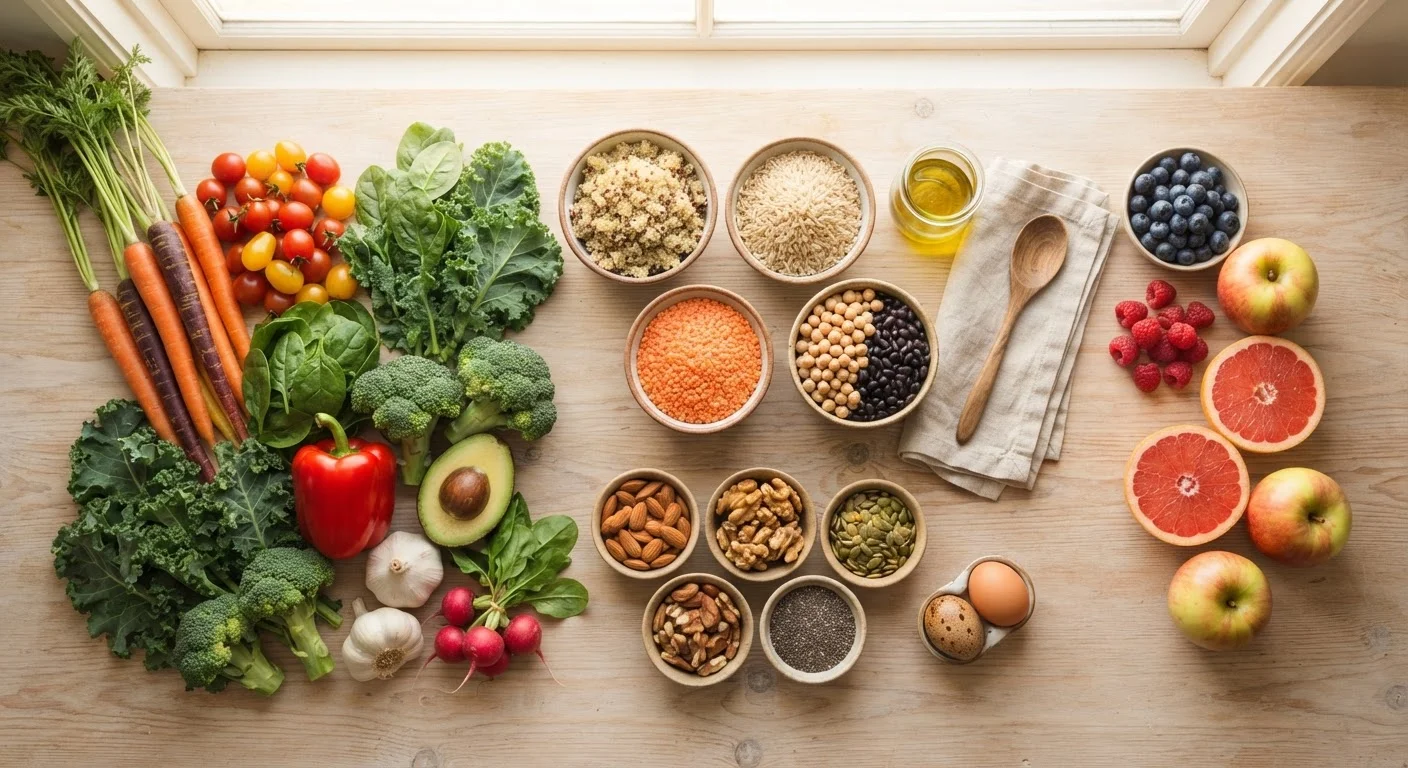
Decades of nutritional research consistently point in one direction: overall dietary patterns matter more than any single food or nutrient. Diets built around vegetables, fruits, legumes, whole grains, nuts, and varied protein sources - with limited ultra-processed foods - are associated with lower rates of chronic disease across many populations.
That doesn't mean every meal needs to be perfect. It means the general shape of your diet over days and weeks is what counts. Cooking from scratch can support this kind of pattern, but it isn't the only path - understanding ingredients and preparation methods matters as much as where the cooking happens.
Once you understand the basics covered here, reading food packaging becomes a genuinely useful skill. Our guide on reading a nutrition label without the confusion is a natural next step. You can also explore more evidence-based guidance through the Nutrition & Diet hub or the broader Physical Health hub.
This article is for informational and educational purposes only and is not a substitute for advice from a qualified healthcare professional or registered dietitian. Individual nutritional needs vary; consult a provider for personalized guidance.