

Key Takeaways
- Dietary fat is a broad category that includes several chemically distinct types with different effects on health.
- Unsaturated fats - found in plants and fish - are generally associated with better cardiovascular outcomes.
- Saturated fat is not uniformly harmful, but most health authorities recommend moderating intake.
- Artificial trans fats are widely considered the most harmful and are largely banned in the U.S. food supply.
- Food labels can help you identify fat types, but whole-food context matters too.
Our Verdict
When it comes to dietary fat, type matters far more than total amount. Unsaturated fats from whole plant foods and fish are broadly supported by nutrition science, saturated fat warrants moderation rather than elimination, and artificial trans fats are best avoided almost entirely. No single fat category is a villain or a hero in isolation - dietary patterns as a whole shape health outcomes.
| Best for | Recommended |
|---|---|
| Everyday heart health and cooking flexibility | Monounsaturated fats (olive oil, avocado) |
| Anti-inflammatory support and omega-3 intake | Polyunsaturated fats (fatty fish, walnuts, flaxseed) |
| Occasional use in cooking and baking | Saturated fat (used in moderation, with context) |
| Fats to minimize or avoid | Artificial trans fats (partially hydrogenated oils) |
Why the Type of Fat You Eat Actually Matters
For decades, dietary fat was treated as a single enemy to be reduced across the board. That framing has since been revised substantially by nutrition research. Fat is a macronutrient your body genuinely needs - it supports cell membranes, helps absorb fat-soluble vitamins (A, D, E, and K), and provides a concentrated energy source. What determines whether a fat is beneficial or harmful is primarily its chemical structure, not the fact that it's fat at all.
The four main types found in food are: saturated fats, monounsaturated fats, polyunsaturated fats, and trans fats. Each behaves differently in the body and shows up in different foods. Understanding these distinctions is one of the more useful things you can do for your nutrition literacy. As our macronutrient overview explains, fat as a category doesn't deserve a blanket bad reputation - but it does deserve nuance.
Saturated Fat: The Complicated Middle Ground
Saturated fats are solid at room temperature - think butter, lard, coconut oil, and the fat marbled through red meat. Chemically, their carbon chains are fully "saturated" with hydrogen atoms, which gives them that firm texture. Most major health organizations, including the American Heart Association, suggest limiting saturated fat intake because higher consumption has been linked to elevated LDL (low-density lipoprotein) cholesterol in many studies.
That said, the science here is more textured than it once appeared. Research in recent years has found that the effect of saturated fat on cardiovascular risk may depend on what replaces it in the diet. Swapping saturated fat for refined carbohydrates, for instance, doesn't appear to lower heart disease risk. Swapping it for unsaturated fats from whole foods does show benefit. The takeaway isn't to demonize saturated fat entirely, but to be thoughtful about overall dietary patterns.
Don't Replace Fat with Refined Carbs
A common error when reducing saturated fat is to replace it with refined carbohydrates - white bread, sugary snacks, low-fat processed foods. Research suggests this swap does not improve cardiovascular outcomes and may worsen other metabolic markers. The goal is to shift toward healthier fat sources, not simply to reduce total fat at any cost.
Unsaturated Fats: Monounsaturated and Polyunsaturated
Unsaturated fats are liquid at room temperature and are generally considered the most health-supportive type of dietary fat. They break into two subgroups:
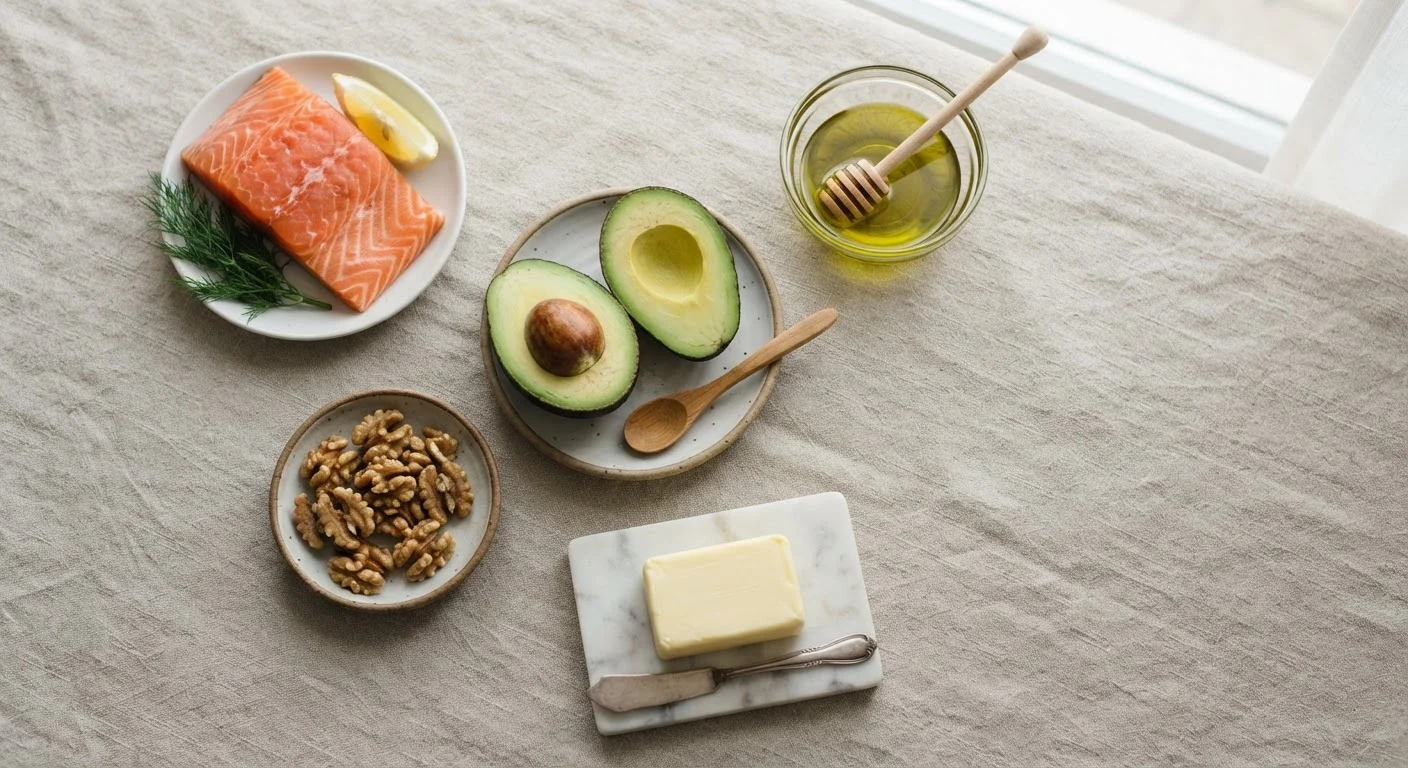
- Monounsaturated fats (MUFAs) have one double bond in their carbon chain. Olive oil, avocados, and most nuts are rich sources. MUFAs are associated with improved LDL-to-HDL cholesterol ratios and are a cornerstone of the Mediterranean dietary pattern, which has a strong evidence base for cardiovascular health.
- Polyunsaturated fats (PUFAs) have multiple double bonds. This category includes the well-known omega-3 and omega-6 fatty acids. Omega-3s - found in fatty fish like salmon and mackerel, as well as walnuts and flaxseed - are linked to reduced inflammation and lower triglyceride levels. Omega-6s appear in vegetable oils like corn and soybean oil. Both are essential fats, meaning the body cannot make them; they must come from food.
| Saturated Fat | Monounsaturated Fat | Polyunsaturated Fat | Trans Fat (Artificial) | |
|---|---|---|---|---|
| State at room temp | Solid | Liquid | Liquid | Semi-solid |
| Common food sources | Butter, red meat, coconut oil | Olive oil, avocado, almonds | Salmon, walnuts, flaxseed | Partially hydrogenated oils |
| Effect on LDL cholesterol | May raise LDL | May lower LDL | Generally lowers LDL | Raises LDL significantly |
| Effect on HDL cholesterol | Neutral to slight raise | May raise HDL | Neutral to slight raise | Lowers HDL |
| General health guidance | Moderate intake | Emphasize in diet | Emphasize in diet | Minimize or avoid |
| U.S. regulatory status | Unrestricted | Unrestricted | Unrestricted | Largely banned (PHOs) |
For a deeper look at how these fats interact with the broader diet, our piece on nutrition myths Americans still believe addresses some persistent misconceptions about fat and weight.
Trans Fats: The One Type to Genuinely Minimize
Trans fats come in two forms. Small amounts occur naturally in meat and dairy from ruminant animals (cows, sheep) - these naturally occurring trans fats don't appear to carry the same risks as their artificial counterparts. The concern centers on artificial trans fats, created through a process called partial hydrogenation, which turns liquid vegetable oils into semi-solid fats for use in processed foods.
Artificial trans fats raise LDL cholesterol while simultaneously lowering HDL (high-density lipoprotein, the "good" kind) - a particularly unfavorable combination. The FDA effectively banned partially hydrogenated oils from the U.S. food supply by 2020, so they've largely disappeared from packaged foods. However, small amounts may still appear in some older-formulation products, so checking ingredient labels for "partially hydrogenated oil" remains worthwhile.
Check Ingredient Lists, Not Just Nutrition Facts
Even if a Nutrition Facts label shows "0g trans fat," a product can legally contain up to 0.5 grams per serving under FDA rounding rules. If "partially hydrogenated oil" appears anywhere in the ingredient list, the product contains artificial trans fats. Reading both sections of the label gives you a more complete picture.
Understanding fat quality fits into a broader conversation about reading food labels critically - the same skill that helps decode the difference between natural and added sugars.
Reading Labels and Making Practical Choices
Nutrition facts panels in the U.S. are required to list total fat, saturated fat, and trans fat per serving. Unsaturated fats are not always broken out, but you can calculate a rough figure by subtracting saturated and trans fat grams from total fat. The ingredients list is equally useful - oils listed early signal a meaningful fat source.
In practical terms, most nutrition research supports a dietary pattern that emphasizes whole food sources of fat: fatty fish a couple of times per week, liberal use of olive oil, nuts and seeds as snacks or toppings, and avocados where they fit. This doesn't require tracking grams obsessively - it's more about consistent food choices than precise arithmetic. If you want to expand your macronutrient literacy further, our guide to what macronutrients do inside your body covers the full picture.
This article is for general informational and educational purposes only and is not a substitute for advice from a qualified healthcare or nutrition professional. Individual dietary needs vary; consult a registered dietitian or your healthcare provider for personalized guidance.