

Key Takeaways
- Human perception routinely underestimates following distance, especially at highway speeds.
- The two-second rule is a minimum standard - adverse conditions demand three to four seconds or more.
- Tailgating is one of the most common contributors to rear-end collisions, which are largely preventable.
- Recalibrating your spacing habit takes deliberate practice, not just awareness.
- Vehicle size and road conditions significantly affect the stopping distance you actually need.
Why Following Distance Is Harder to Judge Than It Sounds
The two-second rule is taught in every driver's education course in America. It's simple, logical, and measurable. Yet tailgating remains one of the most common driver behaviors on U.S. roads - not because drivers don't know the rule, but because human perception is genuinely poor at estimating space and time at speed.
At 60 mph, a vehicle is covering 88 feet every single second. A gap that looks generous in your rearview mirror can close to nothing before your foot even finds the brake. Our brains evolved to judge distance at walking speed, not highway speed - which means the intuitive sense of 'enough room' is almost always wrong when it matters most.
This isn't a knowledge gap; it's a perception gap. Understanding that your instincts are miscalibrated is the first step toward building a habit that actually protects you. For a broader framework on how spatial awareness fits into safer driving, see the principles behind defensive driving.
Rear-End Crashes Are Rarely Sudden
The vast majority of rear-end collisions happen because the following driver didn't have enough time or space to stop - not because they failed to brake. Closing that gap by even one or two seconds can be the difference between a near-miss and a serious crash. Adequate following distance is one of the highest-value safety habits any driver can build.
The Mistakes Drivers Make - and How to Correct Them
Most following-distance errors aren't reckless choices. They're ingrained habits formed from years of driving in low-consequence situations. Identifying the specific pattern you fall into is more useful than a general reminder to 'leave more space.'
Using visual proximity rather than time to judge following distance.
Why it happens: Drivers tend to gauge space by how far a car looks rather than calculating how much time they have to react. At 60 mph, a 'safe-looking' gap can disappear in under a second.
Applying the same following distance regardless of speed.
Why it happens: Many drivers set a fixed distance in their head - say, one car length - and maintain it whether they're doing 25 mph in a neighborhood or 70 mph on the interstate.
Closing the gap to prevent other drivers from merging in.
Why it happens: Some drivers feel that maintaining distance 'invites' lane changes and intentionally tighten up to block others. This reactive habit is common but dangerous.
Failing to adjust for vehicle size and load.
Why it happens: Drivers who switch between vehicle types - say, from a sedan to a loaded SUV or pickup - often don't recalibrate their following distance. Heavier or larger vehicles take longer to stop.
Maintaining normal spacing while distracted or fatigued.
Why it happens: When attention is divided - by a phone, a conversation, or drowsiness - reaction time increases significantly, but most drivers don't compensate by adding more space.
~29%
Of all crashes involve rear-end collisions
According to the National Highway Traffic Safety Administration (NHTSA), rear-end crashes consistently rank among the most common crash types on U.S. roads.
1.5 sec
Average driver reaction time before braking
Research on driver behavior estimates that most drivers need 1.5 seconds or more just to perceive a hazard and initiate braking - before any actual stopping occurs.
These errors compound quickly in real conditions. Rain, construction zones, or a moment of distraction can turn an already-thin margin into no margin at all. For a closer look at how distraction specifically degrades your reaction window, see how distracted driving compares to other reaction-time impairments.
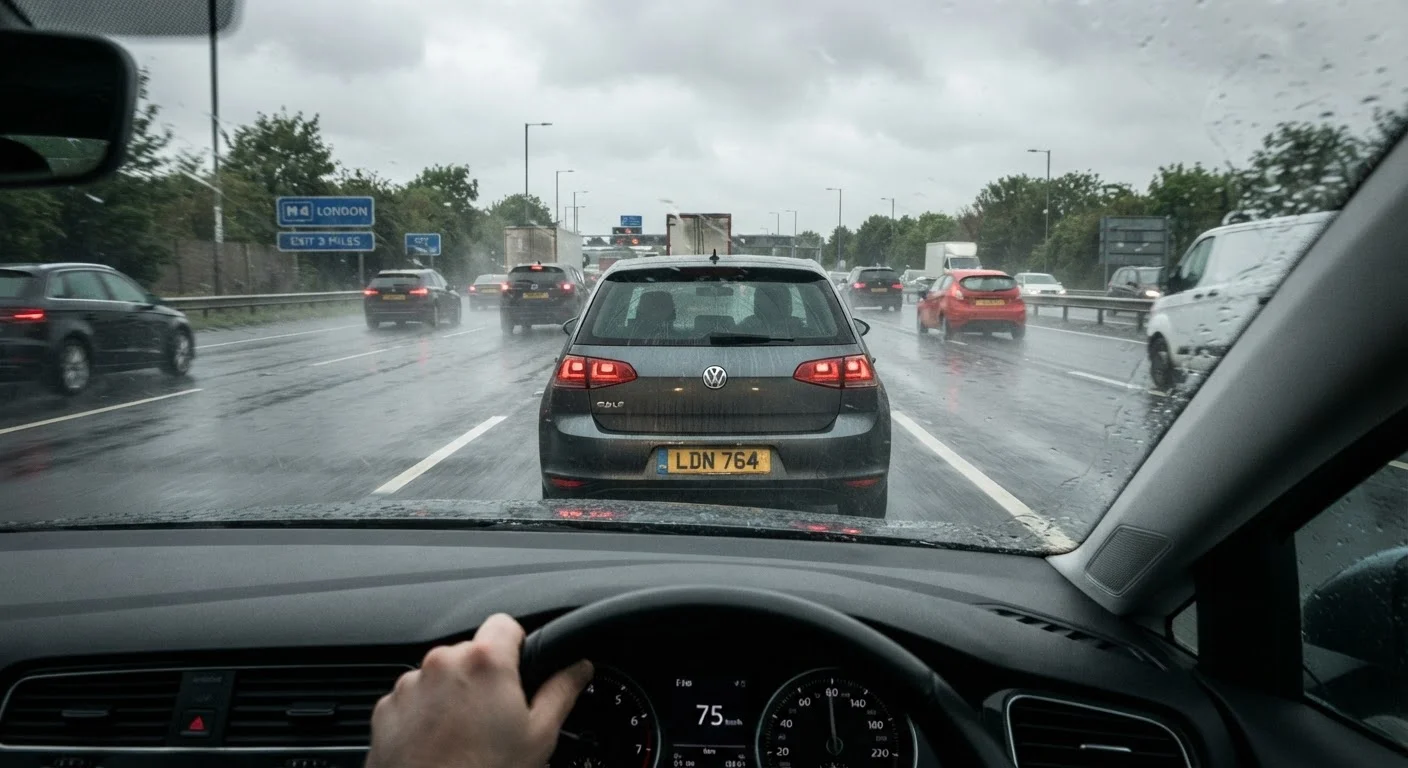
Rain and Wet Roads Change Everything
Wet pavement can increase stopping distances by 50% or more compared to dry conditions. If you're using a two-second gap on a dry highway, that same gap becomes dangerously inadequate in rain. Always extend your following distance in poor weather, and assume other drivers around you haven't done the same.
Building a Spacing Habit That Holds Under Pressure
Knowing the two-second rule isn't enough - you have to make it automatic, because in a real emergency you won't have time to think about it. The goal is to make adequate following distance your default state, not a conscious adjustment you make when you feel nervous.
One effective method: every time you settle into a lane, immediately check your gap using the landmark-counting technique. Don't wait until a situation feels urgent. Drivers who practice this on every trip - including routine commutes - develop a reliable spatial baseline far faster than those who only apply it selectively.
It's also worth acknowledging the social pressure element. Tailgating by the driver behind you can create a subconscious urge to compress your own gap with the car ahead. Resist this. The driver behind you is responsible for their own spacing; your job is to maintain yours. These same dynamics tie directly into how proximity and pressure escalate aggressive driving situations.
Night driving adds another layer - reduced visibility means hazards appear later, which makes existing reaction-time math even less forgiving. After-dark driving requires more than working headlights - spacing adjustments are part of the equation too.
Following distance is one of those habits that feels minor on an uneventful drive and critical in an emergency. The goal is to treat it seriously before the emergency arrives.