
Distracted Driving vs. Impaired Driving: Two Different Problems, One Dangerous Outcome

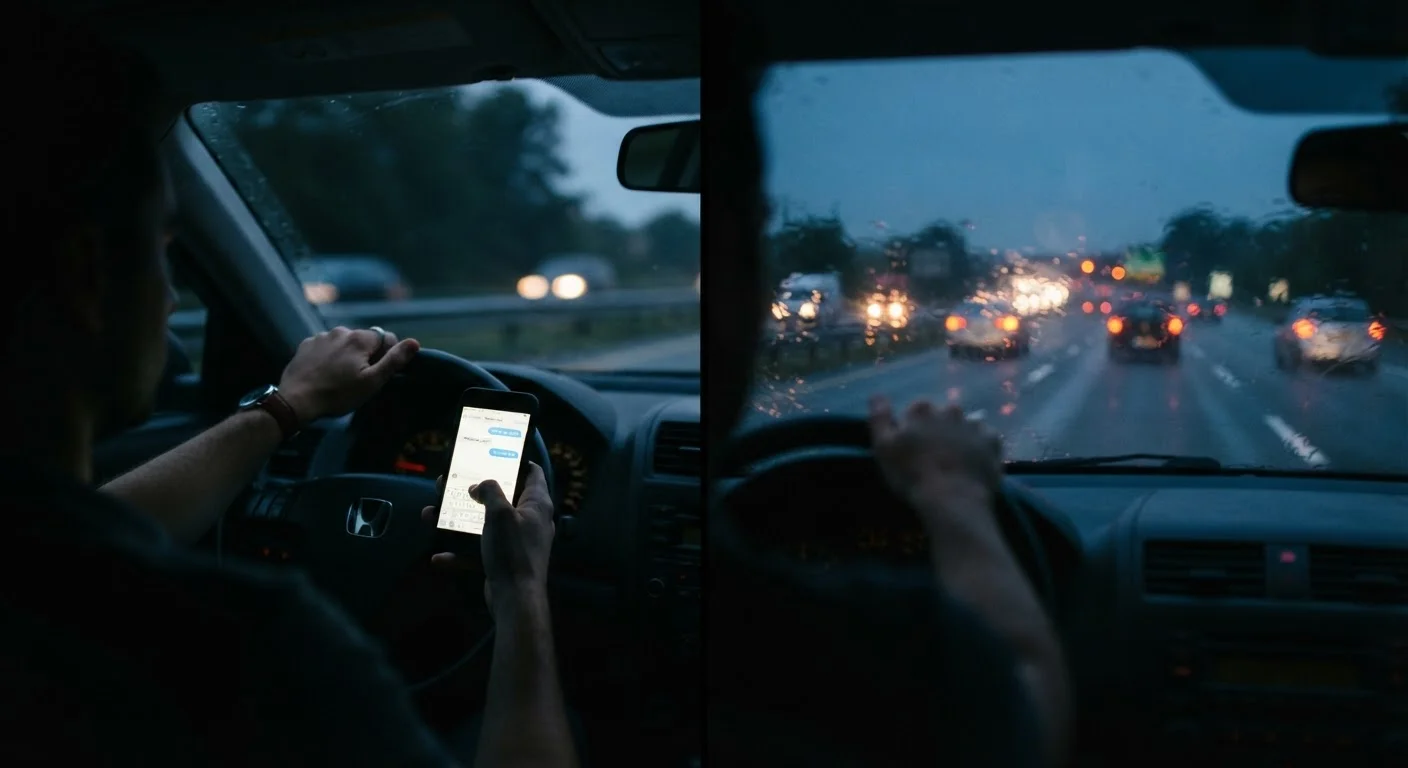
Key Takeaways
- Distracted driving diverts attention; impaired driving degrades the brain and body's ability to function safely.
- Both significantly increase crash risk, but they have distinct legal definitions and consequences.
- Even brief phone use at highway speeds means traveling the length of a football field without truly watching the road.
- Impaired driving includes more than alcohol - prescription drugs, marijuana, and severe fatigue all qualify.
- Prevention strategies differ: distraction requires habit change, impairment requires planning before you ever get behind the wheel.
- Defensive driving principles help guard against both - anticipating hazards buys you the reaction time you need.
Option A
Distracted Driving
An attention problem that can strike any driver at any time.
Best for: Understanding how divided focus - visual, manual, or cognitive - pulls your mind off the road even when you feel alert.
Option B
Impaired Driving
A physiological impairment that compromises the brain and body.
Best for: Understanding how substances or extreme fatigue chemically or physically degrade the core skills driving demands.
If you want to understand what's draining your focus on daily commutes
Distracted Driving
Everyday habits like glancing at a phone, adjusting music, or mental preoccupation are distraction-category risks. Recognizing them by name is the first step to correcting them.
If you're weighing whether you're safe to drive after a drink or a new medication
Impaired Driving
Impairment operates on a physiological level that self-assessment routinely underestimates. Planning a safe alternative before drinking or starting a new prescription is the only reliable approach.
If you're a new driver building foundational safety habits
Distracted Driving
Novice drivers are statistically most at risk from distraction. Learning to manage phone use and passenger noise from day one establishes safer lifelong patterns.
If you frequently drive long highway routes, especially at night
Impaired Driving
Fatigue-based impairment is especially dangerous on monotonous roads. Recognizing that drowsiness is a form of impairment - not just discomfort - could prevent a serious crash.
What Separates These Two Driving Risks
Distracted driving and impaired driving share a grim outcome - they both make crashes more likely - but they operate through entirely different mechanisms, carry different legal consequences, and require different solutions. Treating them as the same problem leads drivers to misunderstand both.
Distracted driving is an attention problem. The National Highway Traffic Safety Administration (NHTSA) categorizes driving distractions into three types: visual (eyes off the road), manual (hands off the wheel), and cognitive (mind off the task). Texting while driving hits all three simultaneously, which is why it draws particular scrutiny from safety researchers. But distraction also includes conversations with passengers, adjusting navigation, eating, or even intense daydreaming.
Impaired driving is a physiological problem. It occurs when a substance or condition - alcohol, certain prescription or over-the-counter medications, marijuana, or severe fatigue - chemically or neurologically degrades a driver's reaction time, coordination, judgment, or perception. The defining characteristic is that impairment affects the brain and body, not just where the eyes or hands are pointed.
| Criterion | Distracted Driving | Impaired Driving |
|---|---|---|
| Root cause | Divided attention | Physiological impairment |
| Primary risk mechanism | Brain stops processing road | Brain processes road incorrectly |
| Common triggers | Phones, passengers, eating, GPS | Alcohol, drugs, medications, fatigue |
| Self-awareness of risk | Often underestimated | Frequently overestimated ability |
| Legal category | Traffic infraction (varies by state) | DUI/DWI criminal offense |
| Prevention timing | In-the-moment habit control | Must plan before the trip |
| Who is most at risk | Young and novice drivers | All drivers; higher in young adults |
Understanding the distinction matters because the fixes are different. You can put a phone in the glove box. You cannot put your blood alcohol level in the glove box. Distraction is largely a choice made in the moment; impairment often requires planning before the trip even begins.
How Each One Degrades Your Driving
Both risks undermine the core competencies driving demands: perception, decision-making, and physical control. But the degradation pathway differs in important ways.
With distraction, your brain temporarily stops processing the driving environment. NHTSA research suggests that at 55 mph, reading a text message for just five seconds means traveling approximately the length of a football field with your attention effectively absent. The road doesn't pause. Other vehicles, pedestrians, and road conditions change in that window regardless of whether you noticed.
~3,000
U.S. distraction-related traffic deaths annually
According to NHTSA data, approximately 3,000 people are killed each year in crashes involving distracted drivers.
~13,500
Drunk driving fatalities per year in the U.S.
NHTSA data consistently shows alcohol-impaired driving accounts for roughly one-third of all U.S. traffic fatalities annually.
4-5 seconds
Average time eyes leave road during a text
NHTSA estimates drivers look away from the road for an average of 4.6 seconds when reading or sending a text message.
With impairment, the driver may have eyes open and hands on the wheel - but the brain itself is processing information incorrectly. Alcohol, for example, slows neural transmission, narrows peripheral vision, and inflates a driver's confidence in their own performance. That last effect is especially dangerous: impaired drivers frequently believe they are driving well when objective measures show otherwise. Fatigue-based impairment mirrors alcohol impairment in its effects on reaction time, a finding supported by multiple driving simulation studies.
This is why defensive driving becomes so important. Building habits around anticipating hazards and maintaining generous following distance gives you a buffer when reaction time is compromised - whether the cause is a glance at a notification or an underestimated level of fatigue. See also: why drivers misjudge following distance.
Legal Consequences: Similar Severity, Different Framework
Both categories carry serious legal consequences, but they're governed by different legal frameworks across U.S. states.
Distracted driving laws - primarily targeting handheld phone use - vary significantly by state. Some states prohibit all handheld use while driving; others restrict only texting. Penalties typically include fines and, in some states, points on a driver's license. A handful of states treat distracted driving that causes injury or death as a criminal offense.
Impaired driving - most commonly charged as DUI (Driving Under the Influence) or DWI (Driving While Intoxicated) - is universally serious across all 50 states. Consequences for a first offense commonly include license suspension, fines, mandatory education programs, and potential jail time. Repeat offenses or impaired crashes involving injury carry significantly harsher penalties. Critically, impairment laws increasingly cover more than alcohol: many states now include drug-impaired driving explicitly, and commercial drivers face stricter thresholds.
Impairment Includes More Than Alcohol
Many drivers associate impaired driving exclusively with alcohol, but U.S. law and safety research recognize a much broader category. Prescription sedatives, antihistamines, marijuana, and even extreme sleep deprivation can impair driving to a degree comparable to alcohol. If a medication label warns against operating heavy machinery, that warning applies directly to driving. When starting any new prescription, ask your healthcare provider directly about its effects on driving ability.
It's worth noting that some of the most seemingly harmless driving habits - including eating at the wheel or adjusting a radio - may fall under distracted driving statutes in certain jurisdictions, even if they feel minor in the moment.
Prevention: Two Different Approaches
Because these are different problems, they require different prevention strategies.
Preventing distraction is primarily about habit and environment management. Silencing notifications before driving, using phone-mount apps with driving modes, and setting passengers' expectations about conversation intensity are all practical steps. The key insight is that the temptation to check a phone or attend to something in the cabin must be anticipated and planned for - not managed in the moment when the impulse is already live.
Preventing impairment requires planning before you reach the vehicle. If you're drinking at an event, arrange a ride home before you arrive. If a new medication carries a drowsiness warning, consult your prescriber about driving and plan accordingly. For fatigue, recognizing the early signs - difficulty maintaining lane position, heavy eyelids, missing exits - is critical. Long highway drives are particularly high-risk for fatigue-based impairment because monotonous roads suppress alertness without the driver realizing how fast it's happening. Similarly, nighttime driving compounds both fatigue and the risk of encountering impaired drivers on the road.
No technology or trick compensates for the judgment lapse either condition creates. Awareness of the distinction between them is the foundation of genuinely safer driving decisions.