

| Right-of-Way Definition | The legal obligation of one driver to yield to another - not a guaranteed entitlement |
| Four-Way Stop Tie-Breaker | Yield to the driver on your right when arriving simultaneously |
| On-Ramp Rule | Entering traffic must yield to vehicles already on the roadway |
| Roundabout Priority | Yield to traffic inside the roundabout before entering |
| Zipper Merge | Use both lanes to the merge point, then alternate; reduces backup length (State DOT studies, multiple states) |
| Emergency Vehicle Rule | Pull to the right and stop until the vehicle passes (Required by law in all 50 states) |
Why These Rules Matter More Than You Think
Right-of-way disputes are a leading factor in intersection and merge-zone crashes across the United States. What makes them especially preventable is that the underlying rules are not complicated - they're simply forgotten, misremembered, or quietly bent over time. Drivers who learned the rules years ago often carry subtle misconceptions they've never had reason to question.
This guide cuts through the ambiguity. Whether you're a newly licensed driver or someone with decades behind the wheel, a precise understanding of merging, yielding, and right-of-way reduces your exposure to collisions and makes you a more predictable - and therefore safer - presence on the road. For a broader look at the mindset that underpins all of this, see our defensive driving overview.
| Right-of-Way Definition | The legal obligation of one driver to yield to another - not a guaranteed entitlement |
| Four-Way Stop Tie-Breaker | Yield to the driver on your right when arriving simultaneously |
| On-Ramp Rule | Entering traffic must yield to vehicles already on the roadway |
| Roundabout Priority | Yield to traffic inside the roundabout before entering |
| Zipper Merge | Use both lanes to the merge point, then alternate; reduces backup length (State DOT studies, multiple states) |
| Emergency Vehicle Rule | Pull to the right and stop until the vehicle passes (Required by law in all 50 states) |
Right-of-Way: What the Law Actually Says
Right-of-way is not a privilege - it's a framework for preventing conflicts. No driver is ever granted the right of way by law; instead, laws specify who must yield. That distinction matters: even if you legally have the right of way, you are never relieved of the duty to avoid a collision.
Four-Way Stops
The rules are sequential. The first vehicle to arrive and stop has the right of way. If two vehicles arrive simultaneously, the driver on the left yields to the driver on the right. If vehicles arrive simultaneously from opposite directions and one is turning left, the turning vehicle yields to the vehicle going straight. These rules apply regardless of vehicle size.
Uncontrolled Intersections
At intersections with no signs or signals - common in rural areas and some residential neighborhoods - the same yield-to-the-right rule applies. Treat these with extra caution; other drivers may not know the rule.
Emergency Vehicles
When you hear or see an emergency vehicle with lights and sirens activated, you must pull to the right edge of the roadway and stop, regardless of which direction the emergency vehicle is traveling. Resuming speed too quickly is a common and dangerous mistake.
Right-of-Way
The legal priority one driver has to proceed before another in a given traffic situation. Laws specify who must yield - no driver is ever automatically granted it.
Yield
To slow down or stop as needed to allow another vehicle, cyclist, or pedestrian to proceed safely before you enter or cross their path.
Zipper Merge
A merging technique where drivers use both lanes fully until the designated merge point, then alternate one-by-one like a zipper closing. Reduces overall backup length in congested conditions.
Uncontrolled Intersection
An intersection with no traffic signals, stop signs, or yield signs. Drivers must apply the default yield-to-the-right rule and proceed with extra caution.
Roundabout
A circular intersection where traffic flows in one direction around a central island. Entering vehicles must yield to those already circulating inside.
Merging: Who Yields, and When
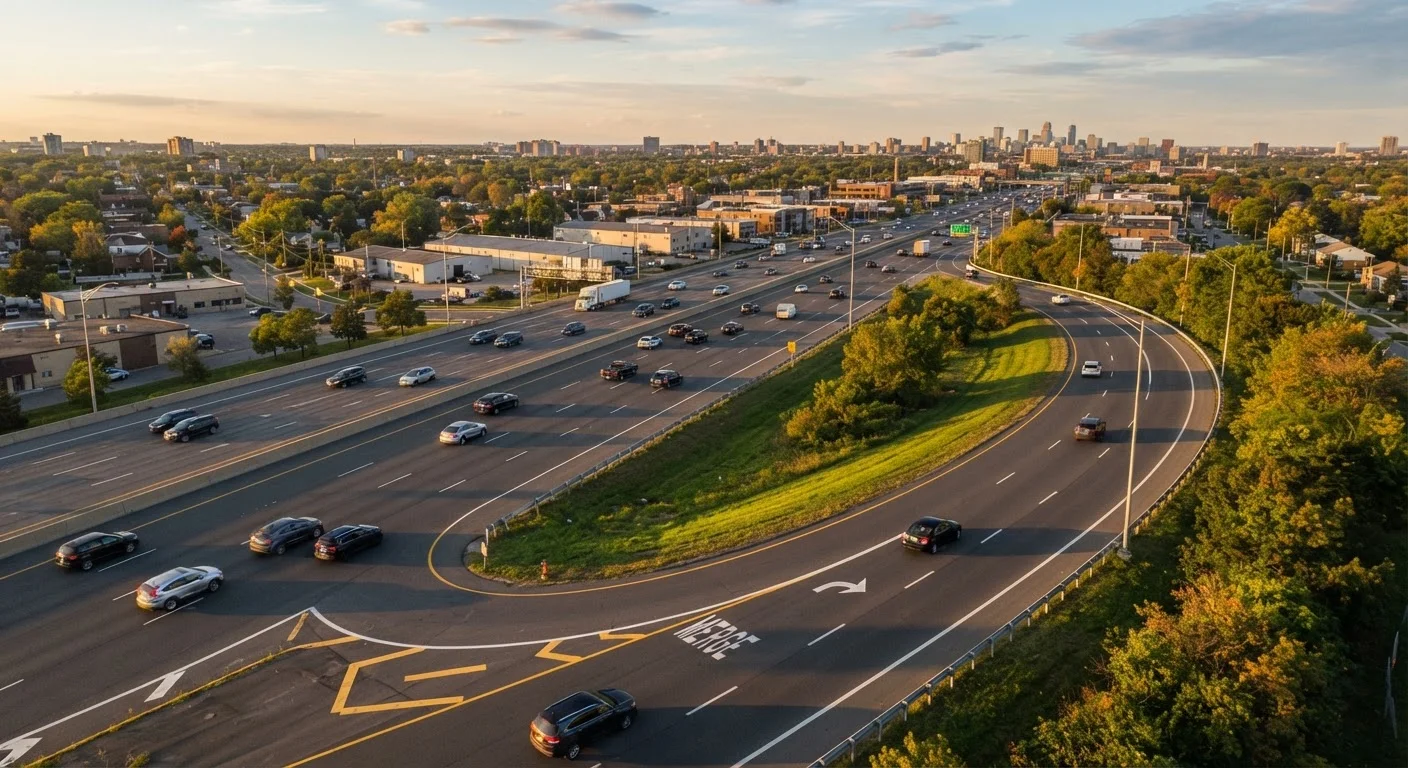
Merging is where many drivers get it wrong - sometimes dangerously so. The core rule: the vehicle entering the roadway must yield to traffic already on it. When you're on an on-ramp accelerating to join a highway, your job is to match the speed of existing traffic and find a gap - not to force your way in or expect other drivers to slow down for you.
The Zipper Merge
In heavy traffic with a lane closure ahead, many drivers move over as soon as they see the merge warning sign. Research from several state DOTs suggests this actually increases backups and can create unsafe speed differentials. The more efficient and increasingly recommended approach is the zipper merge: use both lanes until the merge point, then take turns - one from each lane - in an orderly alternating pattern. This is legal and encouraged in a growing number of states.
Highway Lane Changes
Changing lanes on a moving highway is not a right-of-way situation in the traditional sense, but the principle is the same: you must yield to vehicles in the lane you're entering. Signal early, check mirrors, check your blind spot, and move only when there's a clear gap. Late or absent signaling is one of the habits that compounds into real risk over time.
Yield Signs and Roundabouts
A yield sign means slow down, assess, and give way to traffic with the right of way - but do not treat it as a stop sign if no conflict exists. Unnecessary stops at yield signs disrupt traffic flow and can increase rear-end risk.
Roundabouts
Roundabouts remain a source of genuine confusion for many American drivers. The rule is straightforward: yield to traffic already inside the roundabout, then enter when the flow allows. You do not yield to vehicles waiting to enter from other legs. Once inside, continue to your exit - do not stop in the circle. Roundabouts are statistically safer than traditional signalized intersections for reducing severe crashes, according to the Insurance Institute for Highway Safety (IIHS), largely because conflicts occur at lower speeds and at angles that reduce injury severity.
Understanding these rules pairs well with developing the kind of hazard awareness described in our following distance guide - both are about giving yourself time and space to respond correctly.