

Key Takeaways
- Correct tire pressure improves handling, fuel economy, and tire longevity.
- Tread depth below 2/32 of an inch is legally unsafe in most U.S. states.
- The penny test is a quick, reliable way to check tread depth at home.
- Rotating tires every 5,000-7,500 miles promotes even wear across all four.
- Always use your vehicle's recommended PSI, not the number stamped on the tire sidewall.
- Consistent tire care is one of the highest-impact habits for overall vehicle safety.
Start here
Why Tires Matter More Than Most Drivers Realize
Learn the basics
Tire Pressure: The Number You Should Know
Build on it
Tread Depth: Reading the Wear Before It Reads You
Go further
Tire Rotation: Why Moving Them Around Matters
Apply it
Putting It All Together
Why Tires Matter More Than Most Drivers Realize
Every force that steers, accelerates, or stops your vehicle passes through four palm-sized contact patches where your tires meet the road. That's it - roughly the size of a sheet of paper per tire. When those patches are compromised by low pressure, worn tread, or uneven wear, every system in your car - brakes, steering, stability control - works against a disadvantage it wasn't designed to overcome.
Tire neglect is also one of the most preventable causes of roadway incidents. The good news is that the three fundamentals - pressure, tread depth, and rotation - are straightforward to understand and easy to maintain on a regular schedule. For a broader look at how routine upkeep pays off, see habits that extend the life of any vehicle.
PSI
Pounds per square inch - the unit used to measure how much air pressure is inside a tire. Your vehicle has a manufacturer-recommended PSI that is distinct from the maximum PSI printed on the tire itself.
Tread depth
The measurement of the groove depth remaining in a tire's surface. More depth means better water evacuation and grip; worn tread reduces safe stopping ability, especially in wet conditions.
Tire rotation
The practice of moving tires between positions on the vehicle - front, rear, left, right - on a scheduled basis to promote even wear and extend the life of the full set.
Contact patch
The small area of a tire that actually touches the road at any given moment. All steering, braking, and acceleration forces transfer through these patches, making their condition critical to vehicle control.
Hydroplaning
A condition where a thin layer of water builds up between the tire and the road surface faster than the tread can channel it away, causing the driver to lose steering and braking control temporarily.
Cold tire pressure
Tire pressure measured before the vehicle has been driven, or after being parked for at least three hours. Heat from driving temporarily increases air pressure, so cold readings are the accurate baseline for comparison against manufacturer specs.
Tire Pressure: The Number You Should Know
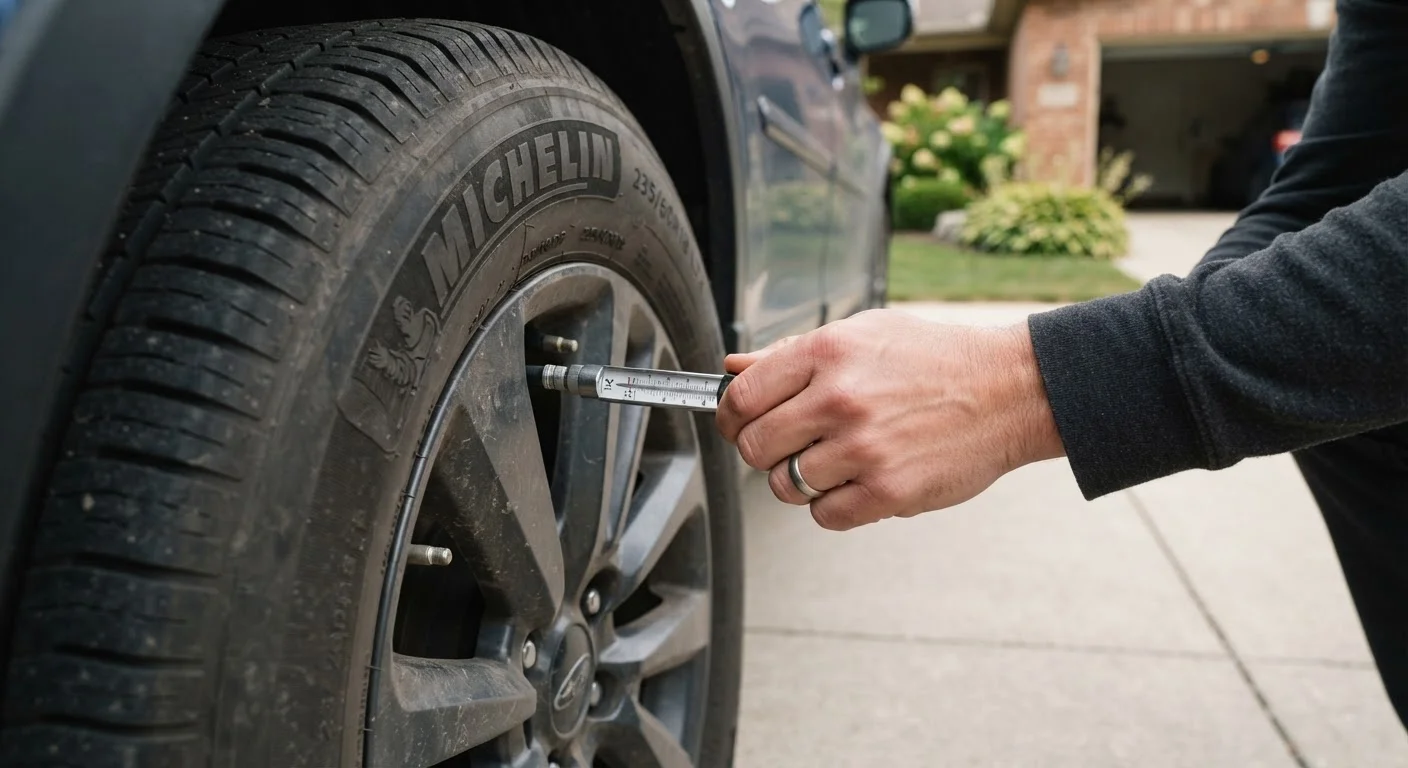
Tire pressure is measured in PSI. Your vehicle has a manufacturer-recommended PSI - find it on the sticker inside the driver's door jamb or in the owner's manual. This is the number to follow. The larger figure stamped on the tire's sidewall is the tire's maximum rated pressure, not its recommended operating pressure; inflating to that level can make the ride harsh and reduces the tire's grip.
Underinflation is the more common problem. A tire can lose pressure gradually from normal air permeation, temperature swings, or a slow leak - often without looking visibly flat. Running tires underinflated causes the outer edges of the tread to carry disproportionate load, wears them faster, generates heat, and reduces fuel efficiency.
Overinflation concentrates wear in the center of the tread and reduces the contact patch, shortening the tire's life and diminishing wet-road grip.
Check Pressure When Tires Are Cold
Driving heats the air inside tires and temporarily raises PSI readings by several pounds. Always measure pressure before your first drive of the day, or after the vehicle has sat for at least three hours. This ensures your reading accurately reflects what you're working with versus the manufacturer's recommendation.
Check pressure when the tires are cold - before driving more than a mile - because heat from driving temporarily inflates the reading. A quality digital or dial gauge is a worthwhile tool to keep in the glovebox.
Tread Depth: Reading the Wear Before It Reads You
Tread channels water away from beneath your tire, maintaining grip on wet pavement. As tread wears down, that channeling capacity decreases - braking distances increase and the risk of hydroplaning rises. In most U.S. states, tires are considered legally unsafe below 2/32 of an inch of remaining tread depth.
The penny test is a widely used field check: insert a penny into a tread groove with President Lincoln's head pointing down into the groove. If the top of Lincoln's head is visible, your tread has fallen to approximately 2/32 inch - replacement is warranted. Many safety organizations recommend the quarter test as an earlier warning: use a quarter the same way; if the top of Washington's head shows, you're at roughly 4/32 inch and should start budgeting for new tires.
Also pay attention to where wear appears. Even wear across the tread usually means pressure and alignment are in order. Edge wear suggests chronic underinflation; center wear points to overinflation; diagonal or patchy wear can indicate alignment or suspension issues that a qualified mechanic should evaluate.
For a detailed look at what happens when worn tires meet hazardous conditions, see hydroplaning, blowouts, and brake fade.
Tire Rotation: Why Moving Them Around Matters
Front and rear tires wear differently because they perform different jobs. On a front-wheel-drive vehicle, the front tires handle acceleration, steering, and a share of braking - they typically wear faster than the rears. Rotation redistributes this load so all four tires age at a more comparable rate, maximizing the usable life of the full set.
Most manufacturers recommend rotation every 5,000 to 7,500 miles, which conveniently aligns with many oil change intervals - making it easy to pair the two services. Confirm the interval in your owner's manual, as some vehicles with performance or directional tires have specific rotation patterns or restrictions.
Don't Skip the Torque Step
If a tire rotation involves removing and reinstalling wheels, the lug nuts must be tightened to the manufacturer's specified torque - not just 'tight.' Under-torqued wheels can loosen at speed; over-torqued ones can warp brake rotors or strip threads. A qualified mechanic with a calibrated torque wrench ensures this is done correctly.
Common rotation patterns include front-to-rear (same side), cross, and X-pattern depending on drivetrain and tire type. A qualified mechanic will select the correct pattern for your vehicle. This is also a good time to have a visual inspection of sidewalls and valves done, so any slow leaks or damage are caught early.
Keeping a simple log of your rotation dates makes it easy to stay on schedule. If you already track your oil changes, see oil change basics for how to build a connected maintenance rhythm.
Putting It All Together
Tire care doesn't require mechanical expertise - it requires consistency. A monthly pressure check, a tread inspection every time you fill up, and a rotation on schedule are habits that collectively have a measurable impact on safety and the useful life of your tires.
Before any long drive, a quick walk-around that includes tire condition is worth building into your routine. Our pre-trip vehicle checklist covers tires alongside the other systems worth reviewing before you hit the highway. For a deeper dive into what the numbers on your tire sidewall mean - including load ratings - Tire Safety From the Ground Up is a natural next step.
The four patches of rubber connecting your car to the road deserve regular attention. The effort is small; the payoff in safety and reliability is significant.