

Key Takeaways
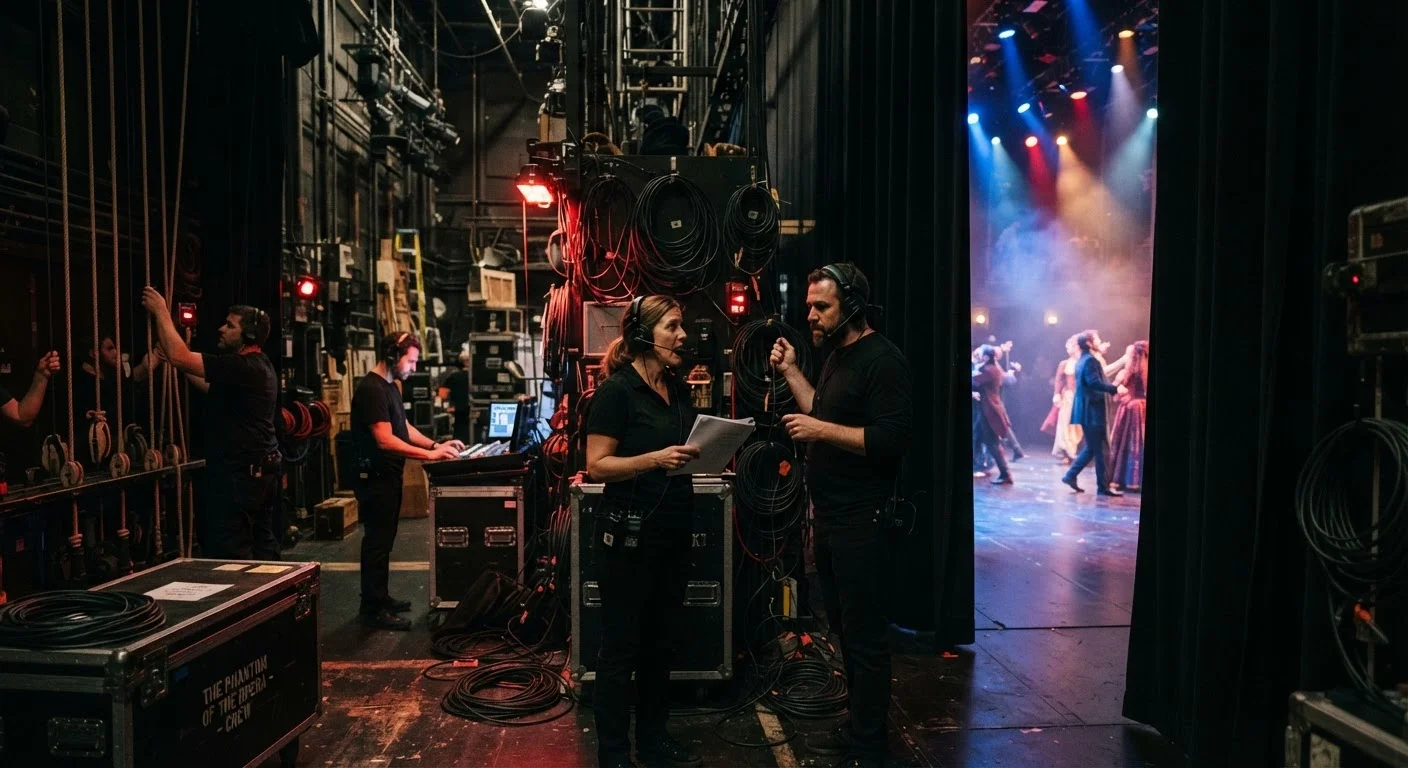
- A Broadway show can employ 50 to 100 or more crew members working backstage during every performance.
- The stage manager is the central authority during a live show, calling every lighting, sound, and scenic cue.
- Fly crews operate systems above the stage that can raise and lower scenery weighing thousands of pounds.
- Wardrobe supervisors and dressers handle costume changes that sometimes take under 30 seconds.
- Load-in - moving a show into a theater - can take several weeks before audiences ever arrive.
- Understudies and swings attend rehearsals continuously so they can step in for any role at short notice.
Broadway Production Backstage
A Broadway production backstage refers to the entire ecosystem of crew, technology, and coordination that operates out of sight to make a live theatrical performance possible. While audiences see the actors and sets, dozens of specialists are simultaneously executing precise cues, managing costumes, operating lighting rigs, and calling the show - often in near-total silence and darkness. This unseen infrastructure runs with the discipline of a military operation, night after night.
Broadway contracts are governed by unions including IATSE (stagehands), Actors' Equity Association, and others - each with specific jurisdictions over which crew members handle what tasks backstage.
The Person in Charge of Everything You Don't See
Walk into any Broadway theater on a performance night and you'll find the audience focused forward. But the real command center is tucked into the wings or a production booth, where the stage manager sits with a thick, annotated script and a headset linking every department. When the house lights dim, it's the stage manager's voice - calm, precise - that cues everything. "Lights, go. Sound, go. Fly, go." Every single moment in a Broadway show is called out loud by this one person.
The stage manager's authority during a performance is absolute. They have typically spent months in rehearsal tracking every directorial decision, logging every lighting state, and building a prompt book that is essentially the show's living document. If something goes wrong mid-performance - an actor stumbles, a set piece malfunctions - the stage manager decides in real time what the audience will or won't notice.
If you want to understand all the roles listed in your program, decoding your playbill is a great place to start.
Above the Stage: The Fly Crew and Automation
Most audience members never look up long enough to grasp what's happening overhead. Above a Broadway stage sits the fly loft - a tall, hidden tower that can be twice the height of the stage itself. This is where the fly crew works, managing a grid of ropes, counterweights, and motorized hoists that can move an entire painted backdrop or a multi-ton set piece in seconds.
Modern Broadway productions increasingly use computerized automation systems to handle this work with extreme precision. A scenic element that floats in from the wings, rises from a trap door, or descends from the heavens is almost always the result of a carefully programmed sequence triggered by the stage manager's cue. The human fly crew, meanwhile, manages manual lines and stands ready to intervene if automation fails.
50-100+
Backstage crew members per performance
Large-scale Broadway musicals routinely employ this many crew members working during every live show, according to Broadway union and production data.
2-4 weeks
Typical Broadway load-in duration
Industry standard for major productions moving into a Broadway house before technical rehearsals begin.
Under 30 sec
Fastest Broadway costume changes
Some productions engineer quick-change costumes and assign dedicated dressers to achieve full outfit swaps in under half a minute.
The physical demands of this work are significant. Crew members may handle counterweight systems that balance thousands of pounds, and they operate in limited light and tight spaces during live performance - a discipline that demands both technical skill and quiet concentration.
The Clock Never Stops: Wardrobe and Quick Changes
Costume changes that appear seamless from the audience are, backstage, tightly choreographed sprints. A wardrobe supervisor oversees all costume maintenance, repairs, and preparation before every show. During the performance, dressers are positioned at specific points in the wings, ready to assist actors who may have 45 seconds - sometimes fewer - to swap an entire outfit.
Certain Broadway shows have become legendary for their quick-change engineering: costumes fitted with hidden magnets, velcro, or pre-set layers that allow garments to be stripped and replaced in under 30 seconds. Dressers rehearse these transitions as carefully as the actors rehearse their scenes. Every button, zipper, and hairpiece has a designated position and a designated person.
Arrive Early to Spot Backstage Prep
If you arrive at the theater well before curtain, you may notice subtle signs of backstage activity - set pieces being quietly adjusted through a barely-open curtain, or crew members checking sightlines from the wings. It's a rare glimpse into the preparation that most audiences never witness. Some theaters also offer pre-show tours when available.
Hair and makeup departments operate on a similarly precise schedule. Wigs - common in period productions - must be maintained, styled, and fitted daily. A Broadway wig can represent hundreds of hours of construction and thousands of dollars in materials.
Before the Curtain: Weeks of Load-In
What audiences experience in two and a half hours is the product of weeks of unseen construction. The load-in is when a production physically moves into a theater: massive scenic units rolled off trucks, lighting rigs assembled on the grid above the stage, thousands of feet of cable run through conduits. For a large musical, this process can consume two to four weeks before a single performer steps onstage.
Technical rehearsals - known as "tech" - follow load-in and are famously grueling. Directors and designers pause the show repeatedly to fine-tune cues, and 12-hour days in a darkened theater are standard. The creative team collaborates with department heads to solve problems that only become visible once everything is assembled together in real space.
This behind-the-scenes intensity stands in notable contrast to how television productions are built - if you're curious how the two worlds compare, see how a TV show gets made from pilot to finale. And if this world of live performance has piqued your curiosity about attending yourself, going to the theater alone can be a surprisingly rewarding experience.