

Key Takeaways
- The Harlem Renaissance emerged from the Great Migration, when hundreds of thousands of Black Americans relocated north seeking opportunity.
- Iconic figures like Langston Hughes, Zora Neale Hurston, and Aaron Douglas defined entirely new artistic voices.
- Jazz and blues music - born in this era - became the backbone of American popular music for decades to come.
- The movement permanently changed how Black identity was expressed and understood in American culture.
- Its influence is still visible in contemporary literature, hip-hop, visual art, and the ongoing conversation about race in America.
The Harlem Renaissance
The Harlem Renaissance was a flowering of African American art, literature, music, and intellectual life centered in the Harlem neighborhood of New York City, roughly from the early 1920s through the mid-1930s. It marked the first time Black artists and thinkers gained widespread national - and international - recognition for work that boldly asserted Black identity and humanity. More than a cultural moment, it was a political and social awakening that challenged the racial hierarchies of its era.
Scholars sometimes debate the movement's precise boundaries, with some extending its timeframe into the early 1940s and others emphasizing its connections to the broader 'New Negro Movement' articulated by philosopher Alain Locke in his landmark 1925 anthology.
A City Within a City: How Harlem Became the Capital of Black America
To understand the Harlem Renaissance, you have to start with a massive human movement. Between roughly 1910 and 1930, more than one million Black Americans left the Jim Crow South - its sharecropping poverty, its legal segregation, its constant threat of violence - and headed north. They went to Chicago, Detroit, Philadelphia, and above all, to New York City. Within New York, many settled in Harlem, a neighborhood in upper Manhattan that had overbuilt its housing stock and opened its doors to Black tenants out of economic necessity.
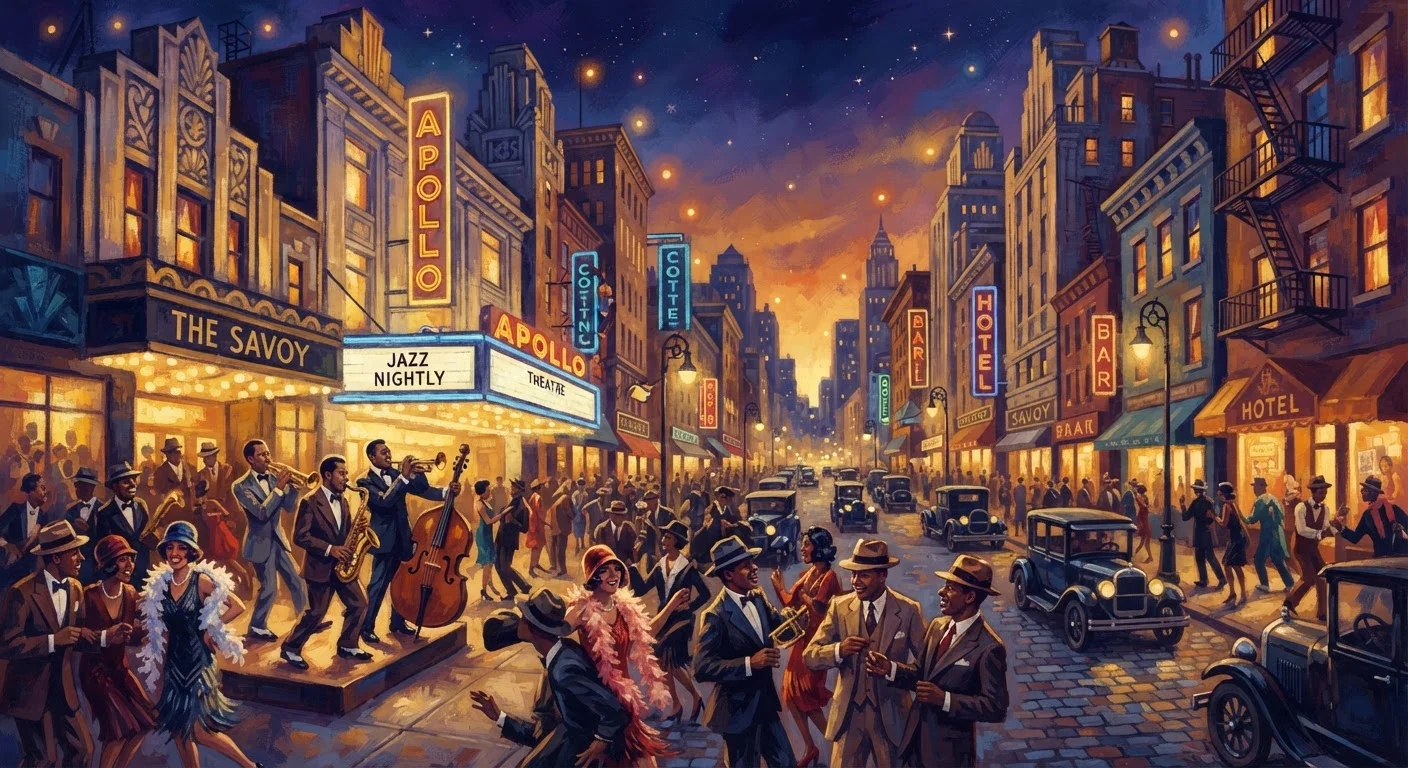
What grew there was extraordinary. Within a few square miles, Harlem contained churches, newspapers, nightclubs, literary salons, and a concentration of Black intellectual and artistic life unlike anything America had seen before. The Crisis magazine, edited by W.E.B. Du Bois, gave writers a national platform. The Apollo Theater and the Cotton Club drew audiences from across the city. A young poet named Langston Hughes could drop into a jazz club and find the raw material for a new kind of American poetry.
1.6M+
Black Americans who migrated north, 1910-1930
According to historical demographic research, the Great Migration's first wave reshaped the racial geography of American cities, fueling the cultural conditions that made the Harlem Renaissance possible.
1925
Year Alain Locke published 'The New Negro'
Locke's landmark anthology, published in 1925, is widely considered the defining intellectual manifesto of the Harlem Renaissance and introduced many American readers to its key artists and thinkers.
~15 years
Duration of the movement's peak creative output
Most scholars place the Renaissance's most productive period between approximately 1920 and 1935, a remarkably concentrated burst of cultural transformation.
The Artists Who Defined the Movement
The Harlem Renaissance was never a single style or school - it was a conversation, sometimes a heated one, about what Black artistic identity should look like and who it should speak to.
Langston Hughes wrote poetry that sounded like the blues, rooted in everyday Black speech rather than European literary tradition. Zora Neale Hurston went further, embedding herself in Southern Black folk culture and producing novels and anthropological work that celebrated vernacular life at a time when many of her peers wanted to project a more formally "respectable" image. Their debate about authenticity versus respectability echoes in every generation of Black artists that followed.
In visual art, Aaron Douglas developed a bold, angular aesthetic that fused African design traditions with art deco modernism - his murals still feel startlingly contemporary. Sculptor Augusta Savage ran a free art school out of a Harlem studio, training dozens of younger artists who would carry the movement's spirit forward. Together, these figures didn't just create great works - they built an infrastructure of Black artistic life.
“Life is for the living. Death is for the dead. Let life be like music. And death a note unsaid.”
— Langston Hughes, Poet and central figure of the Harlem Renaissance
Jazz, Blues, and the Sound of a New America
No cultural history of the Harlem Renaissance is complete without its music. Jazz arrived in Harlem carrying the DNA of New Orleans, Chicago, and the Mississippi Delta, and what it became in those Harlem clubs and ballrooms would reshape popular music worldwide. Duke Ellington's orchestra at the Cotton Club refined jazz into something simultaneously swinging and symphonic. Louis Armstrong's improvisational virtuosity redefined what a soloist could do.
The music wasn't just entertainment - it was a declaration. Jazz's rhythmic complexity, its emphasis on individual expression within a collective structure, and its roots in African American tradition all carried meaning that listeners, Black and white alike, felt even when they couldn't fully articulate it. For a deeper look at how jazz evolved across regions and generations, see our exploration of the American jazz tradition.
Why the Harlem Renaissance Still Matters Today
When the Great Depression struck, it hit Harlem hard. Clubs shuttered, publishing budgets shrank, and many artists dispersed. But the ideas the Renaissance unleashed didn't disappear - they went underground and resurfaced, again and again, in the civil rights movement's cultural politics, the Black Arts Movement of the 1960s, hip-hop's lyrical ambition, and the current generation of writers, filmmakers, and visual artists who openly claim this legacy.
Contemporary authors like Ta-Nehisi Coates and Colson Whitehead work in a tradition Hughes and Hurston helped define. Visual artists like Kara Walker engage with the history and aesthetics the Renaissance grappled with. Even the current conversation about whose stories belong at the center of American culture - in museums, on syllabi, on streaming platforms - is, in a meaningful sense, a continuation of the argument Harlem's artists started a century ago.
The Harlem Renaissance mattered because it insisted, at a moment of brutal national contradiction, that Black life was complex, beautiful, and worthy of the fullest artistic expression. That insistence changed American culture permanently, and it still drives some of the most vital creative work happening today.