
Hardwood vs. Engineered Wood Flooring: Durability, Moisture, and Long-Term Performance

Key Takeaways
- Solid hardwood expands and contracts significantly with humidity, making it unsuitable for basements or high-moisture areas.
- Engineered wood uses a layered plywood core that resists warping and dimensional changes better than solid wood.
- Solid hardwood can typically be sanded and refinished multiple times over decades; engineered wood has a limited refinishing window.
- Both products can achieve comparable appearances, including wide planks and authentic grain patterns.
- Installation method and subfloor type are often the deciding factors between the two options.
- Local climate and the specific room's moisture levels should heavily influence your flooring choice.
Option A
Solid Hardwood Flooring
The time-tested, refinishable classic.
Best for: Dry, climate-controlled living spaces where long-term refinishing and maximum longevity are priorities.
Option B
Engineered Wood Flooring
The moisture-tolerant, versatile modern alternative.
Best for: Spaces with humidity fluctuations, below-grade installations, or over radiant heat systems.
If you're installing in a dry, above-grade living room or bedroom
Solid Hardwood Flooring
Stable humidity conditions minimize expansion risk, and solid hardwood offers unmatched refinishing longevity over decades of use.
If you're finishing a basement or installing over a concrete slab
Engineered Wood Flooring
Its cross-ply plywood core handles ground-level moisture vapor far better, and many products are approved for below-grade installation.
If you have radiant in-floor heating
Engineered Wood Flooring
Radiant heat creates temperature and moisture cycles that cause solid wood to gap and crack; engineered wood's stable core handles these fluctuations more reliably.
If multigenerational longevity and full refinishing are your priority
Solid Hardwood Flooring
With proper care in the right environment, solid hardwood can be sanded and refinished four to six times, effectively lasting the life of a home.
If you want a wood-look floor in a kitchen or laundry room with occasional moisture exposure
Engineered Wood Flooring
While neither product is waterproof, engineered wood tolerates brief moisture exposure and humidity swings better than solid planks in semi-wet environments.
How Each Product Is Constructed
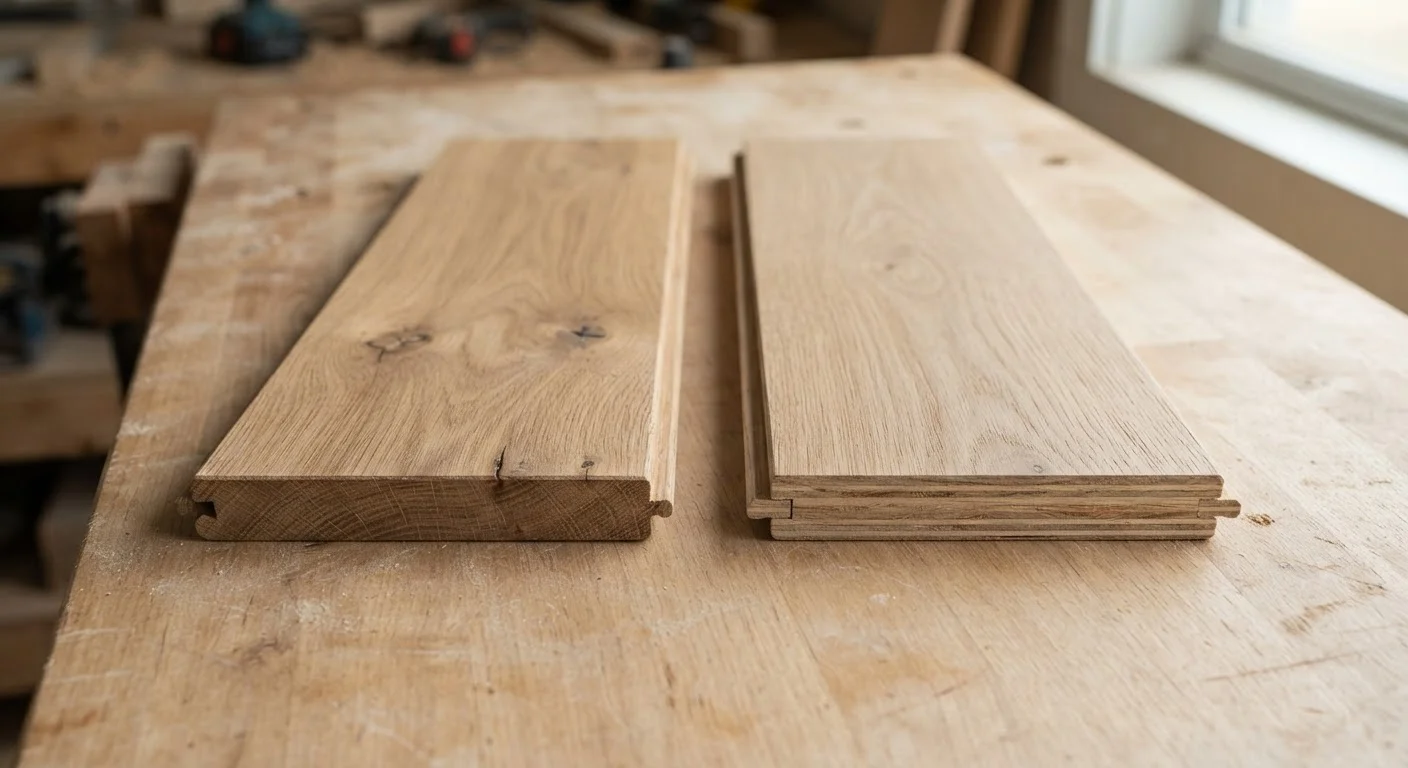
Understanding the physical makeup of each flooring type explains almost every performance difference that follows. Solid hardwood is milled from a single piece of wood - typically species like red oak, maple, hickory, or walnut - from top to bottom, usually ¾ inch thick. Because it's one continuous piece of natural wood, it moves as a unit when temperature and humidity shift.
Engineered wood flooring is a manufactured product built from multiple layers. A real hardwood veneer - the same species you'd see in solid hardwood - sits on top, bonded over a core of cross-layered plywood or high-density fiberboard (HDF). That cross-ply construction is the key: the grain of each layer runs perpendicular to the next, counteracting the natural tendency of wood to expand and contract in one direction.
The veneer thickness on engineered products varies, typically ranging from about 1 mm to 6 mm. Thicker veneers allow for at least one or two sandings, while thinner veneers may allow none. This is the single most important spec to check when evaluating engineered options.
Moisture and Humidity Performance
Moisture is where the two products diverge most dramatically. Wood is hygroscopic - it naturally absorbs and releases moisture from the surrounding air. In solid hardwood, that movement is relatively unrestricted. When interior humidity rises (common in summer months or in poorly ventilated spaces), planks expand; when humidity drops in winter with forced-air heating, planks contract. Over time, these cycles can produce cupping (edges rise higher than the center), crowning (center rises above edges), or gapping between boards.
Engineered wood's cross-ply core reduces that movement significantly. It is not waterproof - standing water or flooding will still damage it - but it handles the day-to-day humidity fluctuations that are normal in most American homes with far less visible movement. This makes it suitable for kitchens, finished basements, and spaces above concrete slabs where moisture vapor is a known concern.
| Criterion | Solid Hardwood | Engineered Wood |
|---|---|---|
| Core construction | Single solid wood plank | Hardwood veneer over cross-ply core |
| Moisture resistance | Low - expands and contracts significantly | Moderate - resists dimensional movement |
| Below-grade installation | Not recommended | Generally suitable |
| Over radiant heat | Risky - can gap and crack | Typically compatible |
| Refinishing potential | High - 4 to 6 times typical | Limited - 0 to 3 times by veneer thickness |
| Lifespan (maintained) | 50-100+ years possible | 20-50 years typical |
| DIY installation ease | Moderate to difficult | Moderate - floating systems DIY-friendly |
| Installation methods | Nail or staple only | Nail, glue, or float |
Solid hardwood is generally not recommended for below-grade installations (basements) or directly over concrete without a proper moisture barrier and extensive testing. Most manufacturers will void warranties for those applications.
Durability and Refinishing Over Time
Both flooring types are durable under normal residential foot traffic when properly finished and maintained. The bigger durability question is long-term performance and what you can do when the surface shows its age.
Solid hardwood's greatest advantage is refinishability. Because the entire plank is wood, a professional floor sander can remove scratches, stains, and worn finish multiple times - four to six sandings over the life of a floor is commonly cited, depending on thickness. This means a well-maintained solid hardwood floor can effectively last 50 to 100 years or more.
Engineered wood can sometimes be lightly sanded and refinished, but the number of times depends entirely on veneer thickness. A 2 mm veneer may allow one careful sanding; a 6 mm veneer may allow two or three. Once the veneer is exhausted, the floor must be replaced. That said, modern factory-applied aluminum oxide finishes on both product types are quite durable and may not need refinishing for 10 to 20 years under normal conditions.
¾ inch
Typical solid hardwood plank thickness
This consistent thickness allows for multiple sandings over decades, a key reason solid hardwood is associated with multigenerational floors.
1-6 mm
Engineered wood veneer thickness range
Veneer thickness directly determines how many times a floor can be sanded; thicker veneers offer refinishing options comparable to solid wood.
35-55%
Recommended indoor relative humidity range
Most hardwood flooring manufacturers specify this humidity range to minimize expansion, contraction, and gapping in both solid and engineered products.
Installation Considerations
Installation method is often the practical deciding factor for many homeowners. Solid hardwood must be nailed or stapled to a wood subfloor - it cannot be floated or glued directly over concrete. It also requires acclimation to the home's environment for three to five days before installation and should not be installed in spaces where subfloor moisture readings exceed manufacturer guidelines.
Engineered wood is more flexible. Depending on the product, it can be:
- Nailed or stapled to a wood subfloor (like solid hardwood)
- Glued down directly over concrete or wood
- Floated over a foam underlayment, with planks clicking or gluing to each other rather than to the subfloor
That installation flexibility makes engineered wood accessible to confident DIYers, particularly with click-lock floating systems. Solid hardwood installation, by contrast, typically benefits from professional installation to ensure proper nailing patterns, expansion gaps, and moisture testing.
In both cases, always verify your subfloor is level, structurally sound, and within the moisture tolerance specified by the flooring manufacturer. Skipping that step is among the most common causes of flooring failures - regardless of which product type you choose.