

Key Takeaways
- The 'eight glasses a day' rule has no strong scientific foundation and doesn't fit everyone.
- Your fluid needs vary based on body size, activity, climate, diet, and health status.
- Thirst is a reliable hydration signal for most healthy adults - but not all.
- Food contributes roughly 20% of daily water intake for the average American.
- Urine color is a practical, low-tech indicator of hydration status.
Where Did Eight Glasses Come From?
The eight-glasses-a-day rule is one of the most persistent wellness myths in circulation. Its origins are murky - one frequently cited source is a 1945 U.S. Food and Nutrition Board recommendation suggesting roughly 2.5 liters of water daily, but that document explicitly noted most of that water comes from food. Somewhere along the way, the food caveat was dropped and the number hardened into a daily target for drinking water alone.
No major health authority - not the NIH, not the Institute of Medicine, not the World Health Organization - currently endorses a universal eight-glasses prescription. The idea persists partly because it's simple and partly because it's benign for most people. But treating it as a medical rule can lead to unnecessary anxiety or, in some cases, actually overhydrating. This article examines what the evidence actually says. For a broader look at persistent wellness beliefs, see our roundup of wellness myths.
Myths and Facts About Daily Hydration
The following myth-and-fact pairs address the most common misconceptions about how much to drink, what counts, and how your body signals its needs.
Myth
Everyone needs exactly eight 8-ounce glasses of water per day.
Fact
There is no single universally correct amount - fluid needs vary significantly by individual, activity, and environment.
The eight-glasses figure is a population-level approximation that ignores body weight, metabolic rate, climate, and diet. A sedentary person in a cool climate eating plenty of fruits and vegetables has very different hydration needs than an athlete training in summer heat. Blanket targets can cause people to either under-drink or obsess over a number that was never personalized to them in the first place.
Myth
If you feel thirsty, you're already dangerously dehydrated.
Fact
Thirst is a normal, reliable early signal of fluid need - not a sign that dehydration has become dangerous.
For most healthy adults, the sensation of thirst kicks in when body water drops by roughly 1-2%, well before any performance or health impairment becomes significant. The idea that thirst means you've waited too long became popular in sports nutrition circles but was based on limited evidence. Drinking to thirst remains a physiologically sound strategy for the majority of people in everyday, non-extreme conditions.
Note: Older adults and people with certain medical conditions may have a blunted thirst response, making it less reliable as a lone indicator. If you fall into these groups, speak with your healthcare provider about monitoring hydration more actively.
Myth
Coffee and tea don't count toward your daily fluid intake because they're diuretics.
Fact
Caffeinated beverages do have a mild diuretic effect, but they still contribute net fluid to your body.
Habitual coffee and tea drinkers develop a tolerance to caffeine's diuretic effect, and research has consistently shown that moderate consumption of caffeinated drinks contributes to overall hydration rather than depleting it. The amount of fluid in a cup of coffee far exceeds any additional urine output it may prompt. Beverages like sparkling water, herbal teas, and even milk are valid contributors to your daily fluid total.
Myth
Clear urine means you're well-hydrated; yellow urine means you're dehydrated.
Fact
Pale to light-yellow urine is the target range - consistently colorless urine can signal overhydration.
A pale straw-yellow color is a reasonable real-world indicator that hydration is adequate. Very dark amber or brown urine does suggest you may need more fluids. However, completely clear urine consistently throughout the day may indicate you're drinking more than your kidneys need to process, which in rare but serious cases - particularly in endurance athletes - can contribute to a condition called hyponatremia (low blood sodium). Certain vitamins (like high-dose B vitamins) and some medications can also alter urine color independent of hydration status.
Myth
You get all your water from what you drink.
Fact
Solid foods - especially fruits and vegetables - supply a meaningful portion of daily fluid intake.
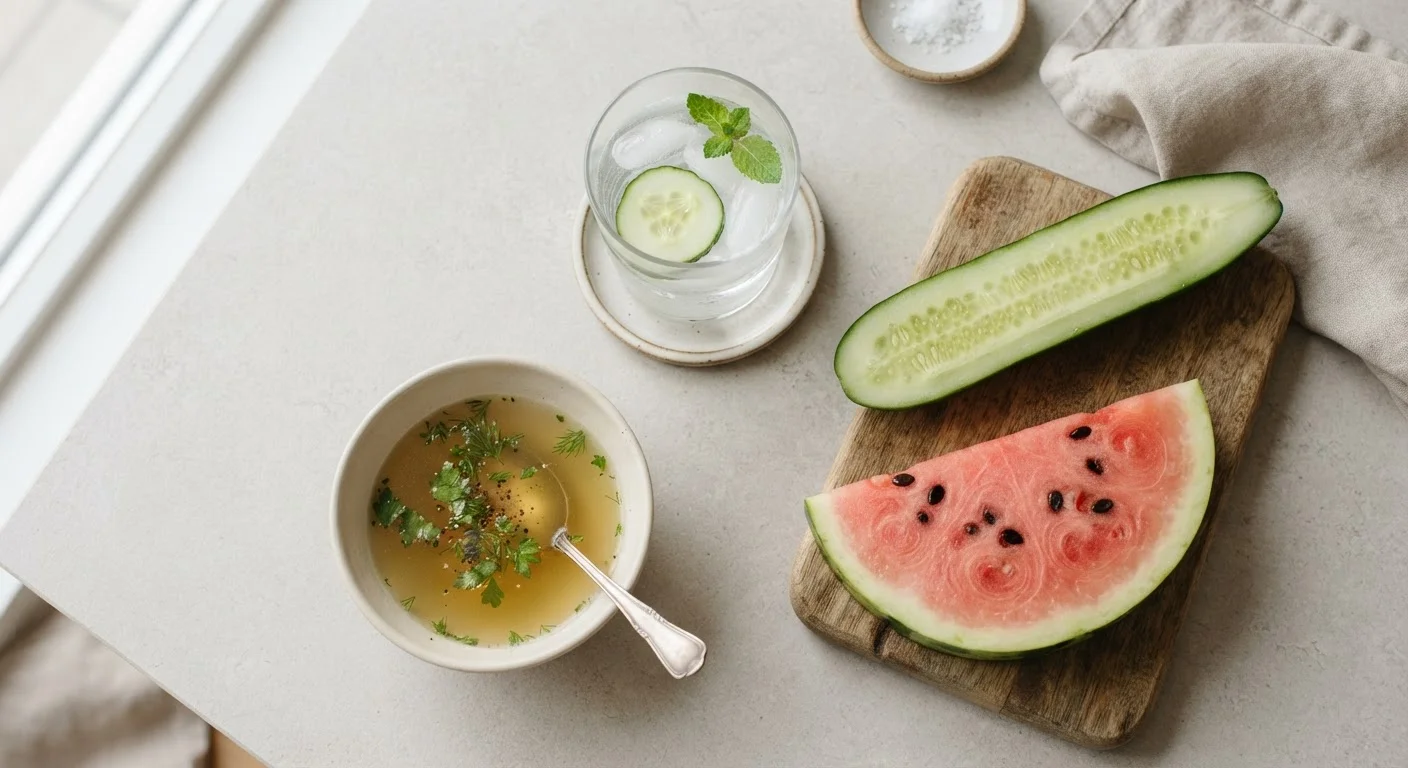
Research estimates that food accounts for roughly 20% of daily water intake for the average American, though this varies with diet. Foods like cucumbers, watermelon, strawberries, soups, and yogurt have very high water content. A diet rich in these foods meaningfully reduces how much water you need to drink separately. This also means that someone eating a heavily processed, low-produce diet may genuinely need to drink more to compensate.
What Actually Drives Your Fluid Needs
~20%
Daily water from food sources
According to nutrition research, roughly one-fifth of daily water intake for most Americans comes from solid foods, not beverages.
1-2%
Body water loss that triggers thirst
Physiological research indicates thirst typically activates at a 1-2% drop in body water - well before meaningful impairment.
3.7 L
Total daily water adequate intake for men
The National Academies set an adequate intake of 3.7 liters per day for adult men, including water from all food and drink sources.
Fluid requirements are dynamic, not fixed. The National Academies of Sciences, Engineering, and Medicine has published adequate intake guidelines - roughly 3.7 liters (about 125 oz) total water per day for men and 2.7 liters (about 91 oz) for women - but these figures include water from all food and beverages, and they represent population averages, not individual prescriptions.
Several factors genuinely shift your needs: vigorous exercise, high heat and humidity, pregnancy or breastfeeding, fever or illness, high-altitude environments, and a diet low in water-rich foods. Body size matters too - a larger body has a larger fluid compartment to maintain. Understanding how water interacts with what you eat can also shape how well your body uses the fluids you take in. The relationship is explored in depth in how beverages affect nutrient absorption and how water interacts with food and digestion.
This article is for general informational purposes only and is not a substitute for personalized medical advice. If you have concerns about your hydration, kidney function, or any health condition, consult a qualified healthcare professional.